9JGBL.AuSt.11

Yong Va Yang put four children through college thanks to hard work at his Turlock strawberry patch.

He and his wife, Blia, who both fled war-ravaged Laos in the 1970s, started farming the 6 acres along Monte Vista Avenue about 20 years ago.

Today, they are part of a notable trend: 85 percent of the state’s strawberry farmers are of Asian or Mexican descent, according to a report this week from an industry group. That’s not the case with any of the other major sectors in California agriculture, where the vast majority of farmers have European roots.

The report, from the California Strawberry Commission in Watsonville, offered a few reasons for the success of these groups: The fruit produces high yields from small plots. The land typically is rented rather than purchased, which reduces upfront costs. And consumers can’t seem to get enough of the product, which has health benefits to go along with the flavor.

The Yang farm, on land leased from a housing developer, relies on family labor in preparing the beds, weeding, watering and harvesting. It’s hard work – there’s still no machine for picking the delicate fruit – but it has been worthwhile for these immigrants.

“They don’t take anything for granted,” Bee Yang, the youngest of the couple’s four children, said Thursday. “They see how hard it was before.”

Yong Va Yang was a police officer in Laos but had to flee when a new regime took power. The family made their way to Thailand, where Bee Yang was born, to await their journey to the United States. The Yangs lived in Memphis before moving to California.

The farm, now managed by Bee Yang, produces berries mainly for freezing by Dole Packaged Foods in Atwater. It also sells them fresh, along with other produce, at a farm stand.

The patch is surrounded by homes, businesses and California State University, Stanislaus. That has forced the family to no longer fumigate the soil for diseases. The Yangs also are concerned that this year’s drought could stress the well that irrigates the plants through drip lines.

The Northern San Joaquin Valley accounts for less than 1 percent of the state’s nearly 40,000 acres of strawberries. The season here used to run from April to July, but heat-tolerant varieties have stretched it into October. Merced County is the region’s top producer.

Almost all of the California crop grows in the coastal belt between Santa Cruz and San Diego counties. It ranked sixth in gross income among the state’s farm products in 2012, bringing an estimated $1.94 billion to growers.

The report is titled “Growing the American Dream: California Strawberry Farming’s Rich History of Immigrants & Opportunity.”

It said 65 percent of the farmers are Latinos, a quarter of them former field workers. The 20 percent who are Asian include Japanese American farmers, who have been part of the industry for about a century, and people with roots in Laos.

Alfredo Ramirez, an immigrant from Mexico, went to work in 1973 for Lassen Canyon Nursery, a strawberry plant producer based in Redding. Today, he manages the Manteca-area branch of the company, which produces about 500 million plants a year for farmers and gardeners around the world.

“I don’t have any worries,” Ramirez said Thursday. “I make enough money to live.”

The same sentiment came from Laotian immigrant Brian Saetern, who lived in Merced before taking on a 4-acre strawberry patch near Manteca.

“I like strawberries,” he said in the report. “They give me enough for my family to survive.”

[readon1 url="http://www.modbee.com/2014/07/04/3424515/asian-latino-farmers-lead-strawberry.html"]Source:www.modbee.com[/readon1]

1s2Vdt.AuSt.11

MEXICO CITY — Three miners were rescued Friday after spending more than two days trapped following a collapse at a small, wildcat gold mine in southern Honduras. Eight others remain missing.

Moises Alvarado, the head of the country’s emergency commission, said the rescued miners are in “relatively good health, though they are exhausted and showing signs of severe dehydration.” One of the three suffered severe contusions.

Alvarado identified the rescued miners as Byron Maradiaga, Bryan Escalante, 20, and Nehemias Mendez, 28.

A crowd of about 300 residents, volunteers and fellow miners cheered as the rescue workers brought the three miners out one by one in a rescue basket from the mouth of the mine.

Emergency personnel and fellow miners had spent hours supplying water and food to the three miners after hearing their shouts and tunneling small holes into the area where they were trapped.

Marco Tulio Artica, the head of the local fire department, said work to find the remaining miners is slow and hard. Workers have to use picks, shovels, and small pneumatic drills instead of heavy machinery because of the risk of further collapses.

“We still don’t know anything about the other eight miners who are in other tunnels,” Artica said.

More than 100 police, firefighters, rescue workers and miners were working during the third day of rescue efforts following Wednesday’s cave-in.

The miners were trapped about 90 yards into the mine. It collapsed shortly after 22 miners entered, but half were able to get out on their own.

[readon1 url="http://www.modbee.com/2014/07/04/3424594/3-honduran-miners-rescued-8-still.html"]Source:www.modbee.com[/readon1]

perry42MCALLEN, TEXAS (Governor's Office) – Gov. Rick Perry told Members of the U.S. House Committee on Homeland Security today that urgent federal action is required to stem the humanitarian and national security crises unfolding along the Texas-Mexico border.

The governor’s testimony highlighted the inability of the federal government to secure the border, and touched on efforts that the state is undertaking to help alleviate the crises, including the $1.3 million per week Texas Department of Public Safety surge announced June 18.

Below is Gov. Perry’s testimony to the committee, as prepared for delivery:

"Good afternoon. I’d like to open my remarks by thanking and commending the members of this committee who made the trip down here. Chairman McCaul is demonstrating true leadership in elevating the visibility of what’s happening along the border.

I would also like to recognize Chairwoman Granger, who is leading the Speaker’s Working Group on the Humanitarian Crisis at the Southern Border, and other members of Congress who are here today in response to these ongoing crises.

And make no mistake, there is more than one crisis happening along the U.S. border.

The first is a humanitarian crisis, suffered by a growing number of individuals crossing our border illegally … many of them just children.

Last week, I witnessed the difficult conditions these children are being housed in while they await action by Washington, whether it’s the right decision to immediately deport them, or the shortsighted and tragic decision to essentially turn them loose in the United States.

Some might think allowing them to stay is a more humane option, I assure you, it is not.

Nobody is doing any of these children the slightest favor by delaying a rapid return to their countries of origin, which in many cases is not Mexico.

Allowing them to remain here will only encourage the next group of individuals to undertake the same life-threatening journey.

Those who have come must be sent back to demonstrate, in no uncertain terms, that risking their lives to cross Mexico and enter our country simply isn’t worth it.

Even those who have survived the treacherous journey are still at risk.

We’ve already had one confirmed case of H1N1 in Texas, and have been informed by our federal partners of two additional cases of Type A influenza that are likely to be H1N1, in addition to reports of other illnesses at other detention facilities.

The second crisis is a crisis of national security.

The rapid influx of illegal immigrants has strained border resources that were already insufficient to the task at hand. Officials who should be guarding the border are dealing with the overflow instead of fulfilling their primary tasks.

As a result, the border between the U.S. and Mexico is less secure today than at any time in the recent past, which is why we ordered the new surge.

We know that drug cartels and transnational gangs are already seeking to take advantage of the situation, attempting to circumvent security and spread pain and suffering on both sides of the border through their criminal activities.

We’re also in danger at the hands of those who might be slipping through from countries with known terrorist ties. With a range of potential threats facing us from abroad, this is not the time to turn our attention elsewhere.

That’s why Texas has taken steps to supplement its law enforcement operations along the border.

Currently, we’re directing $1.3 million in additional funding per week to increase our law-enforcement efforts through at least the end of the calendar year. This is in addition to the more than $500 million we’ve committed to border security since 2005.

Our current operations include increased DPS aircraft patrols, maritime operations, and the utilization of Ranger Recon teams, who are able to quickly respond to remote areas where suspected activity is taking place.

I welcome the funding President Obama has publically announced, but also ask the federal government for the following:

First, increase the Texas National Guard units involved in border security operations…That includes keeping the fleet of UH-72 Lakota aircraft in
Texas to continue its vital missions.

Second, if the U.S. Border Patrol is going to release illegal immigrants into our communities to await a court date, every one should be medically screened to ensure their health and the health of our citizens.

Third, Texas should be reimbursed for the $500 million we’ve spent securing the border over the past decade. We’ve been fulfilling a federal responsibility, and the hardworking people of Texas shouldn’t have to shoulder that cost on their own.

And finally, secure this border once and for all. Invest sufficient resources to put an adequate number of Border Patrol agents on the ground permanently, and utilize existing technology, including drones, to help plug the gaps in security operations currently being filled by Texans."


[readon1 url="http://www.kgns.tv/home/headlines/Gov-Perry-appears-before-US-House-committee-on-homeland-security-265743101.html"]Source:www.kgns.tv[/readon1]

1404412697000-Andreatta-can-am

How about all those fireworks and parades and barbecues this week? Isn't Canada Day great?

Don't pretend you didn't know it was Canada Day, because nearly everyone who knows I came here from the land of loonies, twonies and Mounties wished me a happy Canada Day on July 1.

Then a few of them proceeded, like they do every year, to ask me what that's all about and snicker when I tell them what it's all about after consulting Wikipedia to refresh my memory.

The conversation is an annual tradition that carries right through the Fourth and goes something like this:

"It's kind of like Independence Day," I say.

"Canada's independent?" Insert patronizing tone bordering on jingoism here.

"Of course it is."

"But the queen's on all your coins." Insert patronizing tone bordering on jingoism here, too.

"Yeah, but on the quarter, she's on the flip side of a moose head, which makes her a moose's you-know-what," I reply light-heartedly.

"Aren't your dollars called something weird?" Insert ... well, you get the drill.

"No, they're called dollars."

"No they're not," they say, building to their big punchline. "They're called loonies!"

They can barely contain themselves at this point.

"The currency is the dollar," I correct them. "They're just nicknamed loonies because they have a picture of a loon on them. The two-dollar coin is nicknamed the twonie."

"Why?" they ask seriously, as if the answer weren't obvious and we hadn't run through this "Who's on First?" routine the last five Canada Days.

"Because it rhymes with loonie."

That usually gets them snorting and reaching for something clever to say before shaking their heads and falling back on, "Canada Day. That's hilarious."

This is where I get serious.

"Why's it hilarious?" I ask.

"It just is."

"You know, it used to be called Dominion Day," I say, preparing for my own punchline.

Sometimes even the setup on this one elicits a condescending chortle. "What happened?"

"Dominion was a grocery store chain, so it was kind of like calling the Fourth of July Wegmans Day."

That's a joke from comedian Rick Moranis, a Canadian who was too funny to stay in Canada and whose dim-witted, beer-swilling Bob McKenzie character is for many Americans the zenith of all their knowledge of Canada and its people.

But it's actually true. There was a national supermarket chain called Dominion, and July 1 was Dominion Day. It celebrated the unification of three British colonies on July 1, 1867, into a single country within the British Empire. That would be Canada.

The holiday was renamed Canada Day in 1982 when the British finally gave Canadians permission to change their own laws all by themselves. It was like Canada grew up and got the car keys.

As a kid, I watched all the drama of the bill signing unfold on a TV in the school gym. Queen Elizabeth II was there in her blue pillbox hat right next to the swashbuckling Canadian prime minister, Pierre Elliott Trudeau, whose wife partied at Studio 54 and had affairs with Ted Kennedy and Mick Jagger.

It wasn't Lexington and Concord or anything, but by Canadian standards, it was thrilling.

"That's it?" they usually ask, followed by a guffaw.

"That's it," I tell them. "Not every country was born of revolution, you know."

"I know," they say, as if they really did know. Then they add another, "Canada Day. That's hilarious," and get back to whatever they were doing before Google told them it was Canada Day.

Independence came slowly to Canada. So slowly, in fact, I'm not even sure it's actually arrived. Like you, I don't get why that old bird Liz is still on the other side of the loonie.

The history of it all is dull as dirt, I know, and it's one of the reasons I love America and am so proud to live here. There's something sexy about earning freedom though sweat and blood and standing up to bullies. Every country secretly wants that.

The whole American Revolution storyline is very impressive, and I can tell you as one with an outsider's perspective that much of the rest of the world is impressed by it, too.

But I can also tell you this as one with an outsider's perspective: There are few things less impressive than patronizing another's heritage. It's very un-American.

[readon1 url="http://www.democratandchronicle.com/story/news/2014/07/03/andreatta-loony-independence-day-tradition/12159179/"]Source:www.democratandchronicle.com[/readon1]

Brazil-bridge-coll 2963801c

Part of a passenger bus and a car were crushed as a bridge fails in the Brazilian city of Belo Horizonte

An unfinished overpass collapsed in the Brazilian World Cup host city of Belo Horizonte on Thursday, leaving at least one person dead and casting a shadow over a tournament that has suffered repeated construction accidents and delays.

The bridge, located about two miles from the Mineirao Stadium where World Cup games are being played, collapsed as vehicles were passing on a busy road underneath.

Part of a passenger bus was crushed and another car was still trapped in the wreckage hours later.

The collapsed bridge ran over one of the major thoroughfares connecting the stadium area with the international airport. It was part of a Bus Rapid Transit (BRT) system that officials had promised would be ready for the World Cup.

Groups of people gathered around the scene of the accident, some shouting furiously

"This is the incompetence of our authorities and our businesses," said Leandro Brito, 23, a bank worker. "Because of the World Cup they sped everything up to finish faster. That's why this tragedy has happened. They are not making things properly. Everyone is very angry."

Heavy government spending on the World Cup and long delays in infrastructure projects spurred violent street protests across Brazil over the past year, although they have died down in recent weeks and the tournament has gone more smoothly than many fans and government officials expected.

Still, several projects were plagued by fatal construction accidents. Eight workers died building stadiums in the 12 cities that have hosted games.

There were conflicting reports over the casualties of the accident in Belo Horizonte, which has already hosted five World Cup games and has the semi-final match on Tuesday.

The city's fire department confirmed one death and 19 injuries, Lieutenant Colonel Edgard Estevo said. A health department spokesman earlier said two people died, but later said one of the deaths had not yet been confirmed.

Work on the network of bus corridors, financed with more than 1 billion reais ($450 million) in federal funds, began in 2010 and was supposed to finish in May.

Downtown portions of the BRT network are running during the World Cup, but long stretches are still under construction.

The cause of the accident, the worst since the month-long tournament began on June 12, was unclear and no workers were known to be on the overpass when it fell.

Rescuers had still not been able to reach one of the cars trapped underneath. "We cannot reach the vehicle; we don't know how many victims there are and there could still be someone alive," Estevo said.


"We were traveling normally and then there was a terrible noise," Renata Soares, who said she was on the bus at the moment of the accident, told GloboNews. "I am sure that more people in other cars were underneath the debris."

Last month a worker died after a 90-tonne beam fell during the construction of a monorail train project in São Paulo.

[readon1 url="http://www.telegraph.co.uk/news/worldnews/southamerica/brazil/10945283/Brazil-bridge-collapse-at-least-one-killed-two-miles-from-World-Cup-venue.html"]Source:www.telegraph.co.uk[/readon1]

Running-of-the-Bul 2964556b

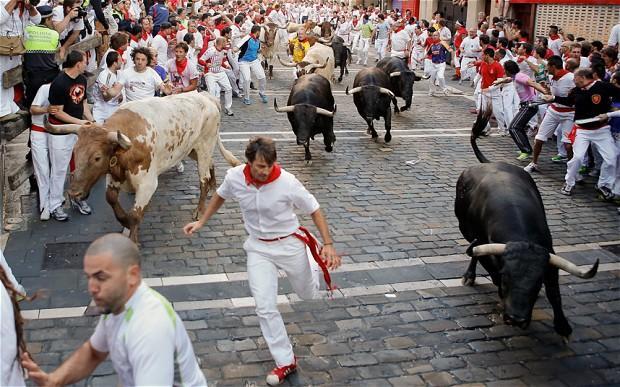
Spanish authorities are trying to cut down on sexual assaults at the Pamplona festival and have asked women to refrain from removing their tops

Women will be banned from baring their breasts during celebrations at this year’s Running of the Bulls fiesta in Pamplona after complaints that it encourages sexual assaults.
Authorities will this year attempt to stop the “bacchanal display” of women lifting their tops as they are held up in the crowds to be groped by men and squirted with red wine when the festival starts on Sunday.

During the Chupinazo, the ceremony which marks the start of the eight-day festival made famous by Ernest Hemingway in his book The Sun Also Rises, thousands of revelers crowd into the square in front of the town hall for the start of the San Fermines fiesta.

Images of women going topless during the celebration, which takes place at noon on July 6, have enraged anti-gender violence groups and led to a backlash against the festivities.
"Accepting these images as a merry bacchanal legitimizes male domination and sexual assault," wrote Emilia Laura Arias, a journalist specializing in gender equality, after the ceremony last year.

The mayor of Pamplona has announced that for the first time in the festival’s history police officers will be on patrol this year specifically to focus on preventing sexist attacks on women, even if the displays are “voluntary”.

“We are concerned about these sexual assaults and want to prevent practices, especially during the Chupinazo, which present a negative image of the city,” said Enrique Maya, the mayor.
Although he admitted that policing the event where thousands are squeezed into a tiny area would be difficult he said that officers would watch from balconies within the square in a bid to prevent sexist aggression and identify perpetrators.

Those found in breach of the new bylaws, which include those regulating behaviour during the bull runs, face fines of up to €3000 (£2,378).

Posters will be placed around the city warning revelers to respect women. “Someone exposing their body does not legitimise assaulting them,” reads one of the warnings.

[readon1 url="http://www.telegraph.co.uk/news/worldnews/europe/spain/10946586/No-bare-breasts-at-this-years-Running-of-the-Bulls-festival.html"]Source:www.telegraph.co.uk[/readon1]

pvwp

Showcased at World Pride 2014
Puerto Vallarta Puts Mexican Folklore
in the Middle of Church Street to Promote its Pride
 
New York, July 1, 2014- The Puerto Vallarta Tourism Board brought a touch of Mexican folklore to the World Pride 2014 celebrations taking place across Toronto. On June 29, Puerto Vallarta's Noche Feliz took place in the offices of leading LGBT Tour Operator Rainbow High Vacations with an hour-long concert by local Mariachi group Viva Mexico Mariachi, go-go dancers and Mexican dishes by Santo Pecado Catering which created Puerto Vallarta inspired dishes for the event. Pairings and tastings were also done with El Jimador Tequila cocktails.
 
Those in attendance were able to register to win trips to Puerto Vallarta's top gay-friendly hotels, including Casa Cupula, Costa Sur, Grand Miramar resort & Spa, Marriott CasaMagna, Villa Mercedes or Velas Vallarta, a tour for two with Gay Vallarta Bar Hopping Tours with an Outdoor Adventure o Hidden Mexico activity with Vallarta Adventure and a dolphin experience with Dolphin Discovery.

On Saturday, June 28, Puerto Vallarta was also featured in World Pride's International Travel Showcase where the tourism board distributed information on the diverse offerings the destination has to offer guests.
 
Puerto Vallarta made its debut as a tourism destination in the 1960s when celebrity visits by Elizabeth Taylor and Tennessee Williams launched the destination into the eye of international media, and has since developed into the country’s leading LGBT destination.
 
One of the few locations in Latin America that can claim to have a gay village,Puerto Vallarta’s Zona Romantica, is home to almost a 100 LGBT-owned or cater to the LGBT traveler, including beaches, tours, activities and restaurants bars and clubs to choose from. LGBT travelers have the option of choosing from gay friendly resorts, hotels, lodges, bed and breakfasts and guest houses.
 
A member of the International Gay and Lesbian Travel Association, Puerto Vallarta has been a preferred LGBT friendly destination in the Americas for over 60 years and has an infrastructure that is frequently included on leading media as gay friendly destination lists. Puerto Vallarta also actively supports GLAAD, HMI and the GMHC.
 
Additional information on Puerto Vallarta is available at www.visitpuertovallarta.com.

VAN

Vancouver is a top tourist destination for sightseeing, watersports and, if a new survey holds weight, having an illicit affair.

In a new survey released by online dating site SeekingArrangements.com, the City of Glass was rated the top vacation destination in Canada to have an illicit affair.

Not only is the city rated tops in Canada, it also ranks quite highly worldwide, taking the eighth most popular spot worldwide for cheaters on vacation.

In a survey of 73,000 male and female self-professed cheaters, Paris is the best destination for a secret rendezvous – almost 2,200 cheaters said they’d visit the City of Love this summer.

Other top-ranked destinations include Puerto Vallarta, Mexico, and Palm Springs, California.

The dating site says adulterers capitalize on the warm summer season by “squeezing in illicit love affairs amidst packed social calendars and business trips.”

But keeping those rendezvous secret isn’t always easy. Sixty-four per cent of cheaters in the survey admitted to travelling separately from their lover to their cheating destination.

Here’s a look at the top 10 destinations:

  1.     Paris, France
  2.     Puerto Vallarta, Mexico
  3.     Palm Springs, California
  4.     San Juan, Puerto Rico
  5.     Chicago, Illinois
  6.     Seattle, Washington
  7.     Punta Cana, Dominican Republic
  8.     Vancouver, Canada
  9.     Las Vegas, Nevada
  10.     Barcelona, Spain

This isn't the first time Vancouver has earned a distinction for all things dubious.

Last year, SeekingArrangement.com said Vancouver is the ‘Sugar Daddy’ capital of the country.

It found that Vancouver Sugar Daddies spent $4,307 monthly on their younger counterparts on average, more than anywhere else in the country.

It also revealed that Vancouver Sugar Daddies are 40 years old and make $292,506 annually, on average.

[readon1 url="http://bc.ctvnews.ca/vancouver-rated-top-canadian-destination-to-cheat-1.1884237"]Sourcebc.ctvnews.ca[/readon1]

20131230175924736734 20

(CNN) -- Three Al Jazeera English journalists were convicted in Egypt on Monday of aiding the Muslim Brotherhood in a ruling that immediately outraged journalists and activists around the world.

Peter Greste, Mohamed Fahmy and Baher Mohamed had been imprisoned in Cairo since December on charges that included conspiring with the Brotherhood, spreading false news and endangering national security.

The three men have steadfastly denied the charges, as has Al Jazeera, and the prosecution put forth no evidence to support the allegations. Prosecutors were criticized for presenting evidence that was purportedly made up or irrelevant to the case, like videos of Greste's old news reports from other countries.

A judge sentenced Greste, a former BBC correspondent, and Fahmy, a journalist formerly employed by CNN, to seven years behind bars. Mohamed was sentenced to a decade -- seven years for one charge and three years for a second.

Al Jazeera journalists found guilty Parents of jailed journalist speak In Egypt, case of trial by error Journalists' support 'keeps Greste going'

Fahmy has dual nationality, with Egyptian-Canadian citizenship. On Monday, Canadian Minister of State Lynne Yelich said in a statement that Canada is "very disappointed with the verdict."

After the verdict, Fahmy's mother, Wafaa Basiouny, wept inside the courtroom. "Why seven years?" she said. "What did he do? Who did he kill?"

Three other international journalists -- Sue Turton and Dominic Kane of Al Jazeera and Rena Netjes, a correspondent for Dutch newspaper Parool -- were sentenced in absentia to 10 years, reports said, adding that the journalists are expected to appeal, according to the nonprofit Committee to Protect Journalists, which advocates for media freedom worldwide.


Sherif Mansour, CPJ's Middle East and North Africa program coordinator, called the convictions "shocking" and "an extremely disturbing sign for the future of the Egyptian press."
CNN has firmly supported the journalists throughout the trial. Because Al Jazeera has no staff operating in Egypt, CNN and other international broadcasters have been contributing reporting to its television coverage.

"All at CNN are dismayed at today's unjust sentencing of the Al Jazeera journalists in Egypt," the network said in a statement. "Freedom of the media must be protected, and journalists must be free to carry out their legitimate work without fear of imprisonment. We stand alongside the journalistic community in calling for the immediate release of these journalists.

Throughout the trial, a who's who of internationally known journalists, including CNN's Christiane Amanpour, repeatedly called for the release of Greste, Fahmy and Mohamed. Amanpour held up a sign on her CNN International show that said "#freeAJStaff" and joined a campaign meant to call attention to their plight.

See Amanpour, on her CNN show, confront powerful Egyptian about journalists' jailing
Amanpour spoke on CNN's "Reliable Sources" in February about the chilling effect of imprisoning journalists.

"If you try to be objective in your coverage, you are deemed a terrorist," she said. "I mean, it is terrible what's happening there. It is silencing the truth."

In an interview on Al Jazeera shortly after the verdicts were read, Amnesty International Director Steve Crawshaw deplored what he called an "outrageous ruling" and called the convictions an "absolute affront to justice."

In a televised interview, Mostefa Souag, the acting director general of Al Jazeera, called the verdict "shocking."

"I don't think it has anything to do with justice," he said, calling it another step in Egypt's "campaign of terrorizing people and terrorizing the media."

Al Jazeera English Managing Director Al Anstey said in a statement that the sentencing "defies logic, sense, and any semblance of justice."

"There is only one sensible outcome now," Anstey added. "For the verdict to be overturned, and justice to be recognized by Egypt. We must keep our voice loud to call for an end to their detention."

CNN correspondent Ian Lee, stationed outside the court in Cairo, said that through an appeals process, "there's a high likelihood that a judge could either reduce the sentence or acquit them later on."

Pawns in a geopolitical dispute?
The Egyptian Embassy in London released a statement Monday, saying that the sentences were the result of "a judicial process during which the court has examined this case over several sessions in the last six months" and that the defense and prosecution were given "full opportunity" to present their cases.

The embassy said it doesn't comment on the content of court rulings, but it added that "freedom of expression and thought are basic and unalienable rights" that are protected in Egypt's new constitution.

Read more about Egypt's new constitution
The prosecution, which has argued that channels like Al Jazeera brought down Iraq and were planning to do the same in Egypt, has been widely condemned by international correspondents, media organizations and foreign governments.

Amnesty International has said that Greste, Fahmy and Mohamed are pawns in a geopolitical dispute between Egypt and Qatar, the tiny Middle Eastern country that finances Al Jazeera. Qatar has long been perceived as a supporter of the Muslim Brotherhood, a religious and political group banned in Egypt and labeled a terrorist organization after President Mohamed Morsy's ouster last year.

That declaration came just days before the Al Jazeera journalists were arrested at the Cairo hotel where they were working. Egyptian state-run media said they were charged with "broadcasting false information" to harm the country's national security and being members of an illegal organization, the Muslim Brotherhood.

A number of other defendants, with no affiliation to Al Jazeera, were also convicted Monday of similar charges.

Canadian Minister of State Yelich said in the statement that Canada is "concerned that the judicial process that led to his (Fahmy's) verdict is inconsistent with Egypt's democratic aspirations. A fair and transparent legal system is a critical pillar of a future stable and democratic Egypt."

Canada wants the Egyptian government to "protect the rights of all individuals, including journalists," the statement said.
'Just doing their job'

The three Al Jazeera employees are "first-class journalists," Anstey said in a statement after the journalists had been detained for three months. "They were just doing their job covering and challenging all sides of the story in Egypt."

In an interview for CNN's "Reliable Sources," Greste's parents, Juris and Lois, said they could not understand why Peter was still behind bars.
"Peter had no reason, no motive for doing anything like the allegations against him," Lois Greste said. "He would have reported the same story, be it for CNN, BBC, Reuters or anybody else."

Juris Greste said it was not unreasonable to characterize his son as a "political prisoner."

"It looks like a kidnapping by the state, as it were," he said, even as he emphasized that he and his wife "bear no ill will against Egypt or its people."

On Sunday, U.S. Secretary of State John Kerry said he spoke "specifically about Al Jazeera journalists" during a meeting with the new Egyptian President, Abdel Fattah el-Sisi.

While Kerry did not elaborate on the outcome, he said generally that they "discussed the essential role of a vibrant civil society, a free press, and rule of law, and due process in a democracy."

On Monday, Kerry said the "chilling, draconian sentences" were "a deeply disturbing setback to Egypt's transition." He said el-Sisi should "consider all available remedies, including pardons," for the journalists and "all of the political sentences and verdicts pronounced during the last few years."
Reading a statement at a media briefing Monday, White House spokesman Josh Earnest said the Obama administration "strongly condemns" the journalists' sentencing. The verdict, Earnest said, "flouts the most basic standards of media freedom," and he added that the White House is calling on the Egyptian government to pardon the journalists.

Journalists in jail
There are 167 journalists imprisoned around the world, including the three Al Jazeera journalists sentenced Monday, according to Reporters Without Borders.
China has the largest number of journalists behind bars, with 32, followed by Eritrea (28) and Syria (16), the media freedom organization says.
Twenty-eight journalists have been killed doing their jobs this year, the group says.

Reporters without Borders ranks Egypt 159 out of 180 countries for media freedom.

According to the Committee to Project Journalists, at least 14 journalists are imprisoned in Egypt and more than 65 journalists have been detained since Morsy was ousted in July. Most, the group said, have been freed.


Egypt court upholds 183 death sentences

[readon1 url="http://www.cnn.com/2014/06/23/world/meast/egypt-al-jazeera-journalists-court/index.html?hpt=hp_t2"]Source:www.cnn.com[/readon1]


bf71bf7c3905aa18570f6a706700228b

PETALUMA, Calif. (AP) — It’s that time of year again when dogs with unusually large heads, hairless bodies and other oddities compete to be the World’s Ugliest Dog.

This year’s winner? A 2-year-old mutt named Peanut, whose wild white and brown hair, bulging eyes and protruding teeth belie his sweet, energetic personality.

   
Although Peanut is healthy now, his owner, Holly Chandler of Greenville, North Carolina, says he was seriously burned as a puppy, resulting in bald patches all over his body.

Chandler hopes Peanut’s victory will help raise awareness about animal abuse.

‘‘We’re trying to use him as a poster child for what can happen to animals who are abused,’’ she said.

She plans to use the $1,500 prize to pay for other animals’ veterinary bills.

The contest, held at the Sonoma-Marin Fairgrounds in Petaluma, California, is in its 26th year.

The dogs are scored by a three-judge panel in several categories, including special or unusual attributes, personality and natural ugliness.

The past five winners have included a duck-footed beagle, boxer and basset hound mix with a waddle, a Chinese crested and Chihuahua mix with a protruding tongue and short tufts of hair and a Chihuahua with a missing eye and a camel’s back.

[readon1 url="http://www.boston.com/news/odd/2014/06/21/photos-there-new-world-ugliest-dog/9jFeflZ7VzI8XI2wferckJ/story.html?rss_id=Top-GNP"]Source:www.boston.com[/readon1]

súper-reloj-cuántico

Thanks to quantum physics, scientists say they could build a global network of much more accurate than any clock atomic clocks today.

If the job is successful, the concept of time as we know it today could change drastically and allow a new idea of ​​accuracy.

A group of scientists, led by Mikhail Lukin, Harvard University, proposes a new concept, called 'quantum superreloj'.

Soon it would be possible to exploit the power of a quantum network world watches to "allow the construction of a single international time scale in real time (World clock) with unprecedented accuracy and stability," says a study published in the journal Nature Physics '.

The clock is based on the principle of quantum entanglement, puzzling phenomenon of quantum mechanics that occurs when two or more particles interact so that the conduct of each depends behavior apparently others.

So far, scientists have managed to weave 14 atoms at the time, but without the precision required to manufacture the superreloj.

early-warning-system

Here’s something you might not know about the 6.4 magnitude earthquake near the Pacific Coast of Mexico on May 8: By the time it hit Mexico City, 270km away, people there already knew it was coming. They were ready — thanks to their advanced warning system. So why doesn’t the US have one?

After a devastating 8.1 earthquake in 1985 which may have killed upwards of 10,000 people, Mexico’s government was determined to find a way to prevent that kind of loss of life again. Mexico City residents knew that this 6.4 earthquake was rippling towards their homes because, in 1992, they launched an effective system that’s able to tell millions of people that an earthquake is on the way. It works.

In fact, Mexico is one a handful of seismically active countries that have a early warning systems. Taiwan, Turkey, and Romania each have one, too. After the 1995 Kobe quake killed 6500 people, Japan employed its own early warning system, eventually becoming the first to take advantage of nascent mobile phone technology. Following the Tohoku earthquake in 2010, over one million people downloaded a new app which helped prepare them — both physically and mentally — for the dozens of aftershocks that rocked the country.

A simple system, properly implemented, could give cities the time to stop trains and freeze elevators. It would give doctors time to halt surgical procedures in hospitals. It would allow police and firefighters to strategize in the case of a power or communications failure. Just a few seconds of warning could prevent millions in financial losses or even an environmental disaster like Fukushima — and it could potentially save thousands of lives.

Why doesn’t the US, which bears a large amount of the global earthquake risk, have any kind of system in place?

Unbelievably, a prototype has already been built in California. The latest version is currently being tested by the United States Geological Survey (USGS) and several other partners. In fact, it’s almost finished. The science and technology is sound. We know it can save money and lives. Perplexingly, there’s just no plan in place to roll it out yet.

We can’t — and shouldn’t — afford to wait. “Most of the systems you find today are the result of some big killer earthquake,” says Douglas Given, the Earthquake Early Warning Coordinator for the USGS. “So one of our goals is to build our system before the killer earthquake — rather than after.”

Like Twitter, But Faster
If you’ve been in an earthquake, you can understand how an early warning system might work by watching a rudimentary version of it that gets used every single time: Twitter. When the shaking starts, our first instinct is to reach for our phones and post our take on the situation. At least this is what happens in my house.

But if you’re looking at Twitter at just the right moment, you might even see those tweets from across town — “Earthquake?” “EARTHQUAKE” “Shaking right now in Hollywood!!!!” — moments before the shaking starts at your house.


[readon1 url="http://www.gizmodo.com.au/2014/06/earthquake-early-warning-systems-save-lives-so-why-doesnt-the-us-have-one/"]Source:www.gizmodo.com.au[/readon1]

bc

The British Council and CONACULTA today announced an open call for six commissioning editors to travel to Mexico City in preparation for The London Book Fair’s 2015 Mexico Market Focus. Taking place in September, the trip will be a unique opportunity for UK editors to develop a greater understanding of contemporary Mexican literature, gain insights into the opportunities of the Mexican market and build long-lasting relationships with their counterparts at Mexican publishing houses.

The programme for the Editors Trip will introduce delegates to the vibrant Mexican literary scene and introduce them to contemporary Mexican writing through meetings with Mexican editors, rights professionals and translators. Meetings will take place at publishing houses, cultural venues and bookshops throughout Mexico City to showcase the best of Mexico’s cultural offerings. The UK editors will also have the opportunity to meet writers and members of the broader literary community.

Delegates will be selected by a committee including a representative from the British Council, CONACULTA, The London Book Fair and The Publishers Association. Preference will be given to applicants from publishers with a proven track-record of publishing literature in translation, especially writing from Latin America, and who express a genuine desire to build new and on-going relationships with Mexican publishing professionals.

Cortina Butler, Director Literature at the British Council says, ‘This is an exceptional opportunity for UK editors to immerse themselves in Mexican literature and the Mexican publishing scene through an intensive programme of meetings and discussion with the best publishers, partners and venues in Mexico City. I am delighted to be able to offer this opportunity to UK editors in advance of The London Book Fair Mexico Market Focus in April 2015.’

The British Council is in its eighth year of working in partnership with The London Book Fair to curate and deliver a Cultural Programme which supports the country or region selected annually as Market Focus. The Cultural Programme seeks to promote cultural exchange with the UK. Together, the British Council and CONACULTA will support and curate a programme of events in the lead-up to the Mexico Market Focus to encourage greater cultural exchange between Mexico and the UK, to build awareness of each other’s literature amongst literary professionals and readers in both countries and to create opportunities for writers from both countries to prosper.

The Editors Trip forms part of the Cultural Programme curated by the British Council and CONACULTA which will include visits by UK writers to Mexico, a translation project, participation of Mexican writers at UK literary festivals, and will culminate in a delegation of ten Mexican writers visiting the UK in April to participate in events at The London Book Fair and around London and the UK.

In addition to the Cultural Programme, the Market Focus initiative comprises a year-long Professional Programme of business-to-business events taking place in Mexico and the UK. Pre-fair learning opportunities throughout the year complement the networking and matchmaking sessions taking place at the Fair itself in April 2015. The Professional Programme is designed to increase knowledge of the Mexican and the UK publishing markets and develop deeper relationships amongst industry professionals from around the world. To register your interest in this year’s Mexico Professional Programme please click here.

The Professional Programme is designed and delivered by The London Book Fair and their UK partner, The Publishers Association, working closely with CONACULTA, CANIEM and other partners in Mexico.

The London Book Fair Market Focus initiative is currently in its eleventh year and has done much to open doors, creating both commercial and cultural partnerships around the world since it was first introduced in 2004. The objective of the Market Focus is to put the spotlight on publishing trade links with the country or region that is showcased, highlighting its publishing industry and the opportunities for conducting business with the rest of the world. Previous Market Focus countries and regions include the Arab World, India, South Africa, Russia, China, Turkey and Korea.

[readon1 url="http://www.londonbookfair.co.uk/news-and-media/press/Press-Releases/Call-for-Editors---Mexico-/"]Source:www.londonbookfair.co.uk[/readon1]