6385173P

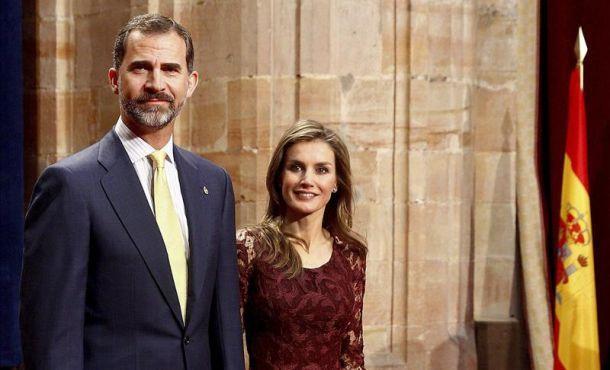
Madrid, Jun 18 (EFE).- Felipe de Borbon officially became king of Spain at midnight Wednesday with the publication in the Official Bulletin of the State of the law formalizing the abdication of his father, Juan Carlos.

The 76-year-old departing monarch signed the measure into law earlier Wednesday during a brief ceremony at the royal palace in Madrid.

Prime Minister Mariano Rajoy added his signature and Juan Carlos rose and turned to embrace his son, who will reign as Felipe VI.

He will be proclaimed king before Parliament on Thursday morning, with the nearly 700 members of the lower house and Senate, the entire Cabinet and more than 100 special guests in attendance.

The 46-year-old king will then deliver the first speech of his reign.

Leonor, the eldest daughter of King Felipe VI and Queen Letizia, will automatically become Princess of Asturias and heir to the throne.

Juan Carlos ascended to the throne on Nov. 22, 1975, and Felipe de Borbon became Prince of Asturias in January 1977.

[readon1 url="http://www.laprensasa.com/309_america-in-english/2590565_felipe-de-borbon-is-king-of-spain.html"]Source:www.laprensasa.com[/readon1]

ns

VANCOUVER, British Columbia--(Business Wire)--NanoStruck Technologies Inc. (the “Company” or “NanoStruck”) (CSE:NSK) (OTCQX:NSKTF) (Frankfurt:8NSK) announces a Letter of Intent (LOI) signed with the Municipality of Puerto Vallarta, Mexico to treat the leachate water at the Puerto Vallarta Landfill site (the “Plant”).
Bundeep Singh Rangar, Interim CEO and Chairman of the Board said: "Leachate is among the most contaminated wastewaters on our planet. Using the capability of our nanotechnology, we are effectively treating the leachate water and are doing so in a way that protects the environment and saves the Mexican taxpayer money. We believe there is a large opportunity is present for us in this regard.”

NanoStruck and Puerto Vallarta Landfill are working towards finalizing an agreement for Puerto Vallarta Landfill to purchase the Plant for a price of approximately C$2.21M including financing costs, payable over 72 monthly payments (the “Contract”). The LOI spells out the technology and commercial terms for the proposed undertaking.

Incorporating NanoStruck’s proprietary NanoFiltration technology, the Plant reduces heavy metals and other contaminants by up to 99%, rendering the treated leachate fully compliant with the requirements of NOM-001-3 SEMARNAT (Mexico’s Environment Ministry). This will allow the Puerto Vallarta Landfill to clean water locally and safely dispose the treated wastewater into local water courses or use it for agricultural irrigation, saving money on offsite third party treatment and associated transportation charges.

There is a major problem with leachate disposal at a significant number of landfill sites in Mexico. NanoStruck’s on site leachate treatment solutions reduce costs and ensure municipalities and private landfill owners are fully compliant with the strictest regulatory requirements. Currently, Mexico has 370 major government owned landfill sites and numerous privately-owned landfills. By law, leachate, which is highly polluted drainage water from land field sites, must be treated to reduce containments before being released into the environment.

About the Company

NanoStruck Technologies Inc. is a Canadian Company with a suite of technologies that remove molecular sized particles using patented absorptive organic polymers. These versatile biomaterials are derived from crustacean shells or plant fibers, depending on requirements of their usage. Acting as molecular sponges, the nanometer-sized polymers are custom programmed to absorb specific particles for remediation or retrieval purposes. These could be to clean out acids, hydrocarbons, pathogens, oils and toxins in water via its NanoPure solutions. Or to recover precious metal particles in mine tailings, such as gold, silver, platinum, palladium and rhodium using the Company’s NanoMet solutions.

By using patented modifications to conventional technologies and adding polymer-based nano-filtration, the Company’s offers environmentally safe NanoPure solutions for water purification. The Company uses Environmental Protection Agency (EPA) and World Health Organization (WHO) guidelines as a benchmark for water quality and safety to conform to acceptable agricultural or drinking water standards in jurisdictions where the technology is used.

Additionally, the Company’s technology can be used to recover precious and base metals from mine tailings, which are the residual material from earlier mining activities. By retrieving valuable metals from old tailing dumps, the Company’s NanoMet solutions boosts the value of existing mining assets and reduces the need for new, costly and potentially environmentally harmful exploration and mining.

The Company’s current business model is based on either selling water remediation plants or leasing out units and charging customers on a price per liter basis with a negotiated minimum payment per annum. For processing mine tailings, the value of precious metal recovered is shared with tailing site owners on a pre-agreed basis.

NEITHER THE CANADIAN NATIONAL STOCK EXCHANGE NOR ITS REGULATORY SERVICE PROVIDER HAS REVIEWED AND DOES NOT ACCEPT RESPONSIBILITY FOR THE ADEQUACY OR ACCURACY OF THE CONTENT OF THIS NEWS RELEASE.

FORWARD LOOKING INFORMATION

This press release contains forward-looking statements. The use of any of the words "anticipate", "continue", "estimate", "expect", "may", "will", "project", "should", "believe" and similar expressions are intended to identify forward-looking statements. Statements relating to "reserves" or "resources" are deemed to be forward-looking statements because they involve the implied assessment, based on certain estimates and assumptions that the resources and reserves described can be profitably produced in the future.

Although the Company believes that the expectations and assumptions on which the forward-looking statements are based are reasonable, undue reliance should not be placed on the forward-looking statements because the Company can give no assurance that they will prove to be correct. Since forward-looking statements address future events and conditions, by their very nature they involve inherent risks and uncertainties. These statements speak only as of the date of this press release. Actual results could differ materially from those currently anticipated due to a number of factors and risks including various risk factors discussed in the Company’s Management’s Discussion and Analysis for the three and six months ended March 31, 2014, filed on May 29, 2014, and for the year ended September 30, 2013, filed on January 28, 2014, under the Company’s profile on www.sedar.com.

ag


[readon1 url="http://www.digitaljournal.com/pr/1996541"]Source:www.digitaljournal.com[/readon1]

flags2

The Linking Communities Wetlands and Migratory Birds International Educators Conference was hosted in Swift Current on June 6 to 9

The Saskatchewan weather was fantastic for educators visiting the province from Utah, Northern California, Nayarit Mexico and Ottawa.

Linking Communities mission is to conserve shorebirds and their habitats through a network of key sites across the Americas. The partners are Chaplin and Quill Lakes in Saskatchewan, the Great Salt Lake in Utah and the Marismas Nacionales in Nayarit, Mexico. The funding partners are Rio Tinto Kennecott Copper and the organizing partners are Utah Linking Org, Nature Canada, Nature Sk and Chaplin Tourism.

The outcome of the partnerships is to promote Conservation, Environmental Education and Ecotourism within their own countries and to share this knowledge with the partners. Each location is a WHSRNS (Western Hemispheric Shorebird Reserve Network Site) and these sites share shorebirds and other migratory birds at different seasons.

Each location is home to significant IBA’s (Important Bird Areas) Chaplin Old Wives and Reed Lake locally. The three communities are linked together by similar economic, social and environmental interests.

The Linking conference was held in Swift Current as this was Canada’s turn to host, and daily trips were made to Chaplin, to take in the annual Shorebird festival. The visiting educators were thrilled with many sights and experiences like mist netting and banding some arctic nesting shorebirds, seeing the Aurora borealis for the first time and tasting perogies! Not to mention being able to see for miles and the expanse of our province, the clear night skies and crisp air…Oh and the ticks!

Some of the highlights of the agenda were visiting Central School in Swift Current and presenting to the grades 3 and 4 classes, visiting Southland Hutterite Colony sharing birds, food and languages. The Mexico group learned some German and the school kids learned a birdsong in Spanish, then in the middle of this a hockey game erupted…Only in Canada EH!

The final farewell supper was held at the Mainstay Inn on the gorgeous South Saskatchewan River.

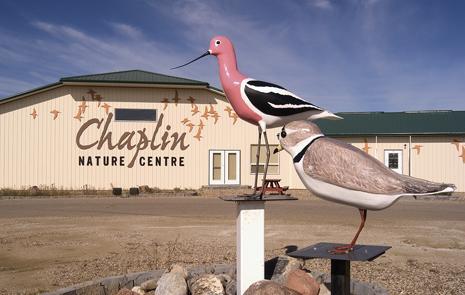
Linking Chair from Utah Don Paul asked what does a perogie and an empanada have in common? He replied, “and American Avocet” the beautiful graceful salmon black and white shorebird that shares these same sites through its migration as it makes its summer home in Canada, stages and refuels in Utah then migrates to Mexico for the winter.

The Chaplin Shorebird Festival was a success again this year due to the community and the surrounding area that is committed to supporting the great work being done at the Nature Centre. The Centre is a not for profit and is dependent on contributions from visiting tourists and the festival fundraiser and those that donate funds and items to the auction. About 170 people attended from the province including an avid bird enthusiast at age 89 from Manitoba, who spent the entire day out on tour. The Centre is busy with year-end school trips but we welcome everyone out to the lake for tours and we will soon h>ave many chicks to see as our endangered Piping Plover and other nesting birds fledge there young.

cha

chaplin statues hires

[readon1 url="http://www.edgeonthenet.com/nightlife/photo_albums/159940/luxury_and_local_adventure_in_mexico%E2%80%99s_riviera_nayarit"]Source:www.edgeonthenet.com[/readon1]

GOOFor day 5 of the 2014 FIFA World Cup, Google celebrated with a Doodle featuring a Mexican wave.

The artwork, which is made up of a jumble of seemingly random colorful letters going up and down on stadium seats, depicts the famous wave from 1986's World Cup in Mexico. The Mexican wave was called the "La Ola" by spectators and has since become an international phenomenon in sports. The letters, which all have stick limbs, represent the fans and "Google" can be seen in the center line of the stands. The "L" in Google seems to miss out on the fun, completely oblivious to the wave around it and enthralled by the book it is reading, but stands and sits out anyway after all the others.
 
Clicking on the image of the Google Doodle will redirect users to the World Cup 2014 search results with the live score and schedule widget. "The football/soccer craze is making waves for...just about everyone," wrote Google on the Google Doodle website.

On the Google Doodle webpage, there are several World Cup Doodles. The opening day of the World Cup, the Google Doodle was an animated image of the city of Rio de Janeiro, Brazil. A green and yellow soccer ball rolls into the foreground of the image and the Google letters jump for joy. Though the Doodle mostly depicted a beach, there were references to the city including the Christ the Redeemer statue and cable cars in the background.

[readon1 url="http://en.kioskea.net/news/25006-google-doodle-celebrates-world-cup-with-mexican-wave"]Source:en.kioskea.net[/readon1]

wcj

Sao Paulo (AFP) - Pop superstar Jennifer Lopez, hundreds of dancers, drummers and gymnasts, and a paraplegic who will kick a football in a robotic suit will deliver a pre-match extravaganza Thursday to open the World Cup.

After the delays that have hampered Brazil's preparations, organizers had one overriding message for fans ahead of the 3:15 pm (1815 GMT) opening ceremony: Don't arrive late.

"Please, get there early," pleaded Brazilian singer Claudia Leitte. She will perform the official World Cup song, "We Are One," along with Lopez, rapper Pitbull and Brazilian drumming collective Olodum in the ceremony's grand finale.

There were last-minute doubts over whether Lopez, who media reports say recently broke up with backup dancer and boyfriend Casper Smart, would attend.

FIFA said Sunday the singer had pulled out of the ceremony over "production issues."

But with two days to go, the world football body said she would perform after all.

"We Are One" has been viewed more than 75 million times on YouTube, though some critics have panned it as a disappointing follow-up to World Cup classics like Ricky Martin's "Cup of Life" in 1998 and Shakira's "Waka Waka" in 2010.

More than 60,000 fans will be in Sao Paulo's Corinthians Arena, including 12 heads of state and UN Secretary-General Ban Ki-moon, and around one billion people are expected to watch the opening ceremony and match on TV.

The 25-minute ceremony will feature more than 600 artists, including acrobatic gymnasts, trampolinists, marshal arts-style capoeira performers and stilt walkers.

"The opening ceremony is a tribute to Brazil and its treasures: nature, people football," Belgian artistic director Daphne Cornez said in a statement.

She said one of her goals was to showcase the diversity of the sprawling South American country of 200 million people.

But Cornez has kept most other details under wraps.

Performers have had to surrender their cell phones before rehearsals to prevent any surreptitious selfies.

- High-tech exoskeleton -

In all, more than 1,200 people have worked on the ceremony.

Organizers said 20 hours of artistic work had gone into every minute of the performance.

The center of the show will be a giant LED ball made up of more than 90,000 light clusters.

But that will be one of the few large-scale technical wonders, since Cornez and team were under orders to avoid placing too much strain on the pitch where Brazil and Croatia will face off at 5:00 pm.

There will be no political speeches this year, not even from Brazil's President Dilma Rousseff, though messages of peace from Pope Francis and other religious leaders will be read out as doves are released.

The most powerful moment may come when a paraplegic, whose identity has been kept secret, gives the first kick to Brazuca, the official World Cup ball, by donning an Iron Man-like robotic suit controlled by brain signals.

The cutting-edge exoskeleton was designed by Brazilian neuroscientist Miguel Nicolelis.

It will also be a special day for several youths from Itaquera, the lower-class neighborhood where the stadium was built in a process plagued by protests, delays, overspending and construction accidents that killed three workers.

"We reached a deal with FIFA for three young people from our neighborhood to participate in the ceremony," said local priest Rosalvino Moran, who runs the charity that chose the youths.

"It was the least they could do. If they hadn't agreed, the kids would have camped out in front of the stadium and protested the World Cup."

World Cup Extravaganza

[readon1 url="http://news.yahoo.com/j-lo-iron-man-suit-star-world-cup-203900370--sow.html"]Source:news.yahoo.com[/readon1]

rhog

  • Margaret Howe lived with a dolphin for ten weeks in the 60s
  • The aim was for her to teach Peter, a bottlenose, to speak English
  • He learned a few words, but mainly, Peter fell in love with her

Of all the weird and wonderful events of the 1960s, few are as strange as an animal experiment that took place on the U.S. Virgin Islands in 1965.

For ten weeks, in a charming villa on the island of St Thomas, overlooking the  Caribbean, Dr John C. Lilly, a neurologist, tried to teach a six-year-old dolphin to speak English.

His 23-year-old assistant, Margaret Howe, a Virgin Islands local, would live, day and night, with Peter, a bottlenose dolphin. And they would eat, bathe, sleep and play together in complete isolation.

By the time of the experiment, Dr Lilly had already written a 1961 bestseller, Man And Dolphin, claiming dolphins’ brains were 40 per cent bigger than ours and that, like us, dolphins trembled at pain and could control their anger. What’s more, he believed, they were capable of understanding human language.

Extraordinarily, he was also licensed by the American government to investigate the effects of LSD, and chose to inject it into two of the dolphins in his care in the Caribbean, though he was disappointed to find it appeared to have no effect.

The preparations for the Nasa-funded experiment into dolphins’ ability to ‘speak’ were extensive. First, Dr Lilly had the villa — Dolphin House — flooded with seawater, so that Margaret and Peter could live as one.

The water on the first floor was 22in deep, allowing Margaret to wade and Peter to swim. Margaret could climb out of the water to work at a desk suspended from the ceiling. At night, she lifted herself onto a hanging mattress, protected from Peter’s splashings by a shower curtain. She ate tinned food, so no need for any deliveries. No one was to interrupt their daily routine.And what a rigorous routine it was, from Sunday to Friday, with only Saturdays off for Margaret. She lived her life in a swimming costume — with an extra leotard on colder evenings — and cut her hair to a quarter of an inch long to make her interactions with Peter easier.

The day began at 8am with Peter’s first English lesson. Margaret’s aim was to encourage him to mimic sounds which she taught him. They can make human-like sounds through their blowholes, and it was Dr Lilly’s aim to nurture that skill.

Margaret came up with the idea of painting her face in white make-up and black lipstick so that he could clearly see the shape of her lips moving.

Audio recordings of the experiment reveal how Howe encouraged Peter to greet her with the words ‘Hello Margaret’.

As she told documentary maker Christopher Riley recently: ‘“M” was very difficult. I worked on the “M” sound and he eventually rolled over to bubble it through the water. That “M” he worked on so hard.’

In time, he could pronounce an approximation of the words ‘one’, ‘we’, ‘triangle’ and ‘hello’, and eventually, when Margaret parroted ‘work, work, work’, he would reply ‘play, play, play’.

At 10am, Margaret and Peter would indeed play together in the pool. There were further lessons at 12pm and 3pm, with five pounds of fish at each session. In between, Margaret continued to play with Peter, inside the villa and in an outside tank, throwing balls and towels for the dolphin to fetch.

Peter was also a keen TV-watcher and would stare at a set she turned on at the side of the pool. During breaks, Margaret wrote her notes, prepared meals and did the housework.

To begin with, all went well, and Peter began to make progress with developing human-like sounds.

‘Peter is his energetic self and a bit nippy on the toes,’ she wrote in her diary, referring to the little nibbles Peter made.

‘I carry a long-handled broom with me for that and ward him off. This is not always the case: we have had several long “loving” sessions. The water is deep enough for him to roll over and this he does for tummy rubs. He sleeps just next to my bed.

‘Some nights he has been quiet and others he just has to yell and splash around. He is always hungry and usually wakes me early in the morning to tell me to feed him.’

Peter was becoming a touch naughty, too. Initially, he listened attentively as Margaret went through lessons devoted to counting and shapes. But, like a lot of unruly six-year-olds, he preferred to talk rather than listen. ‘He seems to have lost his sense of conversation,’ Howe wrote: ‘He often overrides me. I cannot teach him if he is going to yell every time I open my mouth. He has said, for the [recording] tape, one clear word, “ball”.’

Peter also spent a good deal of time staring at himself in a mirror. And, when Margaret answered the telephone, Peter got annoyed,  making loud and competitive noises as she talked into the receiver.

Could Peter have been a little jealous? Certainly, he was getting close to her. By the second week, she wrote, Peter had grown much ‘more sociable, physical, making a thorough study of my feet, legs, ankles, knees. Doing this, he is very gentle, the rough part being when he tries to push me around’.

Peter was growing keener and keener on winning her attentions, hurling a ball against her shower curtain to get her to play. Increasingly, he only wanted to play ball with her and not on his own.

And then, in the fourth week, an alarming development occurred. As Margaret confided to her diary: ‘Peter has become sexually aroused several times during the week.

‘I find that his desires are hindering our relationship,’ she wrote. ‘He jams himself again and again against my legs, circles around me, is inclined to nibble and is generally so excited that he cannot  control his attitude toward me.’

According to Andy Williamson, the vet who looked after the animals’ health at Dolphin House: ‘Dolphins get sexual urges. I’m sure Peter had plenty of thoughts along those lines.’

Now in a panic, Margaret returned Peter to a tank with two other  dolphins, Sissy and Pam, to restrain him, and the period of exile seems to have worked because, on his return, Peter suddenly became gentle, sliding his mouth over  her shin.

Peter, Margaret decided, ‘is  courting me or something very similar. He presents his tummy and genital area for stroking. Perhaps this is his way of involving me in some form of sex play without  scaring me away.’

As she tells Christopher Riley: ‘That relationship of having to be together sort of turned into really enjoying being together, and wanting to be together, and missing him when he wasn’t there.

‘I did have a very close encounter with — I can’t even say a dolphin again — Peter.’

The problem was that, just at the time Peter and Margaret had begun to hammer out a workable relationship, the experiment ended and the lab was closed.

Without funding, the fate of the dolphins was in question. They were shipped to Lilly’s other lab, in a disused bank building in Miami, Florida. It was a far cry from the relative freedom and comfortable surroundings of Dolphin House.

In Miami, Peter quickly deteriorated, and after a few weeks  Margaret received the shocking news that Peter had committed suicide by refusing to breathe, and sinking to the bottom of his tank.

Was it the change in his surroundings, or could it have been that he was pining for the human he had grown so close to?

Vet Andy Williamson puts Peter’s death down to a broken heart, brought on by a separation from Margaret that he didn’t understand: ‘Margaret could rationalise it, but when she left, could Peter? Here’s the love of his life gone.’

Dolphins may not speak English — but, just like humans, they know all about broken hearts.

After the experiment with Peter ended, Margaret Howe left the laboratory and married the project’s photographer, John Lovatt.

Dr Lilly, although mocked by much of the scientific establishment, continued his researches into communication between humans and dolphins into the Eighties (he died in 2001).

He investigated other ways to talk to them, even attempting to use telepathy.

But after the extraordinary events in that sun-drenched laboratory in the Virgin Islands, no one ever tried to teach dolphins to speak English again.

[readon1 url="http://www.dailymail.co.uk/sciencetech/article-2653422/The-woman-taught-dolphin-speak-fallen-love-her.html?ito=video_player_click"]Source:www.dailymail.co.uk[/readon1]


miss-usa baid

Newly crowned Miss USA Nia Sanchez, a fourth-degree black belt in the Korean martial art of taekwondo, says that women need to be able to defend themselves as a way to battle the problem of campus rape and that bringing awareness to the issue is very important.

The 24-year-old from Las Vegas, Nevada, beat out 50 other contestants from all the states and the District of Columbia on Sunday night for the title of 63rd Miss USA.

First runner-up was Miss North Dakota Audra Mari. Sanchez will go on to represent the U.S. at the Miss Universe competition later this year.

In a vibrant red floor-length fishtail gown, Miss Nevada answered judge Rumer Willis’ question about the high rate of sexual assaults on college campuses.

Willis, the 25-year-old daughter of Bruce Willis and Demi Moore, said 19 percent of U.S. undergraduate women are victims of sexual assault and asked Sanchez why she thinks the issue is being swept under the rug and what should be done about it.

Sanchez said women need to take it upon themselves to learn how to defend themselves. After being crowned, Sanchez told reporters she lived for a time in a women’s shelter at a young age with her mother and at age 8 took up taekwondo to learn self-defense and build up her confidence.

As an adult, she has volunteered at women’s shelters, teaching residents how to defend themselves and teaching kids about “stranger danger.”

“I relate to them on a personal level because I’ve been there myself,” she said, adding that she plans to take her passion and knowledge for martial arts to the masses as Miss USA.

Sanchez, of German and Mexican descent, also said she was “so proud to bring the title of Miss USA back to Nevada.” “I’m so excited,” she said. “It’s a dream come true.”

Erin Brady, of South Glastonbury, Connecticut, the 2013 winner, gave up her crown to Sanchez after a three-hour telecast from the Baton Rouge Civic Center in Louisiana.

Besides Mari, the next four runners-up, judged on interviews, evening gowns and swimsuits were: Miss Georgia Tiana Griggs, Miss Louisiana Brittany Guidry, Miss Florida Brittany Oldehoff and Miss Iowa Carlyn Bradarich. All the titles included USA after the state.

Bradarich got a second chance when the viewing audience gave her the most votes on Twitter in the pageant’s first-ever “Save the Queen” option.

The subject of sexual assault was also on the mind of Miss Pennsylvania Valerie Gatto. She made headlines this week when she said she was the product of rape.

During a taped segment that aired when her name was called, Gatto said her mother was 19 when she was attacked leaving work in Pittsburgh and became pregnant.

Gatto said she is living proof “that your circumstances do not define your life.”

First runner-up Mari said she overcame being bullied in high school by competing in ice hockey. The Fargo, North Dakota, native wore a green floor-length evening gown and in her final interview talked about the importance of getting an education and going to college.

Contestants entered the stage on a glitzy float as Louisiana native singer-songwriter Marc Broussard sang the New Orleans hits “Iko Iko” and “Hey Pocky Way” to kick off the 2014 contest.

The women introduced themselves while holding Mardi Gras masks in their hands as purple, green and gold confetti fell in the background.

The pageant also included musical acts by the country music duo Florida Georgia Line, rapper Nelly and Latin pop band Camila.

Celebrity judges walked a red carpet in evening gowns and tuxedos before the start of the show, posing for pictures and talking about the qualities they would be looking for in the beauty they crown the winner.

“It’s very important that she has confidence,” said Barbara Palacios, Miss Universe 1986 and a coach and judge for the new Telemundo reality show, “Miss Latina Universo.” ”The right attitude and perseverance are also very important.”

“It’s all about the eyes,” said Lance Bass of the pop singing boy group NSYNC. “I just want to see a girl that is just really having a good time up there.”

Donald Trump, who owns the Miss Universe Organization, which includes the Miss USA pageant, also walked the red carpet.

Miss USA 2014

[readon1 url="http://voxxi.com/2014/06/09/miss-usa-nia-sanchez/"]Source:voxxi.com[/readon1]

7e9a6d4ed054f5fcb970ebf0ac4e54d900fef20f

Sometimes too much love can be a bad thing as Paris discovered on Sunday when thousands of “locks of love” attached to a footbridge caused part of the railing to collapse, forcing an evacuation.

Thousands of lovers from across the world visit the Pont des Arts every year and seal their love by attaching a lock carrying their names to its railing and throwing the key in the Seine.

But police were forced to hurriedly usher visitors off the footbridge in central Paris early Sunday evening after 2.4 metres (yards) of railing collapsed under the weight of the collected tokens of affection.

“The bridge was immediately evacuated and closed,” local police told AFP.

An architect and local officials rushed to the site and a barrier put in place to stop further access. Police said the bridge would be re-opened by Monday.

The Pont des Arts crosses the French capital’s river Seine just in front of the Louvre museum and is known the world over for its “locks of love”.

The phenomenon has become something of a headache for officials in the City of Light, who would prefer something that poses fewer problems of security and aesthetics.

Two young Americans living in Paris have gathered thousands of signatures for a petition they launched in March calling for the locks to be removed, saying they are eyesores and cause damage to the bridges.

The locks only appeared on the Pont des Arts in 2008, having already become a craze in Germany, Russia, China and particularly Italy.

Today, the full 150 metre length of the footbridge is covered in the locks, and the practice has spread to other bridges around the capital.

Forty locks were also recently removed from the Eiffel Tower.

[readon1 url="http://www.rawstory.com/rs/2014/06/08/paris-locks-of-love-bridge-evacuated-due-to-partial-collapse/"]Source:www.rawstory.com[/readon1]

Plastic-Bags1

Each season has its unique traits. Some are good, some are not so good. This depends upon who you talk to of course. One of the benefits of winter is the view, which brings a barren type of beauty. There is no doubt that leaves and green landscapes are appealing, but as an outdoor enthusiast and trail junky (both on foot and on wheels), I can appreciate the outdoors in every variation. There is a lot to be said for increased visibility too. When the trees are bare, you can see the contour of the land and the flow of the trail.

Sadly, I can also see litter; particularly, plastic bags. When you are hiking down a trail it’s easy to reach down and pick that trash or stray bag up. The easy cleanup opportunity is lost when you are barreling down the highway on the way to work though. It is especially discouraging to see hordes of plastic bags clinging to the tops of trees. These bags have obviously been ejected from passing vehicles to be carried by the wind to their final resting place. I’m sure they are present all year, but the winter draws back the veil of leaves to reveal just how much wasted plastic we generate.

What happens to the rest of the plastic bags that don’t get stuck in our suburban forests? And, what can we do to mitigate our waste? For years I was under the impression that we could not recycle these plastic grocery haulers. I’ve reused them as trash bags, lunch bags and anything else I could think of, but ultimately that just prolongs their life before they end up in the landfill. Luckily, just like a lot of our modern day materials, these can be recycled. So plastic bags really end up in three places (like everything else really).

The landfill
In 2011, Americans produced around 250 million tons of waste, 32 million tons of that solid waste was plastic. That’s 4.4 pounds of waste per person per day! It’s up to you to help keep plastic bags and other waste out of landfills.

Recycled into other goods
There is hope because recycling and composting helped prevent 87 million tons of material from reaching the landfills that year. That gives us an average of about 1.53 pounds of recycled and composted waste out of our 4.4 pounds per person per day. About 11 percent of the recycled waste from the overall count was the category of plastics that include plastic bags. Unfortunately, only 8 percent of the total plastic waste generated was recycled in 2011. We can change this. There are more than 1,800 businesses in the U.S. that handle or reclaim post-consumer plastics. Put simply, bring your used plastic bags to the grocery store when you shop and drop them at the bag recycle bin. If your store doesn’t have a recycle service for plastic bags, ask the store manager why not or what the alternatives are. You can also find a curbside drop off.

Where does recycled plastic go? You handle it all the time and probably don’t realize it. Products include bottles, carpet, textiles, paper coating and even clothes.

In the trees (or anywhere else as litter)
Don’t let your bags end up here. It’s an eyesore for your community, dangerous for the animals in your environment and doesn’t contribute to the reduction of source materials needed for plastic manufacturing.

What’s the bottom line? Recycle your plastic bags, it’s easy. Why? It helps keep trash off the streets. It helps reduce the need for raw resources in manufacturing and it reduces the amount of waste that goes to the landfill; it even helps generate power. Did you know that you can save enough energy to power your laptop for 3.4 hours by recycling 10 plastic bags?

landfill


[readon1 url="http://blog.epa.gov/bigbluethread/2014/03/where-do-plastic-bags-go/"]Source:blog.epa.gov[/readon1]

3mIn a daring, movie-worthy operation, three men escaped from a Canadian jail by helicopter, prompting a massive manhunt, local media reported.


The men escaped from a detention center in Quebec City using a green helicopter Saturday night, CNN partner CBC reported. It's unclear how they pulled it off -- authorities are still working to get more details.

"We are talking closely with the detention center to figure out exactly how the escape transpired," Ann Mathieu, a spokeswoman for Quebec Provincial Police, told CBC. "The priority number one is to find the helicopter."

A manhunt is under way for Yves Denis Yvon Lamontagne, 35, Denis Lefebvre, 53, and Serge Pomerleau, 49.

The first two were arrested in a drug bust in 2010 and were awaiting trial, according to CBC. Police found weapons, dozens of cars and a plane during the bust, it said. CBC did not provide information on the third suspect.

This is the second brazen jail escape in Canada in a little over a year.

In March 2013, two men posing as tourists commandeered a helicopter from a Canadian tour company, ordered the pilot to fly over a detention center near Montreal, hoisted two inmates into the hovering aircraft using cables -- and zipped away.

It was a real "James Bond moment," witness Francis Emond said about last year's escape from the facility in Saint -Jerome, northwest of Montreal. While spectacular, airborne escapes are not unheard of.

Albanian inmate Alket Rizaj broke out of a maximum security prison in Greece twice -- in 2006 and 2009.

On both occasions, accomplices swooped in to the prison's courtyard on helicopters. Inmates then climbed aboard using rope ladders. Both times, Rizaj was recaptured.

Last year, another prison escape in Greece tried to use the same tactic. But the plot was foiled when the prisoner was shot and the chopper was forced to land on the prison parking lot.

In 1971, Joel David Kaplan escaped from a Mexican jail aboard a helicopter.
 
The New Yorker's flight inspired the book "The 10-Second Jailbreak: The Helicopter Escape of Joel David Kaplan" and the 1975 movie "Breakout."

And in France, Pascal Payet escaped not once, not twice, but three times from French prisons.

Each time, he was recaptured.

[readon1 url="http://www.cnn.com/2014/06/08/world/canada-helicopter-jailbreak/"]Source:www.cnn.com[/readon1]

cash-found-in-sofa

It’s the classic dilemma: what would you do if you came across a hundred dollar note in the street: try to find its owner or stuff it in your pocket and walk away? Now imagine that you, a poor student, come across $41,000 in cash stuffed inside an old second hand sofa you’d just scrounged for, what would you do?

When SUNY New Paltz geology student Reese Werkhoven, and his two friends Cally Guasti and Lara Russo were trying out their new couch for the first time after purchasing it at a Salvation Army store, simply because it “fit the right dimensions” for the room, despite it being “pretty ugly”. It was a decision they certainly wouldn’t regret though when Werkhoven felt something in the arms of the sofa and pulled out an envelope stuffed with $20 bills adding up to $700.

Werkhoven stated that at that moment he was ecstatic, having never found more than fifty cents in a couch before. The trio then began a thorough search of the couch to see what other secrets it might be hiding, discovering multiple envelopes packed full with money, each adding up to $1000. After twenty minutes they were sitting on more than $40,000 in cash.

Immediately they began to plan what to do with the money, with ideas ranging from paying off student loans, to buying new cars for parents and travelling the world, until they came across an envelope that was named.

Russo stated: “We had a lot of moral discussions about the money. We all agreed that we had to bring the money back to whoever it belonged to…it’s their money – we didn’t earn it. However, there were a lot of grey areas.”

After discussing it into the middle of the night amongst themselves and their parents, they came to the decision to find the woman it belonged to and then they could decide whether she had earned it and deserved to have it back. Werkhoven’s mother found her in the phone book and the next day they phoned her to get the full story. The first thing they did was tell her about the purchase of the sofa from the Salvation Army, to which she replied: “Oh, I left a lot of money in that couch.”

That afternoon, they made the drive to her house, and handed the money back to the woman. She explained that her husband had dished out money to her each week to put away in the weeks before he died from a heart condition. She then continued to work as a florist, also saving up that money and stashing it in the sofa. The couch stuffed with cash remained in her home until she went for surgery on her back, and her daughter replaced it with a full sized, taking the old couch down to the Salvation Army, unknowing of the secret cash it held.

The woman, who remains anonymous, commented that she felt her husband was present in the room at the time the money was returned. In return for their good deed, Guasti, Russo and Werkhoven were presented with $1000 from the woman as a reward.

[readon1 url="http://www.shockingtimes.co.uk/students-find-41000-in-salvation-army-sofa-return-it-to-owner/"]Source:www.shockingtimes.co.uk[/readon1]

vegas-winner

Sounds easy! It would be great if it was. But for the newest millionaire to leave Las Vegas, Jonathan Dimmig, that’s exactly what he has done. Dimmig has just won the second largest poker tournament prize ever at a whopping $1.3 million.

Dimmig took part in the four day long WSOP 2014 Millionaire Maker tournament making his way through the rounds and remaining in the game beating 7,976 other players. The tournament is a buy in and each player hands over $1,500 for the pleasure of competing to win the top prize, a big gamble in itself.

Dimmig hasn’t always been a poker player and it was only a couple of years ago that he was in the financial industry in Buffalo. He played poker as a hobby earning bits of extra cash on the side and took the brave decision to give it all up and move to Vegas to play the cards full time. Everyone around him must have thought he was totally crazy but he’ll be the one laughing now.

Before swooping on the massive cash prize that would only be unimaginable to all the hopeful poker players mulling around the casinos in Vegas, he’d only ever won a total of $35,000 in winnings as a whole and the most he’d won in one go was just over $11,000, so as he moved on through the tournament his nerves must have been rattling.

It wasn’t all plain sailing though as he was in bottom place at one stage at the final table with a very low count of chips, but battled through and regained a good position. He may be described as a big risk taker going “all in” five times in the final stages but it certainly paid off for him. So what will he do with his new found cash? Gamble it all away maybe? He’d be best to get out of Vegas while he can!

[readon1 url="http://www.shockingtimes.co.uk/go-to-vegas-return-a-millionaire/#more-3633"]Source:www.shockingtimes.co.uk[/readon1]

princess

The Duke and Duchess of Cambridge have arrived in Normandy to meet British veterans who risked their lives on D-Day.

They joined a tea party with former soldiers after events commemorating the invasion's 70th anniversary ended in style with a firework display in front of world leaders at Sword Beach in Ouistreham.

The Duke of Cambridge made a speech during an memorial event in Arromanches-les-Bains - paying tribute to those who gave their lives 70 years ago today.

He said: 'They gave up everything for our freedom. They lie now together in the beautifully kept cemeteries that lie on the coast.'

'However, today is also about the young. It is vital for them that they remember the sacrifice made by so many.'

Prince William then laid a wreath in front of hundreds of former soldiers at an event on Gold Beach.

The royal couple were then shown a reenactment of the D Day landings.

Earlier in the day, the Queen led tributes to the 'immense and heroic endeavour' of the 150,000 Allied troops who attacked Nazi-occupied France on June 6 1944.

 D-Day 70th Anniversary Celebrations

[readon1 url="http://www.dailymail.co.uk/news/article-2650417/Dawn-breaks-Longest-Day-Flags-fly-half-mast-beaches-Northern-France-70-years-ago-today-150-000-Allied-troops-mounted-biggest-amphibious-invasion-D-Day.html"]Source:www.dailymail.co.uk[/readon1]