





Back Roads of Nayarit: Hidden Beaches and Help for the Poor
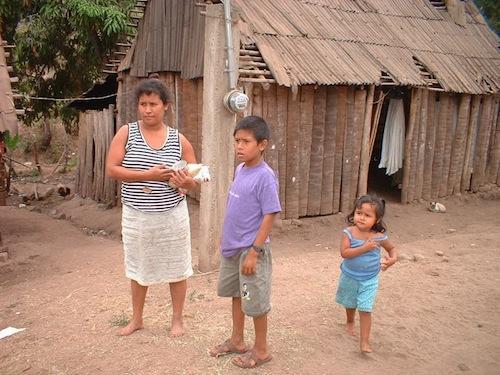
18-They-have-electric-but-are-still-needyThe author and Vicky Flores, who is a nurse at a local hospital and also his partner in the small bed and breakfast, “Mi Casa es Su Casa,” and Jeep trips to the BACK ROADS OF NAYARIT, are going on another discovery trip.

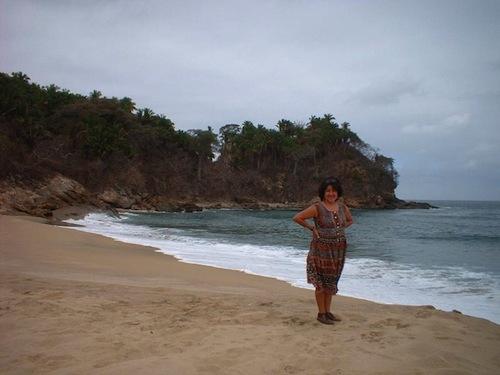
Today we found a true gem. Many years ago a Guadalajara family purchased a parcel of land that included a beach (and what a beach). At that time the family was not so small. There were the grandparents and eight children. No road existed, only a small trail through several miles of jungle. Now a road (rough in spots) goes to the property and there is a sign that prohibits entry. After talking to one of the owners (the family and in-laws now number over 100, although most rarely visit) we were given permission to come in and stay for the day and we could come back any time with a few guests but we had to promise not to disclose the directions on the internet.

So, off we go. It is 10 a.m. and the day is bright and sunny. Our vehicle is a 1985 jeep CJ7. It has only got a little over 18,000 miles on it. I was lucky enough to buy it from a neighbor who seldom used it. One thing I like about it is that there are no computers. If it ever breaks down in a remote area, my mechanic will go there and repair it. Try that with a new jeep.

Editor’s Note: “Back Roads of Nayarit” is a series of essays written by Bob Howell, a long-time resident of Jaltemba Bay. This series details his day trips and adventures between 2001-2007. We are sharing his stories in an effort to preserve Bob’s memory – and to help Bob’s partner and traveling companion, Vicky Flores Ramirez, who still lives in La Peñita and quietly carries on the work that she and Bob so loved. You can learn more below.

Leaving Rincón de Guayabitos, we go along the coastal highway, passing by the many mango groves, planted fields of pineapple, bananas, tobacco, beans, papayas, etc. We pass several villages and finally come to a turn off that we had been meaning to try for several years. The road is dirt and some gravel. It goes through a large canyon, almost a valley. The forest is light at first and then gives way to groves of mangoes, papayas and bananas.
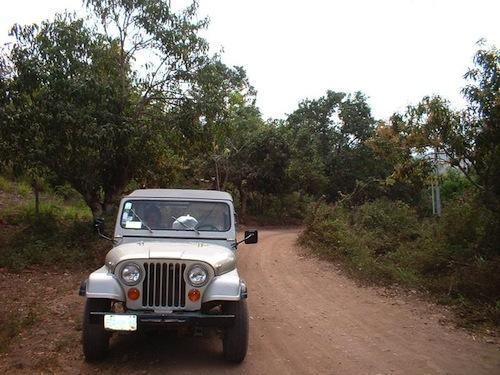
01-We-turn-on-to-a-dirt-road
We turn on to a dirt road: We had been meaning to check out this road for years and now that Vicky is on vacation, we decide it is time.

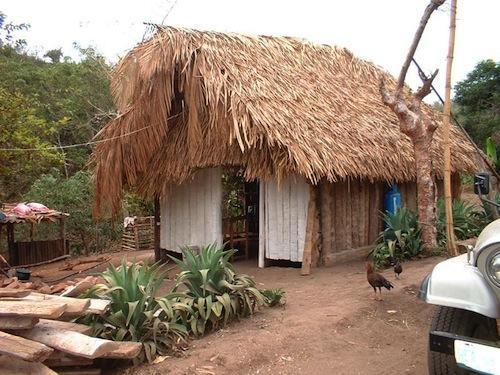
We pass a few scattered homes. These are simply coconut palm slab siding with palapa roofs. It is a poor area. We have food and clothing for them aboard and we will stop on the way out and give out what we have. We see a neat little palapa hut to our right. No siding (this probable means few mosquitoes). A man is asleep in a hammock. What a life. Do we really need our fast pace. Payments, a permanent job, responsibilities, a proper place in society. Maybe we are not so smart. Maybe this fellow is way ahead of us. A couple of hectares. No house payments. He doesn’t need a car. His little garden produces year around. There is always tropical fruit and the sea is near for seafood. Wow! Now I have gotten myself off track. I picture a small jungle hut, a bottle of tequila. The beach nearby. Roberto, what are you doing in front of this computer!

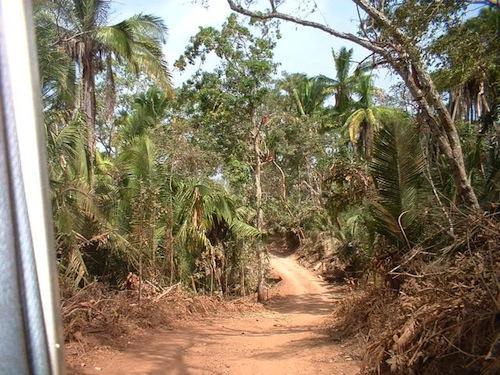
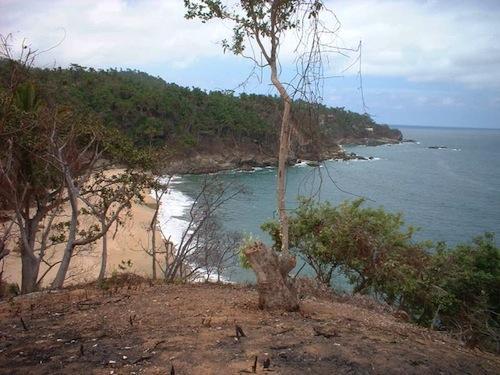
We travel on, passing through hilly country and the green country side. How lucky we are to be doing what we want to do. Soon we top a rise and there in front of us is the blue Pacific. Now we descend through the jungle. The road is getting rougher and very steep. What a place for brake failure. There is much evidence of the hurricane. Many trees are down, yet it is still a jungle.
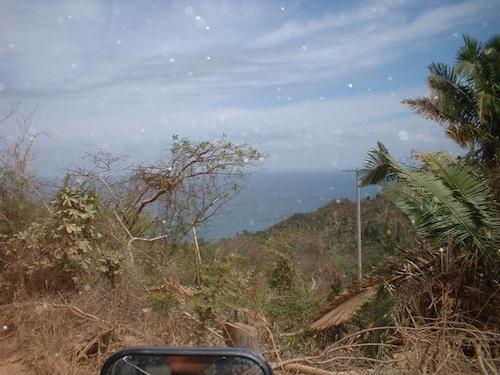
02-There-is-the-blue-pacific
There is the blue pacific: We travel through groves of mangoes, bananas other tropical fruits. We climb hills and go through valleys. At last we see the blue Pacific.

Overhanging palms, the foliage almost closes around us; it is almost like a tunnel. We pass a very small settlement of raised palapas and a few goats.
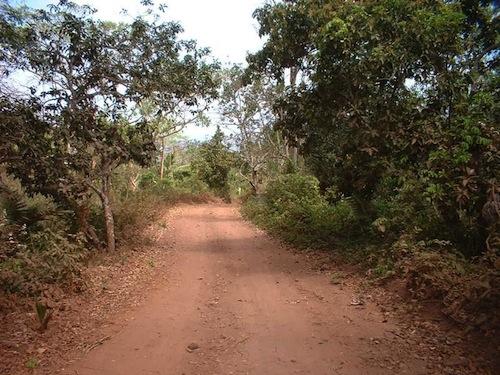
03-Sometimes-the-road-is-like-a-tunnel
Sometimes the road is like a tunnel: The foliage is very green and sometimes shades the whole road.

04-Down-through-the-jungle
Down through the jungle: Not too many tourists travel this road. We see better and worse on our back road trips, but our tourists are never disappointed

05-A-palapa-in-the-jungle
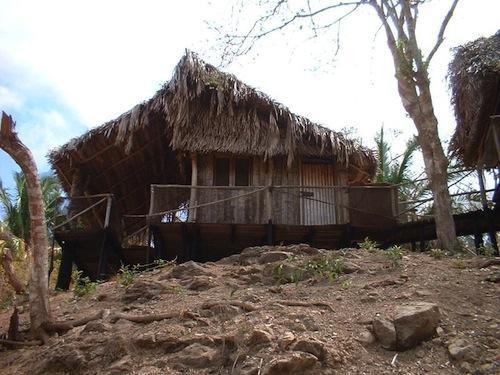
A palapa in the jungle: Here and there we see a small house in the jungle with a palapa (a palm leaf) roof and palm tree slabs for siding. They are cool and can be made comfortable. They all have dirt floors and the occupants have to watch for scorpions and other critters.

There is a well that is giving off water and a road junction going somewhere.

Soon we reach the bottom. What a place. A white beach with many coconut palms. There is a little cove off to the right. It is an old lava flow. It must be loaded with shell fish.
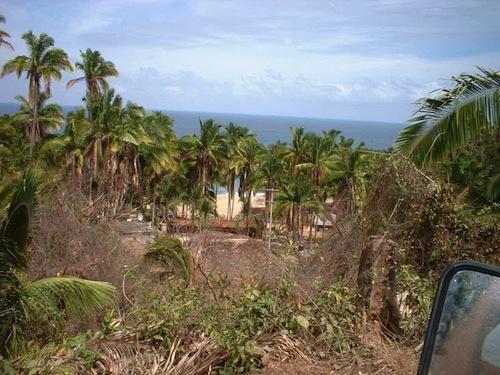
06-There-is-the-beach
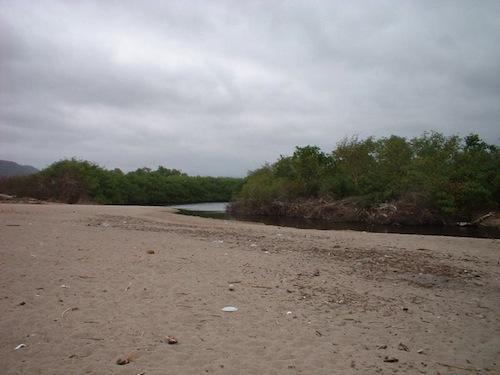
There is the beach?? We have asked a couple of people we saw along the road. They all said the road led to a beach. We can just see it through the palms.

07-Vicky-and-a-family-member
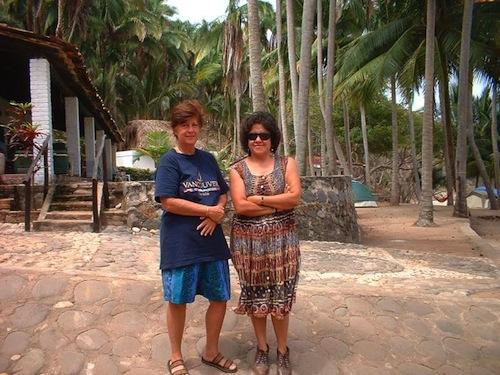
Vicky and a family member: The sign said it was prohibited to enter but this lady said we could, and that we could come back anytime with a couple of guests but she made us promise not to tell where it is on the internet.

08-Nice-beach
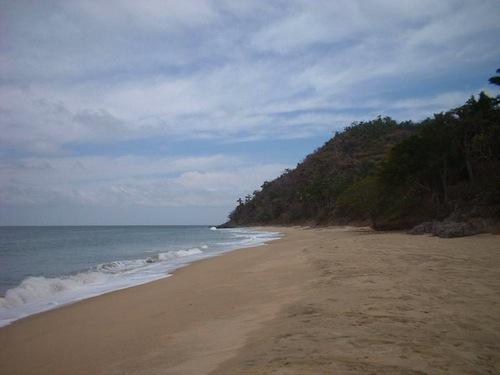
Nice beach: Mild surf and blue water. My kind of beach. A lava flow on either end. Shell fishing must be great.

09-Vicky-checks-out-the-beach
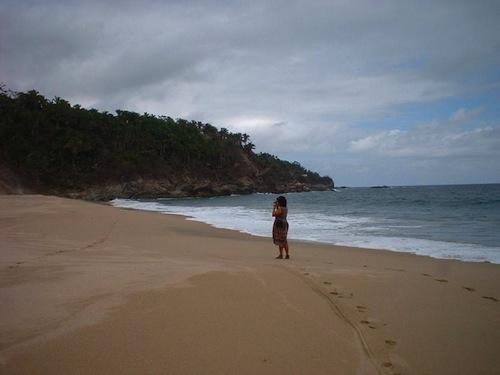
Vicky checks out the beach: This is on the first beach we visited.

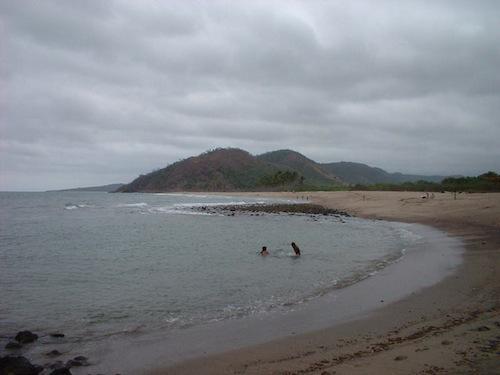
10-A-mild-surf
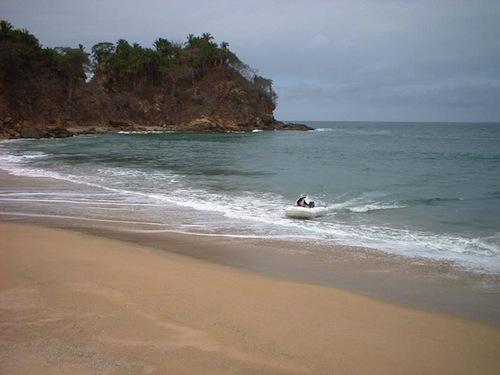
A mild surf: There is a small cove at the end. A good place to swim.

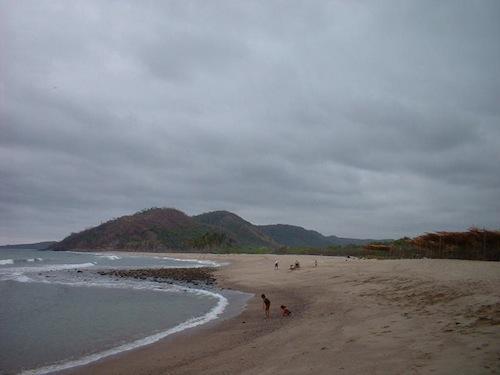
11-The-second-beach
The second beach: We left the first beach and went up through the jungle and over a hill and came to another beach. Almost as nice as the first.

12-Emerald-green-water
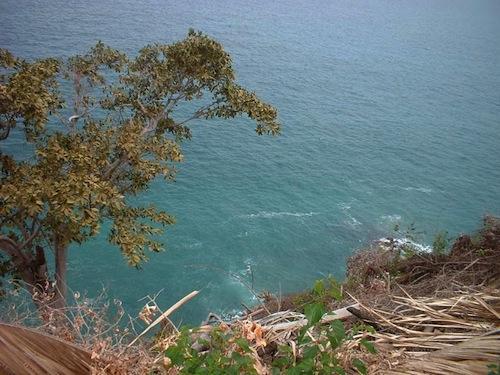
Emerald green water: Looking down between the beaches we see emerald green water and fish.

13-Looking-past-beach-number-2
Looking past beach number 2: You can just see the mountains on the other side of Puerto Vallarta.

There are a few buildings below the coconut trees. Some have well manicured lawns. There is a sign that says private property and no entry without authorization. We park and talk to a lady who is a family member. Vicky chats with her for awhile and she tells us that we can come back for daily visits whenever we want; even bring a few guests but we must promise not to put the location on the internet. A few people o.k., but not a lot. We walk down along the beach and talk to a caretaker. He tells us the swimming is safe and the fishing is good. Returning to the jeep and vowing to return for the day and a picnic, we set off to see what is down that road junction near the well. It is almost noontime.

We travel uphill and through the jungle. The road is narrow and dusty. Soon we top a rise and there is another beautiful cove below us. We park and walk down a steep path. The beach is about a third of a mile long. Easy swimming I would think. Lots of room to sunbath and it is clean. Lava flows on both sides. We snap a few photos and return to the jeep.

On the way we notice a palapa on the hill above us. There is a path so, never ones to pass a new possible area to explore, up we go. On top of the hill, which is actually a cliff above the sea, sits this open sided palapa. There is a very friendly fellow. He has a couple of dogs and chickens. There are two hammocks, although he says he lives alone. What a view. The whole coast can be seen. The air is clear. We can see almost to San Blas in one direction and past Puerto Vallarta in the other. We visit awhile. He tells of his life here. Do I feel a little envious?
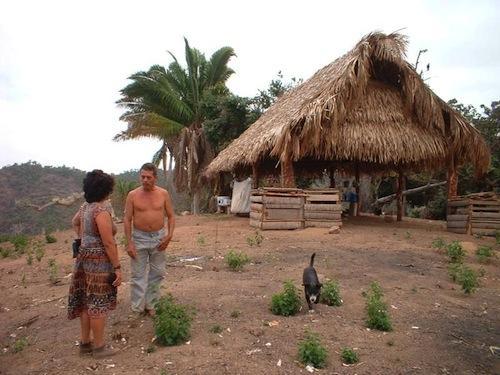
14-A-palapa-overlooking-both-beaches
A palapa overlooking both beaches: This man lives along with his dogs and chickens. He has a view that money can’t buy.

Back to the jeep and we have a tail gate lunch. The usual: Turkey ham and cheese sandwiches with lettuce and tomato. Potato chips, home made pickles, chiles, wine coolers and topped off with our local mountain grown, fresh roasted and ground this morning – coffee. What a bore. Just think, if we were in the frozen north, we could be eating at McDonalds or ? (Are you kidding!)

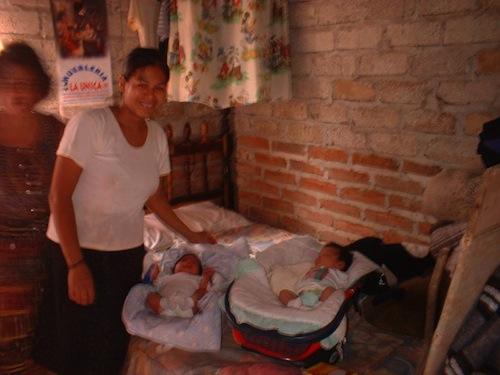
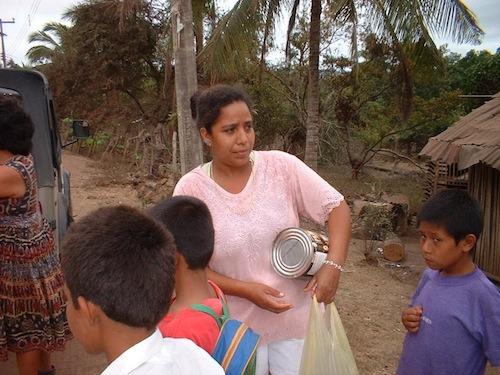
Off we go. The road is steep going up the mountain and I have to put it in 4 wheel drive. No problem getting down with 2 wheel, but don’t plan on returning. We make stops at several very poor palapas, giving out food and clothing. At one palapa we found the mother had just given birth to twins. Beautiful babies. I take photos. I hope they come out because it is dark.
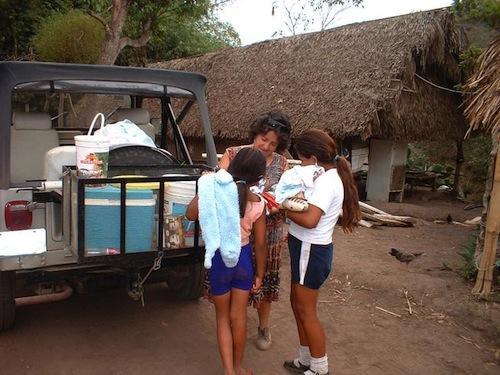
15-Giving-clothing-and-food-to-the-poor
Giving clothing and food to the poor: This mother and her children receive some rice, beans, sugar, canned goods and clothing.

16-Home-is-where-the-heart-is
Home is where the heart is: This home is simple and clean. A family of five lives in one room.

17-New-twins
New twins: We had baby clothes aboard and this lady received those and some food. Six people lived in a two room palapa. / (top photo) They have electric but are still needy: The home still shows signs of the hurricane, but the single room houses the mother and two children.

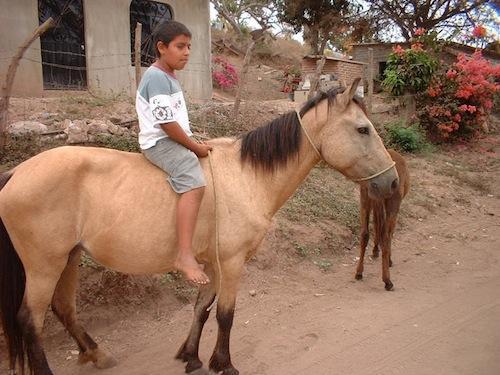
19-A-boy-and-his-horse
A boy and his horse: When I took this photo and then showed it to him you should have seen the surprise on his face.

20-More-help
More help: More smiling faces. We try and explain the English instructions on the cans of food and hope they are remembered.

Then back home we go. We find one other beach but it is not remarkable. A nice swimming hole but a lot of trash and a stopping place for too many people.
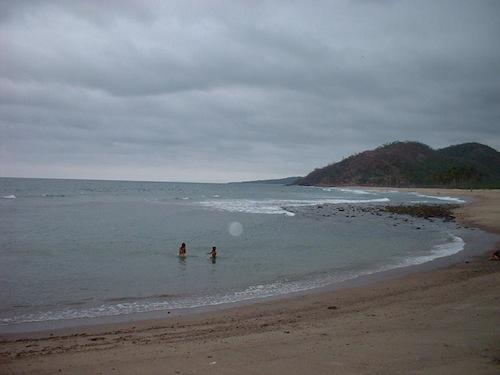
21-Another-beach
Another beach: The sea was beautiful but the beach had lots of trash. This beach will not be on our tourist route.

22-A-long-uninhabited-shoreline
A long uninhabited shoreline: No body lives here. There is a large estuary behind. Another kayak adventure?

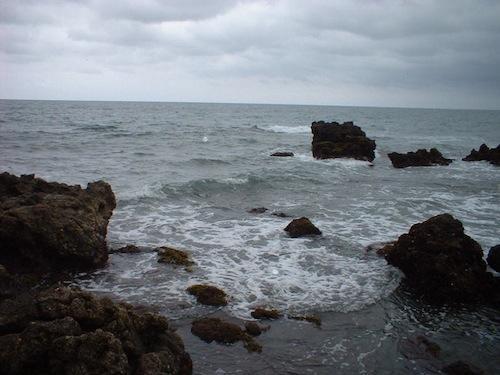
23-An-old-lava-flow-that-ends-in-the-sea1
An old lava flow that ends in the sea: The lava flows are a haven for shell fish and have many tide pools. Neat.

24-A-small-natural-swimming-hole1
A small natural swimming hole: A very safe swimming hole right off of the beach. No wonder this is a popular spot for the locals.

25-The-estuary-starts-here1
The estuary starts here: A good place to start off in a kayak. Many birds, animals and probably crocodiles live here.

We call it a day on the BACK ROADS OF NAYARIT and home we go

[readon1 url="http://jaltembabaylife.com/blog/2014/09/back-roads-of-nayarit-hidden-beaches-and-help-for-the-poor/"]Source:jaltembabaylife.com[/readon1]
Where To Go & What To Do In Guadalajara, Mexico

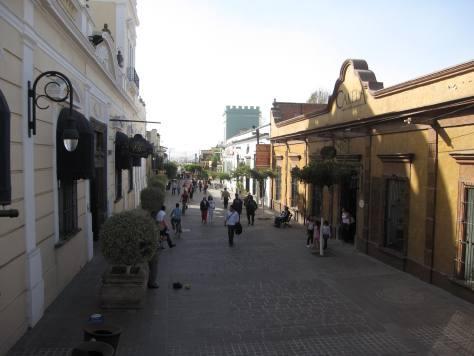
img 6067Let’s be honest, Guadalajara isn’t on your travel bucket list. It certainly wasn’t on mine. But maybe after reading this post, you may consider penciling it in. Do people even use pencils anymore? Here’s the truth. Guadalajara is Mexico’s 2nd largest city. It stands up to the competition quite well. Sure, it has a long-standing arch nemesis (Mexico City), but it plays second fiddle to nobody. It’s classy, sophisticated and takes care of itself just fine. Nicknamed the “Pearl of the West”, Guadalajara is considered a major cultural centre. It has several universities, two culinary institutes and 22 museums. In 2005, it was named an American Capital of Culture. That being said, it’s tough to narrow down what to see and do in a city this influential. But here’s a list of 6 must considers. See – Historic Centre. Not only is this where all the action is with plenty of hustle and bustle, the historic centre of Guadalajara is beautiful, colonial and grand. The main centrepiece is Guadalajara Cathedral. You can’t miss it. Since the mid-16th century, it has been built, destroyed by both fires and earthquakes and rebuilt again. It is the iconic image of the city.
Mexico's Oldest Woman

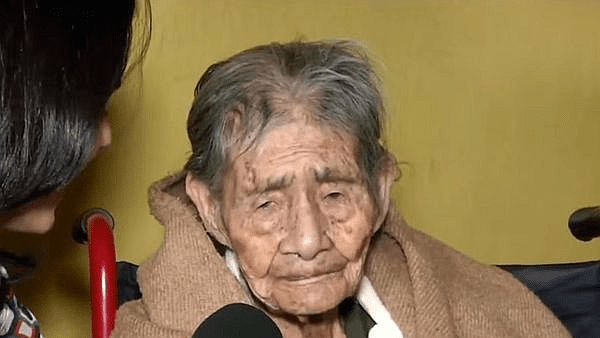
aolderA Mexico woman became the oldest human to have ever lived yesterday when she reached the grand old age of 127, it has been reported. Chocolate-lover Leandra Becerra Lumbreras was born on August 31, 1887 - the year Queen Victoria celebrated her Golden Jubilee. She was 27 when World War II broke out, already a pensioner at 66 when Queen Elizabeth ascended the British throne and 82 when man first set foot on the moon.

And the birthday girl's secret to a long life is eating well, chewing on chocolate, sleeping for days on end, and never getting married, according to her family.

Ms Lumbreras reportedly fought in the 1910-1917 Mexican Revolution as a leader of the 'Adelitas' - women who went with their husbands to the battle front.

The former seamstress, from the western Mexican city of Zapopan, has already buried her five children and several of her 20 grandchildren - the last died in 2013 aged 90. She also has 73 great-grandchildren and 55 great-great-grandchildren.

Grandaughter Miriam Alvear, 43, told Mexico's El Horizonte newspaper that although she is now deaf and suffering from cataracts, Ms Lumbreras still often entertains her family with stories long confined to the history books. They include having to flee their homes and hide in caves to escape being forcibly recruited into the Mexican army.

Her only possessions help her remember years gone by - an old silver spoon made in 1847, a pair of gold earrings, a ring, and an old pocket watch engraved with a steam train.

Alvear said: "She is entirely lucid. She blows your mind with her stories from the revolution. She was always a woman who fought. She was still sewing and weaving until about two years ago. She never ceased to be active, that's why we think she's lived so long."

According to Ms Alvear, she also talks about the three great loves of her life, one of which, Margarito Maldonado, was a famous revoluntionary leader.

When asked about the secret to her long life, another granddaughter, Celia Hernandez, said that she sometimes sleeps for three days on end, but when she's awake likes to eat, talk, and sing lullabies.

Hernandez said: "Her parents were singers. She loves to entertain her grandchildren with the old songs they taught her. She's always had good teeth, even at her old age. She has no diabetes or hypertension so can eat as many chocolates and sweets as she likes."

According to her family, she had told them what she wanted for her birthday party on Sunday was beans with tortillas, even though she isn't allowed solid food on medical advice.

Ms Lumbreras is 12 years older than Japan's Misao Okawa, currently the oldest documented living person in the world, according to Guinness.


Kitchen Advice...How To Choose a Fresh Fish

fresh-fishesLet me share a piece of advice so that you can take home the freshest and healthiest fish or catch of the day, if it turns out to be in season then the quality will be greater.
First, you must observe the fish, the body must be rigid with an arch shape, also, the scales must be all united and shiny but not with a viscous texture, the skin color must be humid, pink or intense red. The eyes also indicate freshness, if they are shiny, transparent and almost out of its structure then it’s a healthy fish, in a fresh fish, the smell must be soft, or it must have the particular smell of ocean water but it must never have an intense or disgusting smell.

If you heed this advice, I guarantee that you will always have on your table a delicious fish, remember that fish is extremely healthy and so we must include it in our diet, plus, it is super versatile to cook, steamed, grilled, baked with garlic, marinated in adobo or with just salt and pepper, its delicious!

San Francisco / San Pancho - Mexico's Riviera Nayarit

SanPancho1The history of San Pancho —as this town is lovingly called— is read on the walls of a compound near the beach; it is shared with images painted in acrylics, with colorful personalities and sprinkled across landscapes of this destination, considered the “cultural capital” of the state of Nayarit, thanks to the numerous initiatives carried out here to promote culture and education.

The first inhabitants of this region, where the Southern Sierra Madre begins, were indigenous tribes pertaining to the Tatuan de Nayares group.

In 1524 Don Francisco Cortés de Buenaventura named the area Azapan, and the Spanish christened the town San Francisco de Azapan and made it a part of the Jaltemba Hacienda, which produced coconut oil.

In 1936, the Sayulita common lands, which San Pancho belongs to, were formed.

This establishment, in a way, created the community spirit that characterizes this destination. And it is precisely the social advocacy of its inhabitants, their work in conjunction with educational projects, environmental issues and the promotion of the arts that has spurred San Pancho’s positive growth and development.

With an intense luminance, the beach of San Pancho welcomes both those in search of rest and relaxation on the ocean shore with the bright sun and a good book, and those with adventurous spirits that defy the waves of the Pacific on their surf boards.

Lining the streets, whose names recall far away places such as Kenya, Pakistan, India and Egypt, you will find cultural centers, galleries, small restaurants, traditional bakeries, diners and even soccer fields and golf courses.

World Tourism Day

World-Tourism-Day-2014-ThemeMany people around celebrate the United Nations’ (UN) World Tourism Day, which is on September 27 each year. The day aims to foster awareness among the international community of the importance of tourism and its social, cultural, political and economic values.

What do people do?
The United Nations’ World Tourism Organization (UNWTO) invites people worldwide to participate in World Tourism Day on September 27 every year. The UNWTO Secretary-General annually sends out a message to the general public to mark the occasion. Many tourism enterprises and organizations, as well as government agencies with a special interest in tourism, celebrate the event with various special events and festivities.

Different types of competitions, such as photo competitions promoting tourism, as well as tourism award presentations in areas such as ecotourism, are held on World Tourism Day. Other activities include free entries, discounts or special offers for the general public to any site of tourism interest. Government and community leaders, as tourism business representatives, may make public announcements or offer special tours or fares to promote both their region and World Tourism Day on or around September 27.

Public life
The World Tourism Day is a UN observance and it is not a public holiday.

Background
Tourism has experienced continued growth and deeper diversification to become one of the fastest growing economic sectors in the world. ‎Modern tourism is closely linked to development and includes more new destinations for tourists. These dynamics turned tourism into a key driver for socio-‎economic progress.‎ Tourism has become one of the major players in ‎international commerce, and represents at the same time one of the main income ‎sources for many developing countries.

The UNWTO decided in late September 1979 to institute World Tourism Day, which was first celebrated on September 27, 1980. September 27 was chosen as the date for World Tourism Day because that date coincided with an important milestone in world tourism: the anniversary of the adoption of the UNWTO Statutes on September 27, 1970.

The UNWTO believes that the date for World Tourism Day is appropriate because it comes at the end of the high tourist season in the northern hemisphere and the start of the tourist season in the southern hemisphere, when tourism is of topical interest to many people worldwide, particularly travelers and those working in the tourism sector. Each year has a different theme – for example, “Tourism – Celebrating Diversity” was designated as the theme for 2009, with Ghana as the event’s host country for that year.


Vaccines to Prevent Hepatitis A

immunization smallThe best way to prevent hepatitis A is through vaccination with the hepatitis A vaccine. Vaccination is recommended for all children age 12 months and older, for travelers to certain countries, and for people at high risk for infection with the virus.
The hepatitis A vaccine is given as two shots, six months apart. The hepatitis A vaccine also comes in a combination form, containing both hepatitis A and B vaccine, that can be given to persons 18 years of age and older. This form is given as three shots, over a period of six months or as three shots over one month and a booster shot at 12 months.

FOR CHILDREN
The first dose should be given at 12-23 months of age. Children who are not vaccinated by two years of age can be vaccinated at later visits.

FOR TRAVELERS
The first dose of hepatitis A vaccine is recommended for healthy international travelers younger than 40 years of age at any time before departure. A shot called immune globulin (IG) can be considered in addition to hepatitis A vaccine for older adults, immunocompromised persons, and persons with chronic liver disease or other chronic medical conditions who are traveling within two weeks.

IG without hepatitis A vaccine can be given to travelers who are younger than 12 months of age, allergic to a vaccine component, or who elect not to receive vaccine.

FOR OTHERS
The hepatitis A vaccine series may be started whenever a person is at risk of infection:

  • Men who have sexual contact with other men
  • Users of certain illegal drugs, both injection and non-injection
  • Family and caregivers before arrival of international adoptees
  • People with chronic (lifelong) liver diseases, such as hepatitis B or hepatitis C
  • People who are treated with clotting-factor concentrates
  • People who work with hepatitis A infected animals or in a hepatitis A research laboratory
  • SOME PEOPLE SHOULD NOT BE VACCINATED OR SHOULD WAIT TO GET VACCINATED
  • Anyone who has ever had a severe (life threatening) allergic reaction to a previous dose
    of hepatitis A vaccine should not get another dose.
  • Anyone who has a severe (life threatening)
    allergy to any vaccine component should not get the vaccine.
    Tell your doctor if you have any severe allergies. All hepatitis A vaccines contain alum and some hepatitis A
    vaccines contain 2-phenoxyethanol.
  • Anyone who is moderately or severely ill at the time the shot is scheduled should probably wait until they recover.
    Ask your doctor or nurse. People with a mild illness can usually get the vaccine.
  • Tell your doctor if you are pregnant. The safety of hepatitis A vaccine for pregnant women has not been determined.
    But there is no evidence that it is harmful to either pregnant women or their unborn babies.
    The risk, if any, is thought to be very low.

What is hepatitis A?

Hepatitis A is a viral disease that is common in developing countries and is generally associated with poor sanitation and poor hygiene. It is one of the most common vaccine-preventable illnesses in travellers.

What is my risk?
Your risk depends on several factors: destination, length of trip, and your living conditions.

The risk of hepatitis A is highest among travellers:

  • Visiting or living in rural areas
  • Eating and drinking in locations with poor sanitation or unsafe food handling practices
  • The risk of hepatitis A exists even for travellers going for short periods of time to urban areas, staying in luxury hotels and who follow good hygiene and water and food precautions.

 How is it transmitted?

The hepatitis A virus is found in the stool (feces) of an infected person.

It can be spread through contaminated food and water or through close contact with an infected person.

Certain uncooked foods such as shellfish, fruits or salads can be contaminated, as well as foods that are prepared in unsanitary conditions or by an infected person with unsafe food handling practices.

It can also be transmitted through close personal contact when poor hygiene is practised: in day cares, households, schools, etc.less commonly, through sexual contact. Infection with the virus gives lifelong immunity (protection) against the virus.

What are the symptoms?
Symptoms can take from 15 to 50 days to appear (average 28 days).

Some people who are infected have no symptoms, others may have only mild symptoms that last from 1 to 2 weeks and some may experience more severe symptoms that can last several months.

In children, symptoms are mild to non-existent. Severity of the illness increases with age.

Symptoms can include fever, fatigue, loss of appetite, nausea and vomiting, abdominal discomfort, dark urine and grey-colored stool, jaundice (yellowing of skin and whites of eyes).

In severe and rare occasions, symptoms can include liver damage, liver failure, or death. Individuals with pre-existing chronic liver disease and older people are most at risk for this.

Recovery generally takes a few weeks, but can take months. Most people recover without side effects and have lifelong immunity against hepatitis A.

Can hepatitis A be treated?
There is no treatment for hepatitis A, only supportive care to help relieve symptoms.

Where is hepatitis A a concern?
Hepatitis A occurs worldwide but is more common in regions with poor sanitation and lack of safe food and water.

Regions where there is a high risk of hepatitis A transmission include Africa, Asia and Central and South America.

A map of countries and areas of risk for hepatitis A is available on the World Health Organization (WHO) website.

Recommendations
Consult a health care provider or visit a travel health clinic preferably six weeks before you travel.

  1.  Practise safe food and water precautions

  2.  Wash your hands frequently
    Wash your hands with soap under warm running water for at least 20 seconds,
    as often as possible, including before eating or preparing food and after using the bathroom or changing diapers. 
    Use alcohol-based hand sanitizer if soap and water are not available.
    It’s a good idea to always keep some with you when you travel.

  3. Get vaccinated if you are at risk but are not immunized
    (either through previous vaccination or previous hepatitis A infection)
    Discuss the benefits of getting vaccinated with a health care provider before travelling if you are: 
    travelling to countries where hepatitis A occurs. visiting areas where drinking water
    may be unsafe and poor sanitation and hygiene conditions exist.

  4. Monitor your health If you develop symptoms similar to hepatitis A
    when you are travelling or after you return, see a health care provider
    and tell them where you have been travelling or living.

DIF Jalisco opened the day of Geronto-geriatric

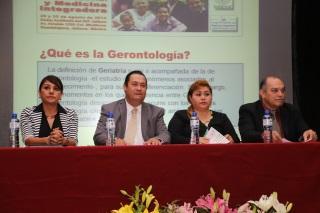
2014-08-29 Fotonota DIF 01Within the framework of the month of the most adult and their families, the system for the development Integral of the family (DIF) Jalisco, in coordination with the Institute of Natural Medicine of the West, BC, opened the day of Geronto - geriatrics and integrative medicine, with the aim of presenting advances in medicine, psychology, nutrition and alternative therapeutic resources focused on the people of the third age.

"Crisis in the rights of older adults", "Hepatic detoxification importance" and "The process of aging" are some of the topics that will be presented, as well as workshops in physical rehabilitation, reflexology and kinesiology applied, among others.

On the day that takes place this August 29 and 30 in Auditorium Fray Antonio Alcalde, located at the headquarters of the DIF, participating doctors, nutritionists, psychologists and staff dedicated to the areas of health, therapists, and older adults.


dif


Retiring In The Riviera Nayarit, The Perfect Choice

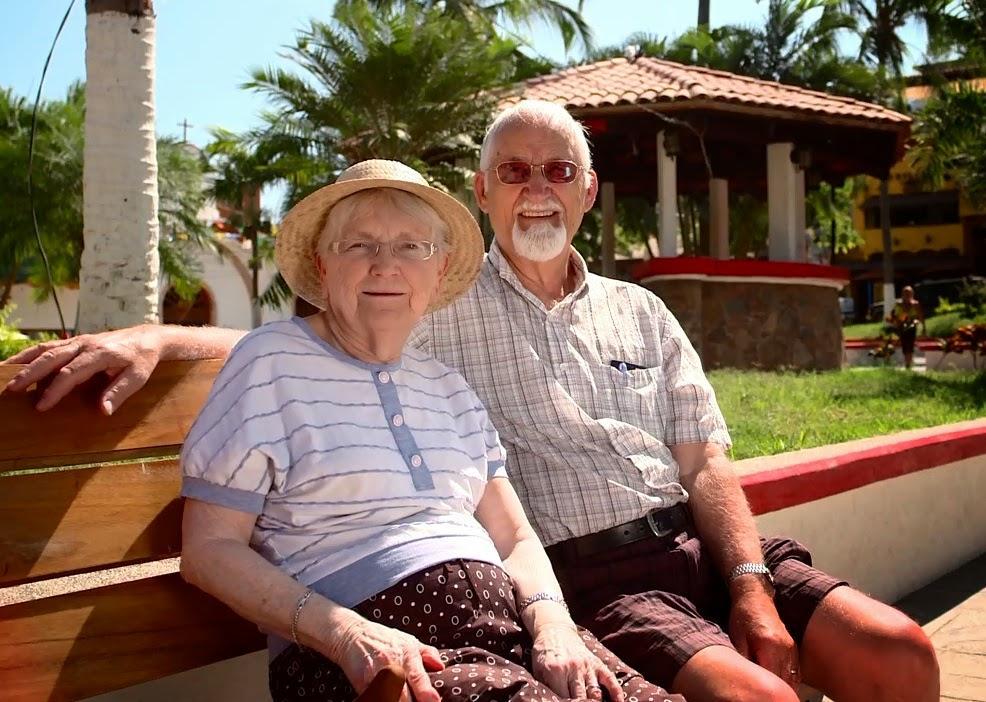
Sayulita4Baby Boomers are retiring in record numbers and many of them are still fit, strong and ready to enjoy their life tempered with the wisdom of experience. The Riviera Nayarit is an ideal choice for retirees, especially for those looking for a change of scenery and a move to a warmer climate.
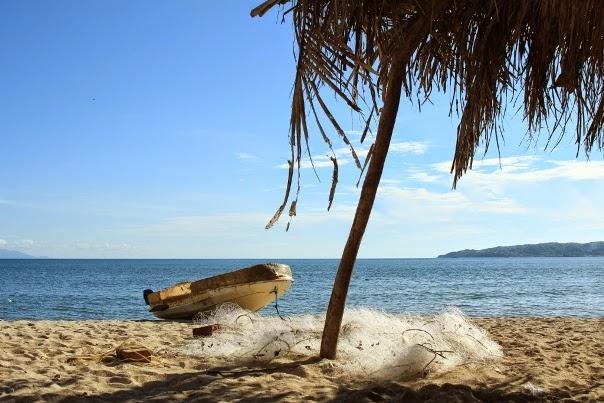
The average yearly temperature hovers around 77˚ Fahrenheit with a water temperature between 72˚ and 77˚ Fahrenheit—the refreshing water and warm climate are perfect for swimming year round. The Riviera Nayarit shares the Puerto Vallarta International Airport with its sister city in the State of Jalisco, so air connectivity is excellent with most major hubs.

  • Among the many services at your disposal, should you become a resident or choose to vacation here, are:

    • Modern shopping centers with imported and domestic products
    • Excellent public transportation in well-maintained vehicles in the area of Nuevo Vallarta and Flamingos
    • Top-notch hospitals in Puerto Vallarta
    • Wellness and yoga centers
    • Dentists
    • Marinas and yacht clubs
    • Casino
    • Canadian and American consulates
    • Variety of green common areas

For more information on the necessary legal documents and more please visit our page:

Riviera Nayarit Legal Documets

The Riviera Nayarit is perfect, not only because of the abovementioned points, but also because its coastline extends over 200 miles and is dotted with a variety of micro destinations—23 to be exact—each of them unique, beachfront and filled with local citizens just waiting to meet you. You’ll be sure to make friends who will end up inviting you into their homes or helping you to learn the language. Of course, there are also language schools for foreigners, should you choose to be a bit more formal about it.

And while retirement can be all about relaxing, you can also integrate a bit of learning, whether you’re interested in the local gastronomy, our culture, traditions, art or folklore. There are several associations in the area where you can become a member or a student. You can also participate in community programs for those with special needs or to help in children’s homes or animal shelters. There are painting and sculpture workshops, even classes on how to recycle materials for reuse at home!

There’s so much to enjoy in the Riviera Nayarit, with its excellent climate, pristine beaches, gorgeous sunsets and verdant nature; and, of course, the warmth of its people! Here you’ll be able to make your mark in the community by collaborating with the local citizens and sharing what you know and love. In return, we’ll teach you all the reasons why you decided to choose the Riviera Nayarit in Mexico for your new home. We’re waiting with open arms: Our casa es su casa!


Basic Information you Should Know About The Riviera Nayarit

IMG 0203For some, the Riviera Nayarit is not that well known, while others might not even know where it’s located! To help clear things up, here’s some basic details everyone should know about this incredible, youthful Riviera.
                                                                                                                                         

  1. You can fly into the Riviera Nayarit via the Puerto Vallarta International Airport, but you can also arrive via the Tepic International Airport.
  2. The Riviera Nayarit is made up of 23 micro destinations, each one with its own personality, identity and traditions.
  3. It has six better-known “anchor” micro destinations, including Nuevo Vallarta, located in the state of Nayarit and only 10 minutes away from the Puerto Vallarta International Airport; La Cruz de Huanacaxtle, Punta Mita, Sayulita, San Francisco and San Blas.
  4. The Marietas Islands are in the State of Nayarit and they are a Protected Area categorized as a National Park since 2005 and declared a UNESCO Biosphere Reserve in 2008.
  5. Isabel Island is also a National Park and Protected Natural Area managed by the Universidad Autónoma de México and the National Institute of Ecology.
  6. The Island of Mexcaltitán is known as the Birthplace of Mexican Heritage.
  7. The Bay of Banderas is the largest in the world, and is shared by Puerto Vallarta in the state of Jalisco, as well as the coastline of the entire Riviera Nayarit, which extends through the municipalities of Bahía de Banderas, Compostela, San Blas, Santiago and Tecuala.
  8. The area of San Blas boasts the largest diversity of birds in the country, some endemic and others migratory.
  9. The only green surrounded by the ocean in the entire world can be found at the Punta Mita Pacífico Golf Club.
  10. The destination is a favorite of domestic and international celebrities.
  11. It’s one of the few destinations in Mexico where the sailing is top-notch thanks to its amazing winds during between the months of March and June.
  12. Very distinguished guests come to visit during the wintertime, including the humpback whale and the whale shark.
  13. This destination holds the most events throughout the year, ranging culinary happenings to sports, music festivals, fishing and golf tournaments, and much more.
  14. There are also a great many activities to do in the destination, including scuba diving, fishing, golf, zip-lining, surfing, ATVs and many others.
  15. This is just a taste of what you can do at the Riviera Nayarit—come, visit and discover for yourself why this destination is at the top of its game, no matter what you play.

Find us on the map at: Riviera Nayarit Map

Don’t forget to follow us on our social media accounts! If you enjoyed this newsletter, please share with your friends and colleagues. Thank you!


Pasos Adelante - Puerto Vallarta

 padePasos Adelante has a unique and highly qualified group of professionals ready to support you and your family.

Our team is equipped to provide dynamic neuro psychological - psycho educational evaluations, which assist in the development of therapeutic treatment plans, implement intervention programs, visit school and homes.

Services are available for individuals from birth to adults and in both English and Spanish.

We provide training to schools, families and professionals on how to work with individuals in the following areas:


• Autism
• PDD - Pervasive Developmental Disorder
• Traumatic - Acquired Brain Injury
• Aspergers
• Attention Deficit - Hyperactive Disorder
• Specific Learning Disabilities
• Speech and Language Impairments
• Epilepsy
• Early Stimulation - Developmental Delays
• Behavior - Emotional Problems
• Critical Thinking

Get in contact!

6 Spanish Words That Are Out To Embarazarte

 embarrassed-woman-0226-main 1Uh, that doesn’t mean what you think it means.

If you’re feeling insecure in your English to Spanish translating abilities, you’re not alone. Especially because there are some Spanish words that are trying to fool you. You know, the ones that look similar to English words but don't mean the same things. These are known as "false friends," and they are probably the reason your abuelita has given you some serious side-eye in the past. Here are some Spanish words you may have used incorrectly in the past:

1. Embarrass - Embarazada

Once, I told my Mom that my 6-year-old cousin was embarazada, and she promptly (and rightfully) burst out in laughter. I ended up telling her that her niece was feeling pregnant, which is not even close to what I meant. Talk about embarrassing.

2. Deception - Decepción

This tricky Spanish word does not mean to deceive someone. But it may be what happens as a result of your deception: disappointment. The correct translation is actually engañar.

3. Stretch - Estrecho

These two very similar looking words may as well be antonyms. Estrecho means narrow. So all those times you meant to say stretching out, you should have been using estirando.

4. Exit - Éxito

And this is why just adding a vowel to the end of an English word doesn’t work. Éxito’s English counterpart is success, and if you need more convincing, just watch any novela where the villain talks about how well his or her evil plans are going. Use salida if you mean exit.

5. Excited - Excitada

They look so similar, but one has a much sexier connotation. You think you’re telling someone you’re so excited a la Jessie Spano, but what you’re really saying is, well, horny. Better stick to emocionada/o.

6. Tuna - Tuna

This one is completely unfair. They are written exactly the same way and are even pronounced almost identically, but in Spanish tuna is an edible prickly pear cactus. If you’re looking for seafood, ask for atún.

[readon1 url="http://www.latina.com/lifestyle/spanish-words-using-wrong"]Source:www.latina.com[/readon1]