Canadians to cut the lights for Earth Hour

canadaluz 
A woman takes photographs along the Stanley Park seawall after
many downtown buildings turned their lights off during Earth Hour
in Vancouver, B.C., on Saturday March 31, 2012.
 

TORONTO - Canadians will be joining millions of others around the globe to mark Earth Hour this evening.

The World Wildlife Fund, the driving force behind Earth Hour, says 13-million Canadians turned off their lights for an hour last year in the symbolic event aimed at drawing awareness to climate change.

It's unclear how many Canadians will join the seventh edition of Earth Hour.

However, Earth Hour is embraced by hundreds of Canadian municipalities and many utilities have Earth Hour sections posted on their websites.

B.C. Hydro, for example, has a way for many of its customers to compare their electricity use during Earth Hour with their normal power usage.

Steven Price, a conservation director with the World Wildlife Fund, says municipalities are a driving force behind Earth Hour.

How a Registered Nurse Finally Found Relief for Her Joints

relieves  relieves1 

A re you suffering from poor joint support? Do your knees, hips, elbows, and hands cry out in discomfort? How often do your joints slow you down or stop you dead in your tracks?

Elaine Simmons from Massachusetts recently faced a major problem…severe discomfort in her left knee. A registered nurse for 40 years—and a serious tap dancer in her spare time—Elaine wasn't ready to slow down.

Elaine wanted to keep enjoying her important work with patients and continue to enjoy her favorite hobby.

To keep moving and enjoying her life, Elaine needed a solution…and FAST…fortunately she found a solution and you can discover more about it in a minute.

If you're like Elaine, then you know about poor joint support. Do your knees, hips, elbows, and hands cry out in discomfort? Problematic joints can slow you down or stop you dead in your tracks.

Every movement your body makes puts pressure on your joints. Over time this wear and tear can lead to discomfort and sometimes more serious mobility issues. Your joints age over time. And like the brakes in your car, joints need regular maintenance. Just like the other parts of the body, joints require the correct nutrition or 'fuel' to perform at their best.

But there's another problem that people with joint discomfort face…the market is flooded with gimmicky solutions and failed joint products. Cheap Glucosamine capsules, cut-rate Chondroitin products, and sometimes a dozen versions of the same brand. The joint market is confusing, mystifying, and for millions of people it just doesn't work.

That's why a team of nutritional developers in Cambridge, MA worked for years to create a single, complete joint solution. A product that works fast, is easy to use, and actually comforts your joints. A product created for people like Elaine who want to keep moving!

After a substantial investment of time and resources, the nutritional developers finally released a compound that actually delivers as promised. The new proprietary compound is trademarked as "Instaflex Joint Support" and offers stunning results. Fortunately, Elaine is one of the tens of thousands of people who have discovered Instaflex.

Instaflex is so effective because of a simple, but ingenious idea. Instead of tearing a product apart so a company can sell several versions of the same brand, why not create one perfectly balanced compound? No men's version, no women's version, no sports version, no adult version, no quick version, or any other knockoff versions. Just one version that actually works.

Instaflex was designed from the start to be an all-encompassing joint solution. The compound combines a wide array of carefully selected all-natural ingredients into a single once-daily dosage.

  1.     Relieve and comfort your joints
  2.     Improve mobility and increase flexibility
  3.     Lubricate for healthy fluid movement
  4.     Protect and enhance your mobility

Plus your purchase benefits the Arthritis Foundation.

There are lots of cheap joint products on the market but very few premium joint brands. Many joint companies nickel and dime you. They keep throwing out different versions of the same low-grade product. So it's understandable that joint companies were skeptical when Instaflex launched a single high-end joint product. They didn't believe people would buy a first-class joint product.

Instaflex proved them wrong. When GNC stores, the nation's largest specialty vitamin retailer, secured the exclusive retail rights to Instaflex's US launch in the summer of 2010, Instaflex had never sold a bottle in stores. In less than ten months, Instaflex became the number one selling joint product in GNC stores nationwide. Instaflex outsells not just every third-party joint product, but even GNC's own in-house brands. Over a million bottles of Instaflex have been sold globally.

The proprietary Instaflex compound includes proven joint ingredients such as Glucosamine and Turmeric Root, but it's the fast-acting White Willow Bark Extract, Hyaluronic Acid, and Boswellia Serrata Extract that provide the biggest kick. Instaflex's compound comes in three pills that are taken once daily in the mornings or evenings. Instaflex works to comfort, relieve, and support your joint function. Take Instaflex to relieve your joints now, then long-term to support your joint function.

Elaine heard about Instaflex and requested the trial sample. She saw dramatic relief and the results she was searching for. Now she's back to helping people and back to tap dancing at full speed…

…All with the help of Instaflex. It's one of the best investments she's made in her ongoing health and well-being.

Now two years after its launch, Instaflex is still the number one selling joint product in US GNC stores, and available in thousands of additional stores including Rite Aid Pharmacies and Vitamin World. Last year Instaflex became available around the world from Canada to Turkey. Instaflex is the top selling joint support product in Canadian GNC stores. Samples are available online to try right now. The samples arrive just a few days after ordering and include a full 14-day supply.

If you're suffering with joint discomfort, then try Instaflex today, and feel the benefits in person—just like Elaine, the nurse from Massachusetts. You can find Instaflex in GNC, Rite Aid, and Vitamin World stores.

Alberta hospitals remove hand-sanitizer bottles after man's 2010 death

hospitalremove 
A news reporter holds a bottle of hand sanitizer at a news
conference,in this 2009 file photo
 

CALGARY -- The death of a man in an RCMP cell in southern Alberta has changed the way hand sanitizer is provided in hospitals.

Mounties took a drunken Kurt Kraus to the Vulcan Hospital in May 2010 and a doctor determined it was safe for him to be taken to a cell in nearby Gleichen to sober up.

A nurse had suspected the chronic alcoholic had ingested some hand sanitizer while at the hospital, but no one knew he had also swallowed 10 anti-depressant pills.

Within minutes of being placed in the cell, the 46-year-old stopped breathing.

A fatality inquiry in Calgary heard the man's death was caused by the combination of drugs and alcohol -- his blood alcohol level was more than four times the legal driving limit.

A judge made no recommendations, but noted that hospitals have since removed all portable bottles of hand sanitizer and replaced them with wall-mounted dispensers in public areas


[readon1 url="http://www.ctvnews.ca/canada/alberta-hospitals-remove-hand-sanitizer-bottles-after-man-s-2010-death-1.1200448"]Source:www.ctvnews.ca[/readon1]

Canada-U.S. ties would suffer if Keystone rejected, Alberta premier says

canada-usa 
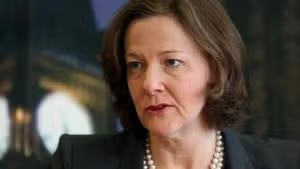
Alison Redford: Alberta's Premier Minister

OTTAWA -- Alberta's premier says a U.S. rejection of the Keystone XL pipeline proposal would undermine the Canada-U.S. relationship.

In an interview with The Canadian Press, Alison Redford says Canada and the United States have a long history of economic integration that would be fundamentally challenged by a 'No' to the pipeline.

She says turning the pipeline down would signal that the United States no longer has faith in Canada as a trusted trading partner that has common cause with Americans. But Redford doesn't think it will come to that.

She  thinks the Obama administration will approve the pipeline eventually, and both countries will soon look back on the contentious debate as a time for honest discussion about how best to expand the North American economy.

She says Alberta is raising its bar for environmental performance, and is re-orienting its economy to focus not just on oilsands but also on sustainable energy.


[readon1 url="http://www.ctvnews.ca/canada/canada-u-s-ties-would-suffer-if-keystone-rejected-alberta-premier-says-1.1200300"]Source:www.ctvnews.ca[/readon1]

5 things to know about the new pope

5pope 
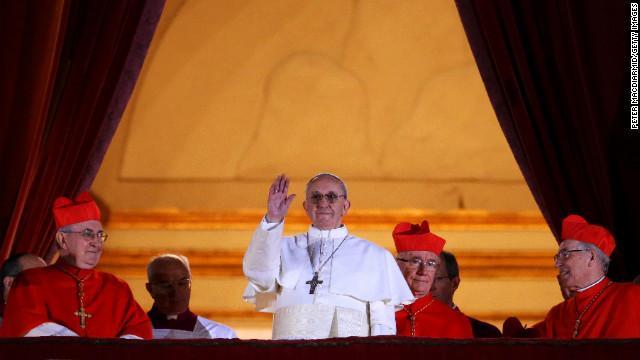
Argentinian Cardinal Jorge Mario Bergoglio was elected as the first
pontiff from Latin America and will lead the world's 1.2 billion Catholics

(CNN) -- From the Vatican to Buenos Aires, Catholics worldwide rejoiced when Cardinal Jorge Bergoglio became the new pope.

He's the first Jesuit and the first Latin American in modern times to lead the world's 1.2 billion Catholics.

But in some ways, he's just a normal guy.

Here are five things to know about Pope Francis:

1. His name says a lot about him

Unlike other recent pontiffs -- John Paul II, Benedict XVI -- Pope Francis doesn't have a numeral after his name. That's because he's the first to take the name Francis.

Why Francis?

The pope wanted to honor St. Francis of Assisi, an admirer of nature and a servant to the poor and destitute.

St. Francis of Assisi was born the son of a rich cloth merchant. But he lived in rags among beggars at St. Peter's Basilica in Rome.

Talk Back: What kind of spiritual leader will draw people back to organized religion?

Those close to Pope Francis see similarities between the two men.

"Francis of Assisi is ... someone who turned his back on the wealth of his family and the lifestyle he had, and bonded with lepers and the poor," said the Rev. Thomas Rosica, the Vatican's deputy spokesman. "Here's this pope known for his care for AIDS patients and people who are very sick. Who is known for his concern with single mothers whose babies were refused to be baptized by priests in his diocese.

"He scolded those priests last year and said, 'How can you turn these people away when they belong to us? '"

Pope Francis, the pontiff of firsts, breaks with tradition

2. He's not actually the first pope from outside Europe

Sure, Francis is the first non-European pope in modern times. But back in the 8th century, a Syrian -- Pope St. Gregory III -- led the church from 731 to 741 A.D.

We've also had popes from Bethlehem (St. Evaristus, from 97 to 105 A.D.), Jerusalem (Pope Theodore I, from 642 to 649) and modern-day Libya (Saint Victor I, from 189 to 199). Several other Syrians have also been pontiff in the last few millennia.

Of course, the majority of popes have been Italian. But with Francis' appointment, the tide could be shifting to outside Europe.

First Latin American pope 'very exciting,' faithful say

3. He's a pope of the people

In some ways, Pope Francis is just a normal guy.

"The new pope is a very humble man," said the Rev. Eduardo Mangiarotti, an Argentine priest. "He takes public transport every day."

He also chose to live in an apartment instead of the archbishop's palace, passed on a chauffeured limousine and cooked his own meals, CNN Vatican analyst John Allen wrote in a profile published by National Catholic Reporter.

In his first public act as pontiff, Pope Francis broke with tradition by asking the estimated 150,000 people packed into St. Peter's Square to pray for him, rather than him blessing the crowd first.

"He is a very simple man," said Luis R. Zarama, auxiliary bishop of Atlanta. "It's very clear from the way he approached the people and asked them to bless him and pray for him. It's a beautiful sign of closeness and humility."

The pontiff broke with another tradition by refusing to use a platform to elevate himself above the cardinals standing with him as he was introduced to the world as Pope Francis.

"He said I'll stay down here," said Cardinal Timothy Dolan, archbishop of New York and the president of the U.S. Conference of Catholic Bishops. "He met each of us on our own level."

From public transport to popemobile: Bergoglio's journey

4. He comes with a side of controversy

Francis opposes same-sex marriage and abortion, which isn't surprising as leader of the socially conservative Catholic church.

But as a cardinal, Francis clashed with the government of Argentine President Cristina Fernandez de Kirchner over his opposition to gay marriage and free distribution of contraceptives.

His career as a priest in Argentina coincided with the so-called Dirty War -- and some say the church didn't do enough to confront the military dictatorship.

As many as 30,000 people died or disappeared during the seven-year period that began with a coup in 1976.

Francis, in particular, was accused in a complaint of complicity in the 1976 kidnapping of two liberal Jesuit priests, Allen wrote. Francis denied the charge.

"The best evidence that I know of that this was all a lie and a series of salacious attacks was that Amnesty International who investigated that said that was all untrue," said Jim Nicholson, former U.S. Ambassador to the Holy See. "These were unfair accusations of this fine priest."

But Amnesty International said it did not investigate any individual for their specific involvement.

"Our research focused on the plight of the disappeared," said Susanna Flood, media director for Amnesty International.

Opinion: Francis, open up the church

5. He faces a host of challenges ahead

Francis takes the helm of a church that has been rocked in recent years by sex abuse by priests and claims of corruption and infighting among the church hierarchy.

He may need to find a way to draw new Catholics into the church where it is in decline, said Phillip M. Thompson, executive director of the Aquinas Center of Theology at Emory University.

And he'll also need to find ways of working with shifting viewpoints among Catholics. In the United States, for example, 90% of Catholics are using contraception and 82% think it is morally permissible.

"The church has conservative positions on human sexuality, bioethics, etc., but liberal positions on issues such as economic regulation, the death penalty and immigration," Thompson said. "A church divided against itself seems unlikely to renew our political or cultural structures."


[readon1 url="http://www.cnn.com/2013/03/14/world/pope-5-things/index.html?iid=article_sidebar"]Source:www.cnn.com[/readon1]


Argentina's Bergoglio named pope

 nuevopapa

Bergoglio is the first pope from outside of Europe in the modern era,
and the third straight non-Italian pope.

Bergoglio, the new pope, has chosen the name Francis, according to Vatican Radio. He's now appearing on the balcony.

Rome (CNN) -- Jorge Bergogolio, the archbishop of Buenos Aires, was elected pope on Wednesday, the first pontiff from Latin America to lead the world's 1.2 billion Catholics.

Bergogolio, who will be known as Pope Francis, was elected by cardinals in what was apparently their fifth round of voting on the second day of their conclave.

Dressed in white papal vestments, Bergogolio first appeared to the world from the balcony of St. Peter's Basilica.

"As you know, the duty of the conclave was to appoint a bishop of Rome," he told a cheering crowd of thousands packed into St. Peter's Square.

"It seems to me that my brother cardinals have chosed one who is from faraway. ... Here I am. I would like to thank you for your embrace."

Until last year, Bergoglio was the archbishop of Buenos Aires before stepping down because of his age. He is 76.

Bergoglio is considered a straight-shooter who calls things as he sees them, and a follower of the church's most conservative wing.

He has clashed with the government of President Cristina Fernandez de Kirchner over his opposition to gay marriage and free distribution of contraceptives.

[readon1 url="http://www.cnn.com/2013/03/13/world/europe/vatican-pope-selection/index.html"]Source:/www.cnn.com[/readon1]

NASA: Yes, Mars could have hosted lif

nasaCuriosity, humanity's most powerful rover  to land on Mars, has made a startling discovery: Conditions that could have supported life once existed there.

"We have found a habitable environment that is so benign, and supportive of life, that probably if this water was around and you had been on the planet, you would have been able to drink it," John Grotzinger, Curiosity project scientist at the California Institute of Technology in Pasadena, said in a Tuesday news conference.

This discovery is based on the chemical analysis of powder that the rover recovered by drilling a hole in a rock. This was the first time a robot sent from Earth had drilled on another planet.

The powder from the drilling turned out to have a wealth of chemicals in it, including sulfur, nitrogen, hydrogen, oxygen, phosphorus and carbon. These are ingredients for life, scientists said.

"What do we mean by habitability? The key thing here is an environment that a microbe could have lived in and maybe even prospered in," Grotzinger said.

What they found

Powder from the drill was a gray-green color, meaning it was not highly oxidized, said David Blake, principal investigator for Curiosity's Chemistry and Mineralogy investigation at NASA's Ames Research Center. That means if there were organic material present there, it could have been preserved.

The sample had between 20% to 30% of a type of clay called smectite, which forms in the presence of water, Blake said.

In Yellowknife Bay, the area where the rover is located, it appears "slightly salty liquid water" was once there, said Michael Meyer, lead scientist for the Mars Exploration Program at NASA Headquarters in Washington.

These observations contrast sharply with the findings of Mars rover Opportunity, which landed on a different part of Mars in 2004 and is still chugging along. A rock that Opportunity found called Wopmayappeared to be made of hematite with iron-bearing sulfates, indicative of acidic water. That would not have been a habitable environment.

The rock that Curiosity found, on the other hand, has calcium sulfate and seems to have been in water with a neutral pH.

"This rock quite frankly looks like a typical thing that we would get on Earth," Grotzinger said.

Were there tiny creatures eating minerals from rocks?

Here's something else exciting: Grotzinger also described what he termed "batteries." Some of the minerals found have various charges and oxidation states. Modern microbiology has determined that tiny organisms can derive energy by feeding on rocks.

Life on Mars could have taken the form of a microorganism that used the minerals as an energy source. He compares this to a battery-powered light, in which you hook up the wires and electrons flow to make a light bulb turn on.

Scientists don't have any other examples of extraterrestrial environments with this distinction of having been able to support life.

"This is probably the only definitely habitable environment that we’ve described and recorded," said Paul Mahaffy, principal investigator for Curiosity's Sample Analysis at Mars investigation at NASA's Goddard Space Flight Center.

The question of organic molecules

With the habitability issue out of the way, Curiosity has yet to explore the question of organic molecules, which could indicate life but could also come from other sources.

Grotzinger identified several challenges with this. For example, although the findings concerning water are exciting, the presence of water may mean that organic molecules indicative of life were not well-preserved, Grotzinger said.

A lot of organic compounds also are degraded in the presence of heat, he said. Mars appears to have cooled with time, so radiation may be the problem instead.

"Our trick is to find a place where all ... of those things went right, and that could take the entire length of this mission, but we're going to give it our best," he said. But organic molecules could be marsmanufactured on Mars from nonlife sources, or they could come from meteorites and comets.

It's also important to note that Curiosity is not a life-detection mission.

"If there was microbial metabolism going on, we wouldn't have the ability to measure that," Grotzinger said.

And if there were microbial fossils in the rock,  the rover would not be able to resolve individual fossil microbes even with the many cameras on board Curiosity, including the high-powered MAHLI, Grotzinger said.

Curiosity won't make its second drill hole until May. Scientists are excited about that because the first sample could have been tainted by material analyzed at a different site on Mars.

The 2-ton rover landed on Mars on August 6 in a series of acrobatic maneuvers dubbed the "seven minutes of terror." The mission comes with a price tag of $2.5 billion.

Scientists have now confirmed that each of the many intricate instruments on board the rover are working. "The rover is now fully commissioned for science," Meyer said. He added, "The keys to rover have been turned over to science team - Woohoo!"

Curiosity still has plans to travel to Mount Sharp, where it will slowly climb a mountain analyzing the sedimentary rock  to explore its geological history.

"The question is: How many of these different kinds of 'batteries' can we find at Gale Crater? I think that really becomes our mission along with the search for organic compounds," Grotzinger said.

What we've done on Mars and what's next


[readon1 url="http://lightyears.blogs.cnn.com/2013/03/12/nasa-yes-mars-could-have-hosted-life/?hpt=hp_c1"]Source:lightyears.blogs.cnn.com[/readon1]

Facebook Chief Should Have Stayed Home With The Kids

facebookSheryl Sandberg is a role model, say her defenders. The chief operating officer of Facebook earned two degrees from Harvard and spent the early part of her career in public service, rising to become chief of staff to Treasury Secretary Lawrence Summers during the latter days of the Clinton administration.

She helped build Google into a powerhouse; she has led the Facebook team in making the social media site ubiquitous. New York Times columnist Maureen Dowd recently touted her as a potential candidate for national office.

And she's a mother who cares deeply about work-life balance and has been outspoken about women pulling together. It's that last part that's the problem, writes Mona Charen in National Review.

Charen takes issue with Sandberg's book, Lean In, which encourages women to stop sabotaging their own professional success by pushing harder in the workplace. Sandberg should instead be encouraging working women to return home and focus on being good mothers.

"Isn't it odd that people who exhort us to increase the number of women in powerful, high-paying jobs, on the speculative grounds that this will be good for the world, discount the roles of women as mothers, which are (usually) of undeniable benefit to their kids?" Charen writes. "Many women have figured this out. One put it this way: 'The world will not be affected one way or another if it has one more accountant during the next decade. But my kids will be profoundly affected by having me raise them.'"

She adds, "Many women also find that devoting their time to raising happy, ethical, and responsible children is more rewarding than spending 60 hours a week at the office. Why should they be made to feel that they are letting down the team?"

[readon1 url="http://politix.topix.com/homepage/5067-facebook-chief-should-have-stayed-home-with-the-kids"]Source:politix.topix.com[/readon1]

Working women, know your value

workingEditor's note: What's really holding women back? The glass ceiling? The boys club? Having a family? Or is it women themselves? Watch CNN's special coverage of "What Women Want" throughout Monday and Tuesday. Plus, watch Soledad O'Brien's interview with Sheryl Sandberg on "Starting Point" at 7 a.m. ET on Monday, March 18.

(CNN) -- I often feel like a high-class prostitute, I just don't charge like one. Call girls seem to know their black book value, or at least their madams do. But sadly, many professional working women don't get or demand the compensation they deserve.

It begins after college when young women are already making less than the guys -- 82% of what their male peers receive, according to a recent study by the American Association of University Women. It gets worse over time, particularly for women who temporarily take themselves out of work by choice or necessity when they become moms. This chronic feeling that they are giving it up for free can hurt women's lifelong earning power and their self-esteem.

Facebook COO Sheryl Sandberg wants to give America's women workplace moxie and the skills to break through barriers that are holding them back, namely themselves. Sandberg's new book, "Lean In: Women, Work, and the Will to Lead," is already generating the kind of buzz-worthy backlash and controversy that brings out the schadenfreude from the entire political rainbow of female commentators. Because she's a billionaire and home for dinner with the kids at 5:30, her gilded life makes her hardly relatable to virtually any other working mom.

The book, together with an ambitious "Lean In" social movement of monthly meetings dosed with inspirational anecdotes from other women, is all about bringing on the girl power and getting us out of the cubicle and into the corner office. "Lean In" comes ironically on the high heels of Marissa Mayer, the 30-something, newly minted Mama Bear CEO at Yahoo! who pulled the plug on the flex policies that allowed employees to work from home. Mayer, who has a nursery for her own newborn in her office, is getting hazed for this seemingly retro and anti-family move. Is Mayer the ultimate sellout or the quintessential feminist? Well, depends who you ask.

But have no doubt, working women are back on the political radar. President Obama gave a shout out to the cause of equal pay at his recent State of the Union. The White House also has created several initiatives in the wake of Obama signing the Lilly Ledbetter Fair Pay Act in January 2009, the first law he signed in his administration. The law amends the Civil Rights Act, extending the period women can sue for gender pay discrimination.

So why do so many accomplished women get snared in the vicious cycle of not getting paid properly for the work they do? The problem, Sandberg's book points out, is internal. Women can get working1squeamish about negotiating for money and don't know how to effectively advocate for themselves. We are hard wired to make nice, not make people uncomfortable. Discussing money, for many women, feels exceptionally awkward.

In my zigzagging career as a TV producer, writer, PR strategist, website editor-in-chief and TV spokesperson, I have cut my rates, jumped at the first offer, and even worked for free. Sometimes, I've just felt lucky to get the job.

This behavior, said Mika Brzezinski, the best-selling author of "Knowing Your Value: Women, Money and Getting What You're Worth" and co-host of MSNBC's "Morning Joe," is not unusual for women, but it's disastrous. It undermines our value. She said we must stop feeling grateful and instead become fierce and focused. Work hard and go after what you deserve.

Brzezinski's book was born from personal experience and her admitted failure of not cutting herself a fair deal and getting the money she deserved. At the time, Brzezinski's on-air TV career had stalled, and when she landed the gig at "Morning Joe," she never negotiated. Barely making ends meet and hearing she was earning 14 times less than her co-host, Joe Scarborough, was depressing and painful. After all, Brzezinski was working her tail off on "Morning Joe," helping take it from an unknown MSNBC show to a political commodity. Like so many women, Brzezinski thought if she worked hard, she would eventually be rewarded. But her paycheck left her defeated and bitter. Brzezniski eventually got a significant raise. But she was prepared to quit the show when MSNBC finally came to the table.

"We are good at advocating for other people but not for ourselves. You are asking not for the money you need, but the money you deserve," said Brzezinski. "It's a cop out to say this just happens to women. We have to step up and take what we want and not feel uncomfortable for it. No drama, no games, no whining. Make them need you and be ready to walk."

Lyss Stern, founder and president of Divamoms.com, a luxury lifestyle company for mothers in the Tri-State area, said she knows what it's like to not be taken seriously. Because of her extensive network of influential and affluent moms -- an important demographic -- Stern's company is highly sought after by consumer product brands, entertainment companies and fashion and beauty businesses around the country. But it has been frustrating for Stern to get men, often the people making the deals, to recognize the value of her company.

"I've found that it's the men who think they can get away with not paying for my work. To them, they see a mom company as a hobby, not a business," Stern said. "I have multi-million dollar companies reaching out to me each day. They will take out a $100,000 ad campaign in The New York Times, but e-mail me and say they want to do business but have no real money to budget for me. It's insulting."

In business for nearly a decade, it was relatively recently that Stern's attitude changed and she had the confidence to politely walk away from a lousy deal.

work-women-pay-story-top"It took me seven years to truly understand the worth of my brand and to be able to say that if you don't take me seriously, I don't want to work with you. It's your loss," Stern said.
But many women simply lack the mojo to say no. It's almost as if women are conditioned to be pleasers and say yes, even if it's not lucrative for them. They depreciate their own value just to get the work but are then resentful that they've sacrificed themselves.

"It's a vicious cycle. All of a sudden 20 years go by and you realize, wait, I'm supposed to be making more not less, what happened?" said Brzezinski.

She said that getting what you deserve at work can also have a domino effect on all areas of a woman's self worth.

"It changes your life to know your value and every relationship you have is better and stronger and more rewarding and lasting," Brzezniski said. "Women end up sabotaging their relationships when we don't demand respect for our value from other people."

[readon1 url="http://www.cnn.com/2013/03/12/living/women-demand-equal-pay/?hpt=hp_c1"]Source:/www.cnn.com[/readon1]

Hold approval on paid blood plasma clinics, Ottawa urged


 li-blood-plasma-320-cp-rtxd
Hold approval on paid blood plasma clinics, Ottawa urged
Blood plasma is the straw-coloured liquid portion of blood traditionally used for transfusions
or hemophilia drugs. It can also be processed into immunoglobulin,
an intravenous drug for cancer and other diseases. (Jean-Paul Pelissier/Reuters)


Health Canada should hold off on approving blood clinics that pay people for their plasma, Ontario's health minister says.

Ontario Health Minister Deb Matthews asked her federal counterpart on Monday to hold off approving two clinics in Toronto and one in Hamilton planned by Canadian Plasma Resources.

"As health regulators and care providers, I strongly believe that before Canada considers allowing paid-donor blood plasma clinics to proliferate throughout the country, we first need to develop a better understanding of the impact that this development would have on our voluntary blood products donor system," Matthews wrote.

"I am confident that Canadians will continue to voluntarily donate blood, plasma and platelets for altruistic reasons, rather than financial incentives. I also believe it would be irresponsible to allow a shift towards a paid-donor system without first determining how it could impact the supply of blood and blood products. I think we owe it to Ontarians and Canadians to have that discussion before any approvals are granted."

Health Minister Leona Aglukkaq responded to questions from CBC News in an email from Yellowknife.

"Canada has one of the safest blood systems in the world, and I want to help keep it that way," Aglukkaq said. "While this application is under review, I've instructed Health Canada to seek the views of individuals and organizations who are interested in this issue."

Last month, CBC News reported that Canadian Plasma Resources is setting up paid-donor blood plasma clinics in Toronto.

Plasma is a component of blood that contains proteins that can be used to treat diseases.

Blood experts raised concerns about the "slippery slope" that could divert volunteer blood donors to the paid system.

Matthews also said her ministry is evaluating what tools the government might have to ensure no paid-donor clinics open in the province before consultation.

The federal New Democrats also raised concerns last Wednesday during question period. Health critic Libby Davies called profit-making brokers one of the causes of the tainted blood disaster that left 20,000 Canadians infected with HIV and hepatitis C.

Canadian Blood Services has said it has no plans to purchase plasma from the new operation.

"Voluntary donations should be maintained and protected," reads a memorandum of understanding between the provinces and Canadian Blood Services.

[readon1 url="http://www.cbc.ca/news/canada/story/2013/03/11/blood-plasma-sale.html"]Source:www.cbc.ca[/readon1]

New Toronto streetcar to get first road test

streetcarFirst of 204 new, longer streetcars to be tested on open roads later this month

The Bombardier streetcars, shown in an artist's rendering, are scheduled for a full rollout next year. (Bombardier Transportation/Canadian Press)

Toronto city officials hope the first test run of a new, longer streetcar will show a smooth ride ahead for the 204 new vehicles scheduled to roll out next year.

The new streetcars, priced at $1.2 billion, have never been tested on city streets.

The test model that's been delivered is still undergoing internal tests at a Toronto Transit Commission yard, and is scheduled to be tried on the road in the next two weeks.

Coun. Paula Fletcher says she's excited and nervous to see them in action. Designed specifically for Toronto by Montreal-based Bombardier as part of a deal signed in 2009, Fletcher's worry is that a vehicle of this kind has never operated in open traffic anywhere in the world.

"Everyone's just waiting to see how well they're going to work on the current track," she said.
Longer than current double streetcars

Each of the vehicles will be 30-per-cent longer than the existing double-length streetcars.

"We have a lot of anomalies on our roads so I hope … that they'll be able to move around the city," Fletcher said.

Coun. Gord Perks is also anxious.

"Until you actually run the car on real streets, you don't know where that one turn that doesn't conform to what you've got on paper is going to be," he said.

TTC spokesman Brad Ross says he'd like to see the vehicle in action too, but is confident everything will go well.

"There are no curves, there are no hills, there are no loops, there are no switches, there are no pieces of track in Toronto that the streetcar is not designed and engineered to handle," he said.

The new streetcars will replace the current fleet of 248 streetcars purchased in the 1970s and 1980s.

According to the 2009 announcement, the new streetcars will be low-floor, quieter and come with air conditioning, and be able to carry almost twice as many people as the current models.

[readon1 url="http://www.cbc.ca/news/canada/toronto/story/2013/03/05/toronto-new-streetcar-tests.html"]Source:/www.cbc.ca[/readon1]

Venezuela's 'Comandante' Hugo Chavez dies

hugochavezVenezuelan Vice President Nicolas Maduro announced on March 5, 2013, that President Hugo Chavez has died at age 58

Venezuelan President Hugo Chavez, the charismatic leftist who dominated his country with sweeping political change and flamboyant speeches, died Tuesday at age 58, after a long battle with cancer that was shrouded in mystery and prevented him from being inaugurated for a fourth term.

Adored or reviled for his self-styled populist revolution, Chavez held sway over Venezuela through a cult of personality, government reforms that championed the downtrodden, and an endless stream of rhetoric denouncing capitalism, imperialism and the United States.

The "Chavistas" praised El Comandante for reducing extreme poverty and expanding access to health care and education. Critics blamed him for high inflation, food shortages, escalating crime and mismanagement of the country’s oil industry.

Human rights groups lambasted him for politicizing the judicial branch, and undermining the democratic system of checks and balances.

To many he was a charming populist who sang and danced on his weekly television show and gave the impoverished a voice; others saw him as an autocrat who plastered his portrait all over the country and failed to deliver on the promises of what he called the "Bolivarian revolution."

"He will be remembers as someone who generated over 14 years an international presence and impact way beyond his country's size or wealth and beyond his own talent and personal charisma,"chavezsick said Jorge Castenada, the former Mexico foreign minister and NBC's Latin American policy analyst.

"And I think he'll be remembered for having tried to make a life of poor people in Venezuela better but in the end of the day, having made it worse. When the consequences of his economic policies become apparent, it will end up that he spent an enormous amount of money to make people a little better off for a short period of time."

The last two years of his presidency were overshadowed by his health struggles. After declaring himself free of an unspecified cancer, he fended off a tough challenge to win re-election in 2012 — even giving an epic nine-hour speech during the campaign.

He soon relapsed and was rushed to Cuba for surgery. He was deemed too sick to be sworn into office in early January, and was still gravely ill when he made a surprise return to Venezuela in mid-February, heralded on a Twitter account with 4 million followers.

His deputies insisted he was still in control, signing documents and holding meetings in a Caracas hospital room even if a tube in his throat had silenced his well-known voice. But by this week, the end seemed imminent with reports of a new respiratory infection.

In an address to the nation Tuesday afternoon, Vice President Nicholas Maduro said Chavez was facing his "most difficult hours." A few hours later, he announced Chavez's death.

Born July 28, 1954, to schoolteachers in a small Venezuelan village, Chavez was raised by his grandmother and entered the military academy in Caracas at age 17. Six years later, inspired by the life of 19th century South American revolutionary Simon Bolivar, he formed a secret movement within the army.

chavez3Rising through the military to the rank of captain, he led a bloody coup attempt in 1992 that failed and landed him in prison. Pardoned two years later, the ex-paratrooper re-launched his revolt against the ruling class and announced his candidacy for president in 1998.

"The resurrection of Venezuela has begun, and nothing and no one can stop it,'' he bellowed to a roaring crowd after a landslide victory made him the youngest president in the history of Venezuela.

As president, Chavez created a new constitution and had the name of the country changed to the Bolivarian Republic of Venezuela. He took greater control of the state-run oil company, expanded the country’s armed forces, and instituted government programs to create jobs, housing and services for the poor.

A 2009 report by the progressive think tank Center for Economic and Policy Research found poverty was cut in half during the first decade of Chavez’s rule; child mortality fell by a third; malnutrition deaths were down by 50%; and college enrollment almost doubled.

At the same time, one non-government report estimated Venezuela’s murder rate quadrupled while Chavez was in power. In 2012, inflation hit 18%. Accusations of corruption and nepotism dogged his administration.

Problems aside, he enjoyed tremendous loyalty from his supporters. A 2002 coup during an economic crisis kept him out of power for just two days — and he claimed the United States had orchestrated it.

Chavez’s relations with the U.S. — referred to derisively as the "empire" in his epic speeches — were icy. He called President George W. Bush "the devil" and "the king of vacations." In 2010, he demanded Secretary of State Hillary Clinton resign "along with those other delinquents working in the State Department."

He lavished praise on Libya’s Moammar Gadhafi and Iran’s Mahmoud Ahmedinejad, but his staunchest ally was Cuba. He kept the island nation flush with oil in exchange for its well-trained doctors and teachers, and he was visiting Havana when he fell ill in June 2011.

In an address to the nation a few weeks later, he admitted neglecting his health and said it was Fidel Castro who got him to admit he wasn’t feeling well, leading to the discovery of a tumor in his pelvis and emergency surgery.

In the following months, the twice-divorced Catholic shuttled between Cuba and Caracas for treatment even as he sought a fourth term, made possible because he had pushed through the abolition of term limits in the constitution he had rewritten.

Days before the election he would win with 54 percent of the vote to his opponent’s 45 percent, he spoke to a rally of supporters in Caracas, displaying the trademark swagger that had made him one of Latin America’s most captivating, if polarizing, leaders.

"Since I haven’t failed you in these 14 years," he said, according to the Associated Press. "I promise I won’t fail you in the next presidential term.

"Because Chavez doesn’t lie. Because Chavez doesn’t sell out. Because Chavez is the people. Because Chavez is truth. Because all of you are Chavez. We all are."

[readon1 url="http://worldnews.nbcnews.com/_news/2013/03/05/17135772-venezuelas-comandante-hugo-chavez-dies?lite"]Source:wworldnews.nbcnews.com[/readon1]