aparroquiapv
Known around the world, the main symbol of Puerto Vallarta, the temple of the Parish of Our Lady of Guadalupe, celebrated 91 years on October 12, 2012.

Its construction is due to the dedication of the temple and parish priest Don Rafael Parra Castillo, who was able to combine the efforts of his flock, which over the years has become one of the most visited and photographed by tourists who come to our city.

Inside house works of art as the paintings that decorate the dome of the temple by the painter Daniel Lechon. The "Via Cruxis" around its inner walls, the pulpit, the confessional and the altar rail railing carved with precious wood by Mr. Martiniano Ramirez, the ancient altar of marble.

And an outstanding image of Our Lady of Guadalupe that was created by the artist Ignacio Ramirez, a true copy and that was played with the original sacred is in the Basilica in Mexico City.

The design of the tower and the crown was presbyter own design Parra Castillo, today the main icon of our city. That's not as erroneously tells, a replica of the crown used by Empress Carlota, because their nest in the nobility only allowed to wear a tiara of Empress.

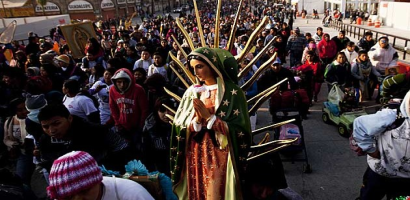
By tradition and devotion on December 12 come to the parish of Our Lady of Guadalupe to celebrate thousands of pilgrims to the Virgin of Tepeyac, attending the festival and strangers.

History of the Parish

The tower of the parish of Our Lady of Guadalupe has become the worldwide symbol identifying the charm of Puerto Vallarta. Not far from the sea and at the foot of the mountain that shelters the village, his poise stands on the red roofs, cobblestone streets and bougainvillea patches of green, gold cups, rubber and palm. The chimes of the clock indicate the pulse of life Vallarta and the ringing of their bells celebrates solemnity, mourning and weeping brings crowds, that in the December festivities, the surrounding streets become true human rivers.

It is commonly accepted that Puerto Vallarta was founded in 1851 by Don Guadalupe Sanchez, who came to this place with his family on December 12, from Cihuatlán, Jalisco. The new village was named Puerto Las Peñas de Santa Maria de Guadalupe, as might be expected from the accumulation of coincidences that occurred around the foundation and alluding to the Virgin of Guadalupe. The name of the founder, the day of his arrival, his devotion to the Virgin of Tepeyac, and even their alleged ancient chapel dedicated to her on this site. The Congress of Jalisco renamed to Puerto Vallarta in 1918.

First belonging to the diocese of Guadalajara, the Puerto de las Peñas became part of Tepic when this seat was created in 1891. Al was in the territory of the parish of Talpa, then went to San Sebastian del Oeste, becoming parish in 1921. At that time also included part of the neighboring municipality of Bahia de Banderas, Nayarit. In 1974 it fell to single municipality of Puerto Vallarta. Finally, the creation of new parishes in 1975 the left of its current size, covering the early settlement of the Port of penalties.

The patron of the parish is St. Joseph and Our Lady of Guadalupe parish church the holder. For residents solemn vow, issued in 1926, the feast of the Sacred Heart of Jesus, in June, was instituted as the next most important parish celebration.

From 1921 to date, the parish of Guadalupe has been administered by seven pastors: P. Francisco Ayala (1921-1926), P. Jose Ramirez (1929-1932), P. Luis Robles (1932-1940), P. Rafael Parra (1942-1966), P. Francisco Antonio Aldana (1967-1979), P. Jesus Meda (1979-1982) and P. Luis Ramirez (1982).

Construction

When the foundations desplantar began in 1903, and had an "old chapel under the same invocation of Our Lady of Guadalupe", it probably founded by Father Sabino Viruete on April 15, 1883. By the P. Francisco Ayala in 1915 convinced the neighbors that it was better to make a temple larger than projected, so it was demolished what had already built, became deeper ditches and more robust foundation. In 1917 he completed the foundation of the porch and moved on the elevation of the pillars and walls. By December 1920 he had incurred in building 26,648.41 pesos, which was not yet at the level "of the category of the People". In 1921, when he became the parish church, still running the "old chapel", which was surrounded by new walls and scaffolding work.

Construction of the temple began in the east, along the hill, to build first the apse, chancel and chapels annexed, where required needs to have a place where they could roofing held divine services. In 1926 the bell was blessed, "Eucharist" and progressed at a good pace, the work, when suddenly suspended, due to the persecution that arose throughout the country against the Church.

Amainada Once the acute phase of conflict, work started again in 1929. It began in 1930 the dome. In the same year as electricity became available in the early hours of the night. But for 1937, "is not yet built the roof and pavement lack much, getting so much dust." By not having proper place, baptisms were administered in the sacristy.

During the forties, the entire building was completed, except for the towers. On October 27, 1946 we acquired a portable power plant and movie projector for catechism classes. The choir premiered on December 12, 1951, along with a Hammond organ and although P. Rafael Parra made every effort to finish the main tower of the same date, but could not do so until 1952. The crown was made in 1963. Finally, the P. Luis Ramirez concluded the facade in 1987, adding the side turrets and links to the central tower. Similarly, the north facade libero adventitious constructions, formed the atrium and overhauled the parish.

[readon1 url="http://www.vallartatoday.com"]Source:vallartatoday.com - Translation by Suyapa Ajuria[/readon1]


ruben-darioTribute to Ruben Aguirre made ??concause Civil Associations "Pasitos de Luz y Alma Amiga." promotion and generate Puerto Vallarta

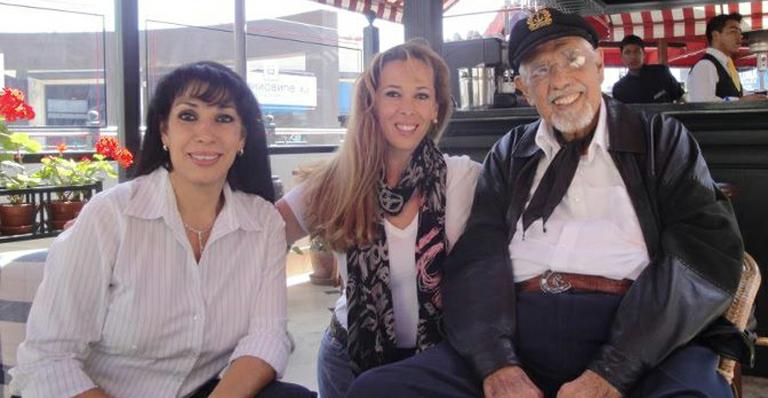
In order to support different civil associations, while promoting the destination of Puerto Vallarta, will honor each month tributes to renowned personalities. The first will be for Ruben Aguirre "Professor Jirafales" on  December 15 in the Arches of the pier at 6 pm, the event is open to the public and free of charge. He was also given the keys to the city.

Tribute will take place after a gala dinner organized in Gsby's restaurant located in the downtown the ticket will cost $ 650 pesos, and will feature the honoree. Proceeds will be used for civil partnership and Pasitos de Luz y Alma Amiga.

The municipal tourism director Charles Gerard, said the destination requires this type of event, and to be recognized personalities are linked to Puerto Vallarta, in this case Rubén Aguirre has lived in this city for several years.

With these events, the 23 associations that are discharged to the Jalisco Institute of Social Welfare (Ijas) will benefit from the proceeds of each event.

Still have not secured the next honorees, but remember the name Yuri for the month of January 2013.

[readon1 url="http://www.vallartatoday.com"]Source:vallartatoday.com - Translation by Suyapa Ajuria[/readon1]

Jose-MujicaJose Mujica is the president of Uruguay,  and the poorest president in the world. He’s made the news recently because of reports of his humble and basic style of life. Some people consider that this is nothing else but a smart marketing campaign to endear Mujica to Uruguay’s low-income voters. Others, perhaps the majority, have Mujica on a pedestal because of his austere lifestyle. Apparently, none of them are correct, as even Jose Mujica declares himself neither a saint nor an opportunist.
A President’s farm

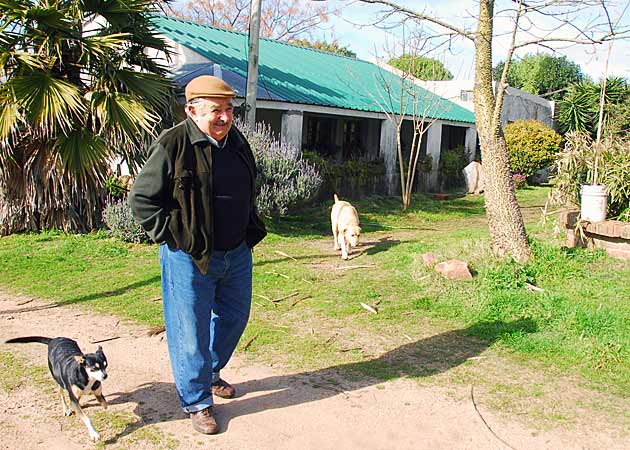
President Mujica lives with his wife, Lucía Topolansky, in a rural area in the outskirts of Montevideo. They never wanted to move to the presidential mansion in Montevideo. Their small farm, actually a land parcel with a rural adobe house, is the same one they bought many years ago with the intention to be farmers. When Mujica was elected deputy and later senator, the job consumed almost all his time and he could not take care of the house and farm maintenance.

The flowers and vegetable growing continues, but Mujica no longer can dedicate himself to the agricultural tasks that he carried out until recently. Mujica and his wife gave part of their land to several families, so that they could live there forever as they had no resources at all.

He did make some improvements to the house, most notably replacing the old straw ceiling. Perhaps, the most significant change is the appearance of security cameras, the new road that connects the farm to the road, and the few guards who take care of the presidential security.

The rest remains more or less the same… including Manuela, their ancient three-legged dog of undetermined pedigree.

Those who know him affirm that Jose Mujica always was as he is now: humble, austere and self-sacrificing. Perhaps the vicissitudes of armed warfare and later, years of jail, fostered in him an appreciation of simple things.

In 1995 he was elected deputy and five years later senator. At that time he already began to stand out among his people because of his humble lifestyle and popularity. Soon that curiosity he provoked in others changed to admiration. In 2005, Mujica obtained the greatest amount of votes of any candidate in Uruguay’s political history and returned to be senator for a second term.

For three years Mujica was minister of Livestock, Agriculture and Fishing, but soon returned to his senate position. Throughout all those years Mujica did not change: and slowly, Uruguayans began to take notice of this simple farmer starting to influence policy.

They say that sometimes he appeared in the Senate with his still dirty boots after having been farming at his place; he just didn’t consider the idea of changing clothes. Others remember him happily driving his little motorbike from his farm to the ministry or pronouncing eloquent, humanitarian speeches with the logic and love of a father to his son. In 2009, José Mujica was elected president of Uruguay.

Today, Mujica donates part of his salary as president to social aid. In their income declaration of this year, the public can see that the couple do not have bank accounts and that their only properties are the small farm, two old 1987 cars, three tractors and agricultural work tools. That’s to say the total Mujica’s patrimony is now of 215,538.46 US$, including all his properties and savings -which he hasn’t.

Mujica has been criticized for his lack of professional political experience, his simple clothes, his gawky walk and his use of popular slang. Yet Mujica was and is a humble person, without a doubt. His austerity, so different from the lifestyle and wealthy status of other international leaders, positions him as the humblest and poorest president in the world. He has demonstrated that his simplicity is not a gimmick for political marketing, but as natural as the flowers and vegetables he has cultivated in his garden for decades.

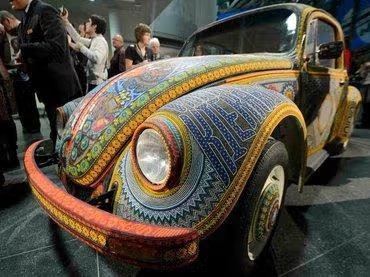
ElVOCHOLBERLIN, GERMANY (06/DIC/2012.) - The Autostadt theme park in the German concern Volkswagen Wolfsburg City (North), shown today for the first time in Germany Vochol a "vocho "decorated with millions of beads created by eight Mexican indigenous artists.
These Huichol artists, in the states of Nayarit and Jalisco, spent more than nine thousand hours and used colorful beads million, coupled with a great fantasy, to "combine the variety of Mexican folk art with the body of a 'vocho "Volkswagen", the statement of the Autostadt.

The "vochol" contraction formed with the words "Beetle" and "Huichol", the indigenous people of the Sierra Madre Occidental, was first exhibited in 2010 at the Museo de Arte Popular in Mexico and then in various parts of the country, and launched in January in U.S. international tour.

"The Autostadt, Volkswagen's communications platform is the ideal place for the first season of this 'vochol' in Germany. At its colorful body joins Wolfsburg's history with the Mexican tradition," said Otto F. Wachs, president of the Motor City theme park.

He recalled that the "vocho" originally from Wolfsburg was made a few years ago at the Volkswagen plant in Mexico.

"And the 'vochol' combines a very special vehicle Volkswagen traditional icon of the consortium, with the folk art of Mexico, a country with which Volkswagen has close ties for more than four decades," he added.

According to Mexico's ambassador to Germany, Francisco N. González Díaz, "the beloved 'vocho' icon twentieth century German and produced in Mexico until 2003, wears wixáricas (Huichol) and travels the world showing the synergy of both worlds, even three: Mexico, Germany and the Huichol ".

"This is the best representation of the close friendship between our countries," he said.

The two million 277 thousand beads used by the eight indigenous artists to decorate the "vochol" in a "magical and colorful design" fixed on the vehicle body with 16 kilograms of Campeche wax, fabric and paint, the statement said.

The "vochol" can be seen at the Autostadt in Wolfsburg until January 5, flanked by two "beetle" as they call the "vocho" in Europe-historical: the model of 1972, sales champion, and the call " Mexico beetle ", from the collection of the Museum of the City ZeitHaus Motor.

Subsequently, the "vochol" example of Mexican folk art on wheels, will be exhibited in the German city of Frankfurt and finally in the Belgian capital, Brussels, after which will be auctioned.

The money raised will go to the Friends of the Folk Art Museum to promote the work of the more than eight million people supporting indigenous artisans in Mexico.

alejandroSanzAlejandro Sanz will be the first artist to perform live on a digitally transmitted concert.

Terra announced the biggest bilingual interactive event of the year, presenting the Latin music icon Alejandro Sanz.

The plan of the Spanish singer and multiple Grammy award-winner to promote his new album “La música no se toca” includes performing his first free and live concert digitally transmitted worldwide by Terra Live Music December 6, 2012 at 6:30 p.m. (EST).

There are high expectations for what some people are calling “the most anticipated concert of the season”, the event will be transmitted in hi-definition online, and on mobile devices in over 19 countries, including the U.S. It will also be transmitted on many social media platforms using the hashtag #TerraLiveMusic.

Sanz is one of the most influential and bestselling Latin music singers, and will also be the first artist to perform live on a digitally transmitted concert.

“I love the fact that we can perform in a concert and simultaneously show it to the rest of the world,” said Sanz.

Alejandro Sanz, La música no se toca

Alejandro Sanz will be performing hit songs from his #1 album “La música no se toca,” which was launched September 25, top-rated in many lists among over 17 countries. Fans all over the world will have the opportunity to listen to songs like “Se vende” and “No me compares,” which remained for two weeks on the “Hot Latin Songs” list from Billboard magazine and became the only Latin pop song to remain for five consecutive weeks in the top 10 Billboard Latin radio songs.

The concert will take place in the city of Miami Beach.

Sanz is in the middle of a worldwide tour that started in Mexico with sold-out concerts. The tour continues with concerts in Spain, Latin America and the United States.

Sanz opened his soul in an exclusive interview for Terra Live Music from the intimacy of his home in Miami. The acclaimed artist talked with VJ Maury about the moment when he felt he had to give the world his magical songs, how he dealt with the transition of labels to launch his record “La música no se toca” and confessed his emotion for transmitting his show live worldwide online for the first time.

“The album ‘Mas’ is an important part of my life, even though ‘Corazón partio’ was also a very important song in my career, but this album is still a reference in regards of Spanish pop music,” said Alejandro Sanz.

When asked about his new record label, Sanz said: “Changes are always scary, specially after 20 years. One believes that you marry one label, Warner, but then, no. I believe it’s important to always have that extra motivation, that’s why I accepted this new challenge to start with a new record label.”

morgan2Morgan, the Mascot of Vallarta Today came up missing Thursday afternoon.  Sometime beyween 1:45pm and 2:30pm he went out visiting neighbors and has not been seen since.  More pictures
navidadvallartaWith perfect weather, very hospitable, gentle, and courteous English speaking locals, clean water and food, safety and security a major priority, and fun galore, you'll not have a Merrier Christmas than in Puerto Vallarta, Mexico.

Five centuries ago, Christmas was virtually nonexistent in Mexico; in fact, Christianity had not even been introduced to the New World. The native Aztec Indians weren't even aware of the concept of Christianity until 1524, when Twelve Franciscans (Twelve Apostles of New Spain) came to Mexico; about a decade later, the Dominicans followed.

Soon after the arrival of the Twelve Franciscans, some of the native Indians began accepting the story of Christ and converting to Christianity. One such Indian, an indigenous farmer named Cuauhtlatoatzin (the talking eagle in the Nahuatl language) living north of what is now known as Mexico City, claimed to have witnessed an apparition of the Virgin Mary on Tepayac Hill. Our Lady of Guadalupe, as the Virgin Mary came to be known, is to this day recognized as the Patron Saint of all the Americas and is the basis for much of the Catholic faith throughout Mexico. As an example, the most predominate historical landmark in Puerto Vallarta is the Our Lady of Guadalupe church in El Centro.

Evidently the Franciscans were quite impressed with their new convert; they moved him and his wife into their new mission and changed his name to Juan Diego (a bit easier for them to pronounce!). After Juan Diego witnessed the mystical Lady on Tepayac Hill who supposedly cured his uncle of a terminal illness, the rest of the local Indians reasoned that it must be an awfully good religion that these intelligent Spaniards had brought to them; they soon dumped their ancient pagan beliefs in favor of the new Catholic Church teachings. With the miracles that these Spanish God-like Fathers had to offer, it took the Franciscans only six years to sign up the first eight million new believers!

Soon after news of Juan Diego's apparition made its way around Mexico, the native Indians reconciled (a polite way of putting it!) with the Spaniards and a new race of people, the Mestizo, was created. In fact, the Lady of Guadalupe is generally depicted as a Mestiza. Today, it is estimated that anywhere from 60-80% of the Mexican population is Mestizo and slightly more than 90% of all Mexicans are Catholic. With well in excess of 100 million Catholics, Mexico ranks second only to Brazil with its population of Roman Catholics.

During the 20th century, the Mexican government took a number of steps to separate church from state and also nationalized much of the wealth that the church had accumulated over the years; however Catholicism continues to have a strong influence in Mexican life today. Although it's influential, it's certainly not forced on anyone or even on display. In our 13 years of living in Vallarta, we've never noticed a priest or nun in the city; they do not wear their habits in public.

Many of the annual Mexican fiestas are religious by nature but Easter and Christmas are the most widely celebrated. We have been fortunate enough to witness the past 13 Christmases in PV and can say that it's a sight to behold! They start the season early in December by hanging colorful lights and decorations throughout the city. The official holiday season begins on December 12th, the birthday of the Lady of Guadalupe, and lasts until January 6th with Epiphany or Los Reyes Magos (the day of the three kings or wise men); some now refer to this holiday season as the Guadalupe-Reyes Marathon!

Approximately 9 days before Christmas, various processions, called Las Posadas, are initiated in surrounding cities and communities as the participants begin their walk to Puerto Vallarta. These processions are a celebration of Joseph and Mary's search for shelter in Bethlehem and they all convene in El Centro on Christmas Eve at the Our Lady of Guadalupe church. The children have their colorful piñatas and the adult celebrations begin as the entire downtown area bustles with activity and music. Christmas Day is a much more quiet and somber day; a day of recovery!

December 28th is the Day of the Innocents, the equivalent of April Fool's Day in the United States; a day when everyone plays practical jokes on each other and not an appropriate time to "loan" money or believe anyone!

Of course, December 31st is another joyful occasion in Vallarta. The entire perimeter of Banderas Bay lights up with incredible fireworks displays lasting almost a half an hour and fiestas can be heard all night long throughout the city; you'll not see a more spectacular New Year's Eve celebration. Of course, New Year's Day is another quiet day as everyone again tries to recover!

The final Christmas season fiesta is that of Epiphany on January 6th celebrating the arrival of the Three Wise Men. The children receive gifts and everyone enjoys a pastry called La Rosca De Reyes (bread of the kings). Typically, there is a very small doll buried in the bread roll and the person that gets the piece containing the doll is responsible for hosting the next fiesta on February 2nd, the Day of Candlemas. (You've got to give them credit; they have plenty of reasons for planning the next fiesta!)

Now you know why they refer to Christmas Season as a Marathon! By the way, in Mexico, it's never referred to as "Winter Solstice Holidays", "Non-Denominational Festivities Season", or by any other politically correct term; it's Christmas Season!

It should be mentioned that there are a few things obviously missing in Puerto Vallarta during this season of celebration. Beautiful snow covered pine trees and deep snow drifts for Santa's sled are nowhere to be found; of course, they were probably also lacking 2,000 years ago in Bethlehem! The average daily low temperature during the holidays is 65°F and the average high temperature is 80°F, resulting in the average daily temperature for this festive season of 72°F with clear blue skies and zero chance of rain; it just doesn't get any better than this!

If you want your surroundings to look more like that to which you're accustomed, you can purchase all sizes of artificial Christmas trees at Sam's Club, Costco, Home Depot, or Wal-Mart; better yet, you can just hang your lights all over the beautiful palms. Finding poinsettias for that additional touch of Christmas ambiance is not a problem; after all, poinsettias are indigenous to Mexico and are abundant in Vallarta. Throw in a few bougainvilleas, hibiscus, birds of Paradise, geraniums, orchids, and numerous other tropical flowers (all in full bloom over the holidays) and you'll have the most beautiful Christmas you've ever experienced.

So, what are you waiting for? Vallarta's a short 2-3 hour flight from most US cities and with more than 50 international flights arriving daily, it's a simple and relatively inexpensive way to enjoy the best holiday season of your life. With perfect weather, very hospitable, gentle, and courteous English speaking locals inviting visitors with open arms, clean water and food, safety and security a major priority, and fun galore, you'll not have a Merrier Christmas anywhere; as they say south of the border, Feliz Navidad!