oro

PUERTO VALLARTA: Armed robbers have taken $US8.5 million in gold from a Mexican mine refinery, McEwen Mining Inc says

Canada-based McEwen Mining Inc says armed robbers have taken $US8.5 million ($A11.13 million) in gold from a refinery at a mine in Mexico's Sinaloa state.

A company statement said the theft occurred on Tuesday at the El Gallo 1 mine and involved 900 kilograms of gold-bearing concentrate containing approximately 7000 ounces of gold.

The company said on Tuesday that the crime was being investigated by Mexican authorities.

It said its insurance policies will not be enough to cover the losses.

The statement said no one was injured and mining operations were not affected, but did not provide any more details about the robbery.

The Toronto-based company has operations in Mexico, the United States and Argentina.

vallartatodaysource

reportproblem

DSC0234jpg 3206808 p9

PUERTO VALLARTA: The Mexican navy rescued 14 Cubans travelling in a barely seaworthy boat off the coast of the Yucatan peninsula, the navy said on Tuesday.

The migrants were spotted on Monday by a navy aircraft and later taken to shore aboard a navy ship and handed over to immigration authorities. One of them was a minor.

On March 20 the navy reported a similar rescue of 15 Cubans off the coast of the resort city of Cancun.

Many Cubans take to the sea in flimsy vessels to try to make it to Mexico and then cross illegally into the United States.

vallartatodaysource

reportproblem

hsbc bank

PUERTO VALLARTA: “Despite challenges associated with this business, we believe BNS would be an interested bidder,” Dechaine said Tuesday in a note to clients, referring to Scotiabank by its ticker symbol. “Failing a turnaround of this business over the next 12 to 24 months, we believe senior executives at HSBC could consider selling.”

HSBC Chief Executive Officer Stuart Gulliver is under pressure to break up Europe’s largest bank amid rising capital demands and a sluggish global economy. In a Feb. 23 earnings call, he cited Mexico as one of four potential markets the lender may exit.

Scotiabank, with operations in more than 55 countries in Latin America, the Caribbean and Asia, is targeting Mexico, Peru, Chile and Colombia as countries offering the best growth potential. CEO Brian Porter said in January that he’s preparing the Toronto-based bank’s Mexico unit to be a player in that country’s “next round of consolidation.”

Integration Risks

Scotiabank is the seventh-largest lender in Mexico with a 6 percent market share, Dechaine said in his note. He estimates HSBC Mexico could be worth about C$11.5 billion ($9.2 billion), based on 2.2 times price to tangible book value and a 20 percent takeover premium. That valuation would be 6 percent dilutive to Scotiabank’s estimated per-share earnings for 2016, Dechaine said.

Buying the HSBC unit would increase Scotiabank’s market share in Mexico to 13 percent, propelling it to a fifth-place ranking in the country, Dechaine said. A 10 percent-plus share is the “magic number” for improved efficiency and scale benefits, he said.

“Integration risks are a key consideration,” Dechaine said. “The situation with HSBC Mexico may be even more worrisome, given issues the business has encountered in recent years.”

Those issues include money-laundering fines, “troublesome” loans and deteriorating efficiency ratios, he said.

‘Priority Markets’

Sharon Wilks, HSBC’s Canadian spokeswoman, said the firm doesn’t comment on analysts’ speculation, as did Scotiabank’s Diane Flanagan.

“We are focused on investing in our priority markets, including the countries of the Pacific Alliance,” Flanagan said in an e-mailed statement. “This includes Mexico, where we recently announced a C$300 million internal investment.”

Scotiabank’s Mexico had 179.1 billion pesos ($12 billion) in loans at the end of January, according to data from Mexico’s bank regulator. It’s the fifth-biggest foreign-owned bank, trailing local units of Banco Bilbao Vizcaya Argentaria SA, Citigroup Inc., Banco Santander SA and HSBC.

HSBC’s Gulliver said in the earnings call that Mexico, Brazil, the U.S. and Turkey represent “the biggest problems” in terms of underperforming operations.

“There are parts of the group that aren’t offering a return that’s anywhere near their cost of equity, and we’re working on restructuring those,” Gulliver said. “And there are no options in terms of that restructuring that we would not consider.”

--With assistance from Stephen Morris in London and Ben Bain in Mexico City.

vallartatodaysource

reportproblem

A trainer moves a dromedary during a show at the Cedeño Hermanos Circus in Mexico City on 9 March. A ban on animal performers is due to come into effect on 8 July.
Circus owners claim the ban will put non-human performers in danger as zoos and sanctuaries look unprepared to provide homes

A trainer moves a dromedary during a show at the Cedeño Hermanos Circus in Mexico City on 9 March. A ban on animal performers is due to come into effect on 8 July. Photograph: Henry Romero/ReutersWith animal acts about to be banned from all circuses in Mexico, the fate of the non-human performers has become mired in acrimony and doubts over whether the legislation will actually lead to an improvement in animal protections.

Rather than bring relief to the elephants, lions, tigers and other animals they currentlytransport around the country in cages, circus owners claim the ban in fact puts the animals in danger.

“A lot of owners don’t want to give the government the animals that are their livelihoods, and which they look after well,” said Armando Cedeño, president of the national association of circus owners. “Some are looking to sell them, and you don’t always know who is buying. Others are so desperate they are thinking of putting them to sleep.”

But the government of Enrique Peña Nieto has brushed aside such warnings with promises of a bright future for Mexico’s four-legged circus performers. The implementation of the ban is just three months away.

“We will ensure that all the animals have top-level destinies that attend to their comfort and wellbeing,” the chief environmental prosecutor, Guillermo Haro, told reporters earlier this month.

Such optimism sounds a little glib given the vagueness of the legislation, the state’s limited capacity to provide sanctuary and a long history of a black market trade in exotic species. All within the context of wildly varying estimates of how many circus animals there are.

tigers mexico circus Tigers are seen in a cage during a media tour organised by circus workers union, to show animals from some circuses that have already shut, in a town called Tizayuca, near Mexico City on 9 March. Photograph: Henry Romero/Reuters

The ban explicitly gives Mexican zoos first pick of the animals. The rest, the legislation says, can be handed over to the authorities, though this is not obligatory.

So far, the big public zoos have expressed little interest in the animals, given their tight budgets, and other state-owned sanctuaries do not have the infrastructure to receive more than a small number. Expansions have been promised, as have arrangements with privately run sanctuaries, but how this will be arranged or funded remains a mystery.

Doubts over numbers

Although authorities have said that the owners could face legal action if they put their animals down, there has been almost no comment on the prospect of mass sales of old circus animals. A thriving black market in exotic species already feeds unregulated private collections – such as the tigers found in drug traffickers’s mansions – as well as the trade in pelts.

“It’s very difficult to get a handle on what is going on,” said Dilce Winders of the international animal rights group Peta that lobbied energetically in support of the Mexican ban. “And the deadline is looming.”

Winders stresses that there is still very little solid information about the animals that will be needing a new home. This should come, theoretically, when the owners provide a census immediately after the ban comes into force in early July, but they currently claim it is about 4,000. The authorities say their existing registers suggest the number is closer to 2,500.

Tim Phillips of Animal Defense International, a group which has been at the forefront of campaigns to ban circus animals across the world, has dismissed the larger figure as “circus propaganda”, and the warnings of deaths and mass sales as “outrageous threats” designed to force some kind of compensation deal.

Still, Phillips, who said ADI had been involved with the Mexican case from the start, added that the Mexican authorities seemed “a bit overwhelmed” in recent meetings and suggested they may soon announce a delay in implementation.

ADI, Phillips said, had already “emptied Bolivia” of old circus animals with a number of “rescues” in the wake of its ban in 2010. The group is currently finishing a similar operation in Peru, preparing to airlift 33 lions and a bear to sanctuaries in California and Colorado.

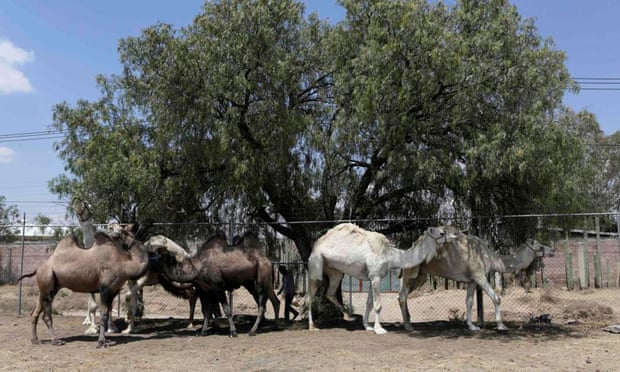
dromedary bactrian camels mexico circus A group of dromedary and bactrian camels from some circuses that have already shut shelter under a tree. Photograph: Henry Romero/Reuters

Phillips expects ADI will be invited by Mexico to help place the animals and, perhaps, even to help enforce the ban.

“Often the countries most in need of animal protection laws are the ones with the least resources to enforce them,” he said. “We are getting a taste of that in Mexico.”

Phillips said that he expected the numbers to fall dramatically as the most common species, such as llamas and horses, were sold off easily. He said some of the exotic ones might also “disappear”, though he insisted that feeding the black market is a longstanding practice among circus owners and should not be blamed on the ban.

“We have to be realistic,” he said. “If this is the last generation to suffer in circuses in Mexico it is a very positive thing.”

‘They are killing the industry’

The ban is already partially in action, thanks to local-level legislation in about a third of Mexico’s states.

Circus owner spokesman Cedeño said this has had a major impact on audiences for the family-based companies that set up their big tops in small towns and poor barrios across the country, forcing some to close down altogether.

“They are killing the industry,” he said.

Cedeño insists the ban goes beyond concern for animal welfare and is – at least partially – a cover for powerfully connected people seeking a cut from selling off valuable animals appropriated from the circuses.

The evidence is suspect, but such stories gain some traction in Mexico thanks to the dubious reputation of the Green party, which has been the ban’s main promoter and whose leadership is mired in allegations of corruption.

They have also previously used publicity campaigns that have had little to do with environmental issues. One candidate used an elephant to launch his campaign in 2012, and the Green party governor of the state of Chiapas gave a key position to a businessman who boasted of his exploits hunting elephants in Botswana.

But animal rights activists insist that none of this is relevant to the task at hand.

“No political party has a good reputation in Mexico,” said Leonora Esquivel of the group AnimaNaturalis that has worked closely with the Green party on the ban. “Our responsibility is to ensure that this opportunity results in the end to the exploitation and mistreatment of animals in circuses.”

vallartatodaysource

reportproblem

Acapulco251428105684

PUERTO VALLARTA, Mexico — From the beachfront boulevard, the predominant view here is of tourists throwing themselves into the sunset off bungee platforms above techno-blasting beer bars, as paragliders drift along under billowing Dos Equis chutes.

But closer up, you can’t miss the guns. There are state police with black masks in trucks with gun mounts. Roving pods of armed federal gendarmerie on souped-up three-wheelers. Assault-rifle-toting Mexican marines on foot patrols with armbands that read “Tourist Protection.”

Once the most famous and glamorous beach spot in Mexico, Acapulco has long struggled with drug violence and gang warfare that have sullied the sun-and-sand image. Over the past several months, teachers strikes and street protests have clogged the city. Military and federal forces took control from the ousted municipal police. Mexico’s worst tragedy of the past year, the disappearance and likely murder of 43 students at a teachers college, took place up the road in the same state, Guerrero.

“In the city of Acapulco, we definitely have security problems,” said Luis Walton, the former mayor and current gubernatorial candidate. “We hardly have any international tourism now.”

But despite the image problems, domestic tourism has been inching up. Droves of tourists are arriving — most are Mexicans leaving the capital during the Easter holiday. The city’s tourism department estimates that 350,000 people will visit Acapulco over the next two weeks — and occupancy rates in the city’s 18,500 hotel rooms will surpass 80 percent. Boosters say there have been no violent incidents targeting tourists in more than two years — since a group of six Spanish vacationers were raped by gunmen.

Mexican Marines patrolling the beach run to avoid a wave in Acapulco. The Mexican beach destination has long struggled with drug violence and gang warfare. 

To attract tourists, there are cheap flights and discount hotel rooms. This spring, Acapulco has been the site of an international banking conference, a professional tennis event and a big tourism conference. Expedia, the online travel company, said that demand for trips to Acapulco grew by 50 percent last year. But billy-club wielding marines and patrolling police trucks can be seen everywhere.

“The tourist area is ‘bulletproof,’ ” said Netzah Peralta Radilla, the city’s tourism secretary, in a new government center to help tourists. And it needs to be. “We don’t have anything else. We live off of tourism. That’s why it’s so important.”

Grecia Falcon, a 22-year-old veterinary student from Leon, in central Mexico, was worried about spending her holiday in this “gangsters’ paradise,” but agreed to come with her friend who grew up in Acapulco.

“I’m kind of afraid,” she said, sitting on a beach blanket one evening next to tourists who had set up tents in the sand. Now that the local police have been replaced, “people do whatever they want.”

“We smoke and drink and fly kites,” she said. “They say the city’s more peaceful now that the cops are far away.”

For many Mexicans, the springtime rites of beach debauchery surpass any lingering fears of violence.

“I’m very happy to be here,” said Luis Alberto, wearing little more than his Mahalo Beach hotel wristband and holding a can of Modelo beer in the sweltering sun. “The problems are somewhere on the outskirts, not here.”

A clubgoer checks her phone inside the Baby O nightclub. (Jonathan Levinson/For the Washington Post)

The 37-year-old real estate worker in Mexico City said visiting Acapulco is a “national phenomenon,” one he has participated in more than a dozen times. He likes the happy hour deals, hotel specials and the toll-road discounts during holidays. “Everything’s cheaper here.”

Acapulco once symbolized luxury and glamour. A post-World War II haven for Hollywood stars such as Errol Flynn and John Wayne, it was known as the Mexican Riviera and a place where people such as the Nixons would celebrate their anniversaries.

The gradual transformation from international hot spot to domestic weekend getaway has been accelerated by the city’s drug wars.

Walton, the former mayor, last year asked the federal government to send reinforcements after more than half of the city’s 1,500 local police failed the vetting to root out ties to organized crime. The city has been one of the early tests of the gendarmerie, a federal police force created by President Enrique Peña Nieto to be deployed to crisis spots.

Some business owners feel that the city’s war zone look is overkill.

“When they carry weapons of that caliber, the only thing it looks like is that they’re the ones who are afraid,” said Fernando Alvarez Aguilar, a restaurant owner and local historian. “The perception remains that the problems are enormous.”

But when the nights get going and the salsa beats blast from the dance halls, security seems far from anyone’s mind.

On Thursday night outside the Baby Os nightclub, posh young Mexicans crowded the sidewalks and pressed themselves several deep against the velvet rope, calling out, “Martin! Martin!” trying to catch the bouncer’s attention. Inside, where you can watch AC/DC videos on a giant screen and drink a $1,000 bottle of tequila amid the cavern and jungle themes, the partiers pressed into every available nook.

“We’ve recovered some, without a doubt. We’re getting better, but we haven’t fully recovered,” said Carlos Hernandez, the club’s manager. “We haven’t yet become the business we should be.”

The abduction and disappearance of the 43 students from Iguala last fall is one of the reasons. The reaction to the tragedy grew into a national protest movement, with marches that drew tens of thousands in Mexico City and near daily demonstrations across Guerrero, including in Acapulco. Among the common protest tactics: blocking the highway connecting the beach town to the capital, which made potential tourists question running the gantlet of angry villagers just to visit the Señor Frog’s gift shop.

“Our tourists, many of them come from Mexico City, and they don’t want to deal with what they deal with every day there, with traffic and protests,” Hernandez said. “Many decide not to come because they’re afraid of a roadblock, that they’ll be stuck for hours on the highway.”

Tourism took a nose dive in the late fall. But the swell of visitors surged back for the Christmas and New Year’s holidays, when many people head for beach towns across the country. During the peak days, hotel occupancy rates reached 98 percent, according to tourism officials.

“It’s the closest beach to Mexico City,” said Oscar Gomez, a 36-year-old bodyguard for a wealthy family in the capital who has already visited three times this year. During his January visit, to be safe, “I brought my gun.”

But Americans and other foreign tourists, so ubiquitous in other Mexican beach towns such as Cancun or Puerto Vallarta, seem far more scarce in Acapulco.

“The internationals have dropped off, but the Mexicans are still here,” said Alejandro Hidalgo, a 45-year-old school administrator from Toluca, as he sipped a piña colada. “I get afraid when I go to parts of Las Vegas. I’m afraid of Detroit. It’s always bad in cities where you’re unfamiliar.”

“Here, we feel safe with ourselves,” he said.

IMRSJoshua Partlow is The Post’s bureau chief in Mexico. He has served previously as the bureau chief in Kabul and as a correspondent in Brazil and Iraq.


vallartatodaysource

reportproblem

sam nazarian

PUERTO VALLARTA.- Days after Sam Nazarian’s return to SBE Entertainment Group, the company announced that it will be expanding into Mexico.

The firm, headquartered on L.A.’s Miracle Mile, announced Friday that it will manage five resort hotels to be built by Armar Group, a privately held Mexican real estate development and investment company.

The first project is a 200-room hotel with 250 residential units in Medano Beach in Cabo San Lucas, scheduled to open in 2017. The second project, in Cancun’s hotel strip, is a 150-room hotel with 150 residential units, slated to open in 2018.

Three other hotel projects will follow in Puerto Vallarta, Mexico City and Punta Mita, just northwest of Puerto Vallarta. A spokesperson for SBE said the company would not yet discuss how the projects will be financed.

The deal with the Armar Group follows the return of Nazarian, SBE’s founder, who rejoined the company at the end of March as chairman and chief executive after a 10-week leave following his testimony to Nevada gambling regulators about his illegal drug use.

The company also announced changes to its board of directors, which is now headed by Nazarian, his father Younes Nazarian and his brother David Nazarian. Three executives of Cain Hoy Enterprises resigned as the Greenwich, Conn., private-equity firm scales back its ties with SBE, ditching plans to be the vehicle through which SBE’s luxury hotel brand SLS buys and develops hotels.

The Mexico hotels are the latest location in SLS’ expansion. The firm is opening a hotel in the Bahamas in April; hotels in Philadelphia, Seattle, New York City, and Hollywood over the next three years; and a residential complex in Miami.

vallartatodaysource

reportproblem

TIPS

PUERTO VALLARTA - Prudencio Diaz, a 66-year-old one-armed retiree, stuffs groceries into bags at a Mexico City supermarket, working as a "volunteer" for tips to complement his miserly pension.

Diaz is among 22,000 seniors who toil at the end of checkout lanes across Mexico, wearing aprons and hoping generous customers will hand them a few pesos for their efforts.

The retired mechanic gets the minimum pension of 1,200 pesos ($80) per month, a bit more than half the minimum wage.

"My pension is not enough. I have no problem being a volunteer packer," the former boxer said with a smile, exposing some missing teeth.

Making between $10-$20 per day in tips, Diaz can earn the equivalent of his monthly pension in a week of packing groceries.

Only a quarter of the 11 million senior citizens in Mexico -- Latin America's second-biggest economy -- receive a pension.

Many do not get any retirement benefits in their less than golden years because they worked in the informal sector all their lives, or did not contribute long enough to the pension system.

After spending his childhood raising cattle in Zacapoaxtla, a town in central Puebla state, Diaz moved to Mexico City when he was 15 years old.

Once in the mega-capital of 20 million people, he held a series of informal jobs, from carrying water bottles to truck driver and bartender at a high-end restaurant, where he made pina coladas and other cocktails.

A fan of sports, he was paid $10 per fight as a boxer. Losing his arm in an accident while working as a mechanic at the age of 25 did not stop his passion for sports -- he has run 35 marathons over the years.

Today, to make ends meet, he also sells tamales, or cornmeal dough, outside the supermarket, makes sandwiches for parties, trains young marathon runners and acts in commercials.

Despite all these jobs, "it's not enough to live," said Diaz.

- Lucrative tips -

With 60 percent of Mexicans in off-the-books jobs, President Enrique Pena Nieto pushed through a fiscal reform aimed at luring people out of informal work in return for better social security coverage.

"We need to open spaces for them, or they'll do it themselves, working as street sellers, taking risks in activities in which they could have an accident. This program is better, it's more controlled," said Barbara Bernes, deputy director of the government's senior citizens affairs department, which promotes the volunteer work at supermarkets.

"It isn't the policy we love the most, but, as the song goes, that's what's on offer."

Some 800 Mexicans turn 60 every day and have no more than primary education on average, limiting their options for formal work, so many are willing to work for tips putting groceries in plastic bags. And by not getting salary, they can still receive their pension checks.

With only 10 percent of seniors saying they have technological training, "many can't compete with today's labor market demands," said Mayra Membrillo, a department head at the senior citizens affairs department.

Adelina Gonzalez, of the Mexican Human Rights and Democracy Institute, said the labor and consumer markets "have imposed competition, producing the socially excluded, the rejects ... a break between generations."

- Labor discrimination -

Wearing pearl earrings and her silver hair tied with an elegant scarf, 62-year-old Maricela waited outside a supermarket for her shift to begin.

The former saleswoman regrets being unable to land a job as a phone operator.

"They told me that they noted my ease with words, my preparation and friendliness, but they didn't take me due to my age. That's discrimination," she said.

This exclusion of older Mexicans from the workforce contrasts with the privileged place they had in pre-Hispanic Mexican society.

"They were in charge of keeping the traditions and the wisdom of the people alive. The fact that they were so close to death gave them a certain sacred place," said Patrick Johansson, history researcher at the National Autonomous University of Mexico.

After putting meat, fruits and vegetables into bags for five hours, Diaz counted his coins one by one.

"I tell young people to do their best because, as the saying goes, 'as you see yourself, I saw myself; and as you see myself, you will see yourself'," he said with his usual smile.

vallartatodaysource

reportproblem

sfPUERTO VALLARTA.- Daylight saving time (DST) will begin in México on April 5, the first Sunday in April, except for the municipalities located less than 20 kilometers from the USA border. Those municipalities changed to DST on March 8, the second Sunday in March, along with the United States and Canada.

MEXIU

PUERTO VALLARTA — A Mexican official's use of a government helicopter for personal transportation sparked calls for his resignation and an investigation of possible abuse of office Thursday.

The Public Administration Department, Mexico's anti-corruption agency, said in a statement that it was probing the incident, the latest in a string of recent scandals reaching the highest levels of government.

The uproar began with photos published online showing several people walking from an SUV toward a helicopter emblazoned with "Conagua," the acronym of Mexico's National Water Commission.

Although the faces were not clear in the pictures, some Mexican news outlets and social media identified the people as Conagua director David Korenfeld and family members. The photos were said to have been taken by a neighbor.

Through his Twitter account, Korenfeld acknowledged and apologized for using the helicopter. He said he was reimbursing the government for the cost of the flight, but did not disclose how much that was.

"I made an inexcusable error by using a Conagua helicopter to transport myself to the AICM," or Mexico City International Airport, Korenfeld tweeted. "For that, I offer a public apology."

Critics nevertheless called for him to step down.

Sen. Javier Lozano of the conservative opposition National Action Party tweeted that the incident "merits the resignation of the person who made the mistake."

Columnist Julio Hernandez Lopez wrote in the left-leaning newspaper La Jornada that Korenfeld was "caught in a flagrant abuse of power."

Abuse of power, corruption and favoritism are longtime complaints in Mexico, and the current government has not been exempt from allegations of impropriety.

President Enrique Pena Nieto, his wife and the Treasury Department secretary came under fire last year over the purchase of luxury homes from government contractors, though they denied any wrongdoing or conflict of interest.

In 2013, shortly after taking office, Pena Nieto fired the head of Mexico's consumer protection agency after the official's daughter tried to have inspectors shut down a restaurant that didn't give her the table she wanted.

vallartatodaysource

reportproblem

Mexico Dog KillerJulieta Robles shows a photograph of her dog "Box," in Hermosillo, Mexico, Wednesday, April 1, 2015.

PUERTO VALLARTA – The Mexican city of Hermosillo, in the border state of Sonora, has become the setting for an inexplicable act of cruelty. Since mid-March, somebody is systematically poisoning the dogs of Hermosillo, and not just strays: At least 64 pet dogs and six strays have died of a similar poison in the past couple of weeks.

Authorities were stunned when 10 dead dogs were found or reported in one day.

No one knows who the dog killer is, or whether it’s more than one. The "Mataperros," or "The Dog Killer" uses an organic phosphate compound, possible an insecticide or rat poison.

Officials say the killer even has tossed poison into the gated patios of some homes.

A male caller to a local radio station in Hermosillo claimed to be, along with accomplices, the killer. But he complained about loose dogs, dog bites and dogs spreading disease and uncleanliness — complaints that don't jibe with attacks on pets inside their owners' homes.

Animal rights activist Carolina de la Torre said it’s likely more than one killer is involved because there appears to be a modus operandi: poison wrapped in a hot dog or meat as bait.

"This is systematic. This can't be the work of one person alone," said De la Torre, who says a total of at least 71 dogs have been killed in the city of about 800,000.

She said the killings appear to be concentrated in three neighborhoods on the city's south side.

"It could range from a neighbor who is bothered by noise (from pets), or even thieves who want to get rid of the dog in order to be able to break into the house," said De la Torre. "Those are the two theories we are looking at."

Animal defenders are starting to fight back – even across the border.

Los Angeles-based actor Raul Julia Levy has offered a $10,000 reward for information leading to the arrest of the culprit or culprits.

"When have you heard of anything like this?" Julia Levy said, "We know there are serial killers of humans, but we've never heard of a serial killer of dogs."

While killing a dog is considered a non-serious crime in Hermosillo, punishable by a fine of about $225, the dog killer has introduced poison into people's homes, a much more serious crime involving trespass and risk for the human inhabitants that could carry a four-year sentence.

Hermosillo resident Julieta Robles, 23, lost her 5-year-old female German Shepherd, "Box," to the poisoner two weeks ago. The dog had gotten out of her home, but was wearing a collar and tag.

"When she came home that night, she was disoriented," Robles said. "We tried to help her, we took her to the vet, but we couldn't save her."

"It was a feeling of a lot of helplessness," Robles added, "not knowing who they are or how to respond to a mass poisoning."

The killings started to come to light in mid-March. While an average of about 10 dogs, mainly strays, are found dead in Hermosillo each month, authorities were stunned when 10 dead dogs were found or reported in one day.

vallartatodaysource

reportproblem

Cabrera painting edit
Painting by Miguel Cabrera. "From Spaniard and Morisca, Albino." Purchased by the Los Angeles County Museum of Art through funds
by Kelvin Jones and partial gift from Christina Jones Janssen.
 (PHOTO COURTESY OF LACMA.)

PUERTO VALLARTA.- An extremely rare and thought lost masterpiece from the Mexican Colonial era was found in the most unlikely of places.

A painting by Miguel Cabrera, considered the greatest painter of his era, was found neatly rolled up and well-preserved under the couch of retired corporate attorney Christina Jones Janssen, the Los Angeles Times reported.

“My dad always told me it was old and probably from Spain,” she told The Times. “He though it had some mates there. He wanted me to look into it someday.”

Janssen said she didn’t know the importance of the painting’s legacy, but that her father always said it belonged in a museum.

Cabrera’s work is a casta painting – a controversial genre invented in Mexico that explores the Enlightenment Age theme of interracial marriage among Indians, Spaniards and Africans. The artist painted only one set and is widely considered the genre’s finest.

According to the LA Times, the painting shows “a prosperous Spanish father and doting Moorish North African (or Morisca) mother dandling their cheerful albino baby.”

Art experts are considering the painting’s rediscovery a major historical event in the art world.

The Los Angeles County Museum of Art purchased the newly found masterpiece for an undisclosed sum.

Curator Ilona Katzew told the Times it was “easily the most important Mexican Colonial painting to come to market in years.” She said it could bring in at least $1 million at auction.

Janssen said “From Spaniard and Morisca, Albino” came to the U.S. in the early 1920s after it was purchased by David Gray, son of Ford Motor Co.’s founding president.

Prior to his death in 1928, Gray gave the painting to his neighbor James R.H. Wagner, who just happened to be Janssen’s great-grandfather.

Joseph Fronek, conservator at LACMA, said the painting was in overall very good condition with only minor paint loss in secondary areas.

vallartatodaysource

reportproblem

imagen.aspx

PUERTO VALLARTA.- Jewelry, clothing and shoe stores, as well as restaurants, in Mexico City's historic downtown district are hoping that Holy Week spending by residents and visitors will help them recoup the losses caused by street closings for the shooting of the new James Bond film "Spectre."

A survey found that the 6,627 businesses affected by street and sidewalk closings experienced average sales drops of 60 percent in the two weeks of location shooting by the film's crew, Small Business Chamber of Commerce, Services and Tourism president Gerardo Lopez Becerra told Efe.

Location shooting for "Spectre," the 24th film in the James Bond series, cost merchants an estimated 376.9 million pesos (some $24.7 million).

The losses are the product of "bad public policy" on the part of Mexico City officials, "who agreed to provide locations for the production (of the film) without considering or respecting business, mercantile and even religious activities" in the area, Lopez said.

"We're not against promoting the country and the capital with these kinds of films, it's a good reflection on Mexicans. But they are not dealing with the effects it might have on businesses," Lopez said.

Mexico City officials closed streets and sidewalks in the quadrant formed by Belisario Dominguez street, Republica de Uruguay street, Eje Lazaro Cardenas and the Correo Mayor to give the filmmakers space to shoot scenes for "Spectre," whose cast includes Stephanie Sigman, the first Mexican Bond girl.

City officials should have "foreseen the possibility (of losses) and avoided affecting" businesses, Lopez said, adding that about 100 businesses were paid between $98 and $131 per day by the production company.

Mexico City's historic downtown district is one of the locations for "Spectre," which features the traditional Day of the Dead celebration.

Mexico is only featured during the first 10 minutes of the film, which also has scenes shot in London and Rome.

The street closings will end on Wednesday, Mexico City Mayor Miguel Angel Mancera said.

"Spectre" stars Daniel Craig, who is appearing in his fourth Bond film, and features Monica Bellucci, Lea Seydoux and Sigman as the latest Bond girls.

In the the film, Agent 007 will battle the Special Executive for Counter-Intelligence, Terrorism, Revenge and Extortion, or SPECTRE, and arch villain Ernst Stavro Blofeld.

Austrian actor Christoph Waltz plays Blofeld, whose character first appears in Ian Fleming's "Thunderball" and has been featured in several Bond films.

Craig also starred as 007 in "Casino Royale," "Quantum of Solace" and "Skyfall."

vallartatodaysource

reportproblem

anti smoking laws

Puerto Vallarta, Jal.- The regulations for the application of the anti-smoking law in Puerto Vallarta is a step away to enter into effect, informed María Candelaria Villanueva Sánchez, City counselor and head of the Health Committee.

Villanueva Sanchez explained that the regulations were discussed at the last meeting. Some corrections and observations, considered relevant, were made. Regulations are ready to go in such a way that they expect the Health Committee to approve it at the next meeting, and then submitted to Town Hall officials for its final approval.

"It is a100 percent done, it only needs to be approved. All the articles from 8 to 30 have already been written, discussed and corrected; all we are waiting is for them to meet and approve it".

As for the possibility of any more changes, yes, it is possible. Some of the aldermen were not present at the meeting where the law was discussed. We did send a copy to them, but at the time of the approval, if they think some changes need to be done, they are in the position of making those changes. Their ideas should be taken into account.

With respect to the restrictions of this regulation and the question of whether there will be fines for those who do not respect it, Villanueva Sanchez said that economic sanctions “are the core part, that’s what is going to hurt those who do not respect the regulation. We need to remember that health is for all of us and everyone should take care of it".

She explained that subpoenas will come first, then fines; but in the case of recidivism, greater sanctions will be applied. In addition, smokers who do not abide by the rules and procedure will run the risk to be removed from the area where they are breaking the law.

In this context, Villanueva Sánchez said that, it is considered that this is the only way to gradually change the culture of smoking in spaces shared with non-smokers, taking into consideration that, at the end, they, the non-smoker, are the ones that most suffer the consequences.

Finally, concerning whether it is believed that this can affect the economy of establishments, which restrict the consumption of tobacco in their places, she noted, "at the beginning there will be discomfort, but I think it is good for everyone in general. Businesses eventually will set up areas for their clients. She insisted that is the only way to change the culture and to improve everyone’s health".

n0yr1k b781266017z.120140213175528000g6m1igpbe.1

[readon1 url="index.php?option=com_sobipro&pid=1&sid=703:mar&Itemid=212"]Source:www.VallartaToday.com-by MAR Translation Services[/readon1]

reportproblem