




Televisa Will Transmit Riviera Nayarit Special


 Vallarta Today - Puerto Vallarta's Only Daily English Newspaper - Vallarta Daily News
The Newspaper Of The Bay
Vallarta Today - Puerto Vallarta's Only Daily English Newspaper - Vallarta Daily News
The Newspaper Of The Bay
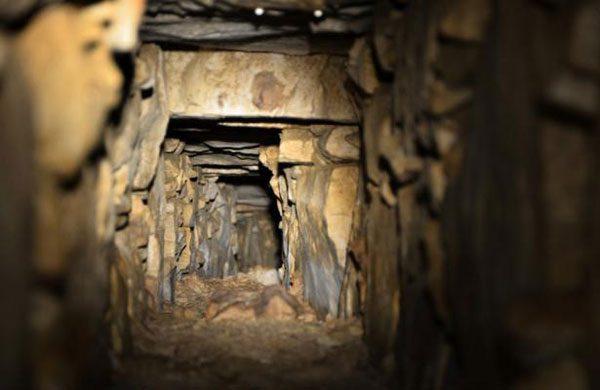
A man-made waterway was discovered beneath the tomb of Pakal
Archaeologists have discovered a system of underground canals beneath the Temple of Inscriptions in the city of Palenque, Chiapas, a find that puts in doubt a theory that the ancient ruler Pakal flew off in a spaceship after he died.
One particular canal was found under Pakal’s tomb and dates back to the seventh century, according to lead archaeologist Arnoldo González Cruz, who said researchers believe the tomb and the pyramid in which it is housed were purposely built over a spring.
The tunnel carried the spring water to the esplanade in front of the temple and, according to the researchers, would have provided Pakal with a path to the underworld.
The spaceship theory came out of the belief by some researchers that carvings on the stone sarcophagus in which Pakal was buried show him seated at the controls of such a craft. “There is nothing to do with spaceships,” González said in a report by the Associated Press.
In 2012, specialists worried that the soil under the Temple of Inscriptions, or Bʼolon Yej Teʼ Naah, which is classic Maya for “House of the Nine Sharpened Spears,” might contain sinkholes or geologic faults after a geo-radar study identified underground anomalies.
A dig began in front of the temple’s staircase where the archaeologists discovered a section of carefully layered rocks covering what has now been identified as a 17-meter-long man-made canal.
Pakal himself began construction of the temple in the last decade of his 70-year reign, and it was completed by his son and successor, K’inich Kan B’alam II, 10 years later.
Only a small section of the canal system has been yet studied with the aid of a camera mounted on a robot, but the specialists have reported that canals can be found in several orientations and levels.
According to Maya beliefs, after Pakal’s death his body had to be submerged in pure water before Chaak, the god of water and rain, transported him to the netherworld.
The director of archaeology at the National Institute of Anthropology and History, Pedro Sánchez Nava, explained that the theory of waterways as roads to the underworld makes sense when compared with elements from other pre-hispanic cultures.
“An analogy can be made with what was found in the citadel at Teotihuacán,” he said, adding that those cultures gave great importance to water. “In both cases there was a water current present. There is this allegorical meaning for water . . . where the cycle of life begins and ends.”


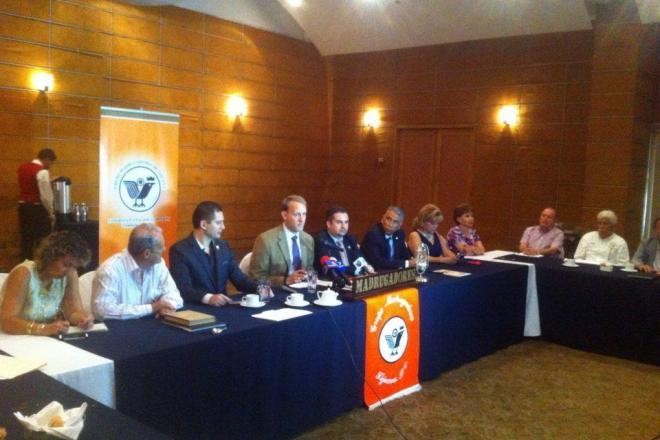
70% of those who ask for political asylum in the United States are Mexicans, and some others are Central Americans, with only a minor part from other countries in Africa and Europe, reported the United States Consul General in Tijuana, William Ostick.
During his participation as an invitee to the weekly Grupo Madrugadores, the consul admitted he did not have precise data on the success of these requests for political asylum for the hundreds of people who have arrived in the region in the past two months.
He said the problem with the increase in foreign refugees is a matter of international rights, shared by Mexico and the United States, as the first obligation is to attend to them during their temporary stay and secondarily after their requests have been received.
"There was a rebound in May and the number of refugees arriving has decreased, but this is going to be a chronic problem for awhile as they continue to arrive, even though in the same numbers," he detailed.
He said most of the foreign refugees are from Haiti and left their country due to the poor living conditions after the earthquake five years ago in that country, and not for some change in the asylum policies in the United States.
The American consul said the refugees had chosen Tijuana because it is the safest route for them.
 Licenciado Gustavo Díaz Ordaz International Airport (sometimes abbreviated as Lic. Gustavo Díaz Ordaz International Airport) (IATA: PVR, ICAO: MMPR) is an international airport located at Puerto Vallarta, Jalisco in Mexico. The airport is named after President Gustavo Díaz Ordaz (1964–70). It handled 3,039,126 passengers in 2014 and 3,517,801 passengers in 2015
Licenciado Gustavo Díaz Ordaz International Airport is mainly a tourist airport, with most passengers visiting the airport in the winter, spring and early summer, just before the rainy season hits the area. The airport serves multiple destinations in North America, and the British tourist airline Thomson Airways serves the airport with two weekly year-round flights to both London-Gatwick and Manchester using their Boeing 787 aircraft. The Thomson Airways flight from Manchester to Puerto Vallarta is also the airline's longest route currently. Los Angeles, San Francisco, and Phoenix–Sky Harbor are the busiest international routes from the airport, serving more that than 100 thousand passengers annually. Among all airlines that serve the airport, Westjet serves the greatest number of international destinations, connecting 13 different Canadian cities with Puerto Vallarta during the high season. Free Wifi is available throughout the airport, and food services and shopping are both abundant after clearing security.
Puerto Vallarta has seen recent growth and expansion due to higher demand. In recent year multiple airlines have expanded at the airport along with new airlines, and aircraft upgrades. Air Transat, one of the largest airlines at the airport, has had aircraft upgrades in recent years.[citation needed] Seasonally, Air Transat services their Airbus A310 from Vancouver. From Montréal and Toronto, Air Transat upgraded to their largest aircraft, the Airbus A330s. October 2014, Air Canada's subsidiary airline Air Canada Rouge connects Vancouver to Puerto Vallarta, with their Airbus A319 and Boeing 767-300 twice daily year round. The newest airline serving the airport is Southwest Airlines, which began service to Puerto Vallarta in June 2015 to Orange County.


Air Canada Rouge will be increasing its capacity in Western Canada by a whopping 242% when it starts flying a Boeing 767 from Vancouver this winter season.
As such, passengers will be able to fly non-stop from Vancouver to Cancun on Monday and Thursday, or to Puerto Vallarta on Tuesday and Friday. Plus, they can take advantage of increased capacity to Ixtapa on Wednesday, and Los Cabos on Sunday.
“Our partners have been asking us for more air from the West for a number of years and now finally we’re able to give them what they’ve been asking for,” said Nino Montagnese, Managing Director, Sun Markets, Air Canada Vacations. “We’re thrilled to be able to marry our great hotel product with both Air Canada and Air Canada Rouge in Western Canada.”
Air Canada Vacations’ Sun packages include free connecting flights from select cities to gateways in Western Canada. Passengers can also take advantage of Air Canada’s extensive network and connect at competitive rates from any city.
More news: International tourism on the rise, says UNWTO
Free connections are available from Vancouver to: Castlegar, Cranbrook, Kamloops, Kelowna, Nanaimo, Penticton, Prince George, Quesnel and Victoria.
From Edmonton: Calgary, Cranbrook, Fort McMurray, Grand Prairie, Lethbridge, Kamloops, Kelowna, Nanaimo, Penticton, Regina and Saskatoon.
From Calgary: Cranbrook, Edmonton, Fort McMurray, Grand Prairie, Kamloops, Kelowna, Lethbridge, Nanaimo, Penticton, Regina and Saskatoon.
Free connections are also available from Winnipeg to Regina and Saskatoon.
Clients who book winter packages to Mexico or the Caribbean by Aug. 31, 2016 will save $800 per family ($250 per adult, $150 per child ages 2-12). Plus, they can take advantage of ACV’s Price Drop Guarantee; if the price drops after they book, ACV will refund up to $800 per couple.
Until July 31, 2016 travel agents can enjoy an exclusive reduced deposit, now $100 per person instead of $250.
Plus, they get $0 admin fee for Price Drop Guarantee. These offers are valid for departures between Nov. 1, 2016 and April 30, 2017.
More news: Southwest says technology outage fixed but more flights cut
Also until July 31, travel agents can earn 4X ACV&ME Points on ACV’s most popular SUN destinations for departures between Nov. 1 and Dec. 31,2016. 50 passengers is enough points to redeem for $600 in ACV travel credit or a $500 VISA Cash Card.
 On the Mexican border countless female migrant workers live in precarious conditions, working in the informal economy. According to data from the 2010 census, eight out of every ten people live in poverty in the State of Chiapas and 55 per cent of those born in other countries are women, mostly from Central America. In addition, there are many internal migrants from various parts of the country who routinely face abuse and discrimination.
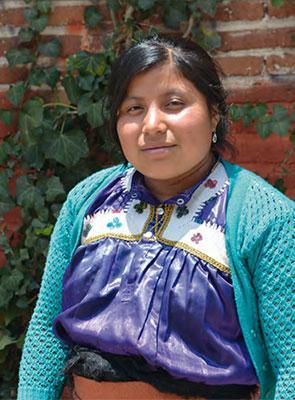
“I cried a lot because of what people did to me. They locked me up, forced me to work without any pay. Although I didn't go to the United States like many others, migration is difficult here in Mexico too,” recalled Teófila Díaz Jiménez, aged 20, who was born in the community of Dos Lagunas, San Cristóbal, in the Mexican province of Chiapas and comes from a family of internal migrants.
Teófila left home at a very young age, looking for ways to make a living. She couldn’t go to secondary school as it was too far from her community and she only spoke the indigenous Tzotzil language. In 2009 she settled in Cancún, Quintana Roo, selling crafts, doing domestic work, but faced relentless abuse. A life of dignity was a distant dream.
Eventually Teófila learned about the organization Voces Mesoamericanas from another family of migrants and started attending their training workshops to strengthen her involvement in the community. These included training courses provided as part of a UN Women project funded by the European Union (EU) in three countries (the Philippines, Mexico and Moldova), which seeks to promote and protect the rights of female migrant workers during all stages of migration.
Drawing made by the women who participated in the workshop “Migración Género y Desarrollo”. Photo: Voces Mesoamericanas: Acción con Pueblos Migrantes/ Rodrigo Barraza
In late 2015 and early 2016 a series of 39 training courses were organized all over Mexico by UN Women in partnership with five civil society organizations, including Centro de Derechos Humanos Fray Matías de Córdova, Voces Mesoamericanas: Acción con Pueblos Migrantes, Instituto para las Mujeres en la Migración (IMUMI), Instituto de Liderazgo Simone de Beauvoir and Sin Fronteras, I.A.P. The trainings in the southern border area brought together local organizations, migrant women and civil servants to discuss ways to address migration, gender and development.
These sessions offered safe spaces where migrant women could share their experiences, and local organizations and civil servants could discuss how to leverage their influence at various levels to improve the lives of migrant women. The participants identified that a key lever is acknowledging that migration affects women and men differently and analysing migration from a gender perspective. They highlighted, when women migrate they usually look for other women to care for their sons and daughters in their country of origin; also, female migrants tend to find more informal work with lower wages, such as domestic work or retail work.
Teófila says that the training helped her find her own voice, understand her rights and pass on the knowledge to other indigenous migrant women: “Now I’m not afraid of taking part, I have more self-esteem,” she shared.
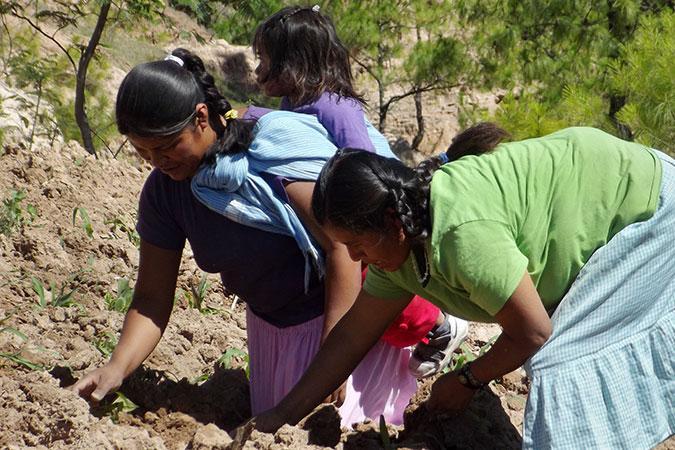
Rural women carrying out agricultural production activities on allotments. Photo courtesy of the Instituto para las Mujeres en la Migración.
Following the trainings, Teófila herself has helped to organize groups of female migrant workers in various communities. Their cooperation has led to the creation of a civil society organization called Coalición indígena de migrantes de Chiapas (CIMICH). Teófila is on the CIMICH board, which works to ensure that migrant women are able to speak about their experience without fear and intimidation, they are recognized in the receiving communities and their rights are respected by the authorities.
Along with other participants from the training workshops, Teófila has developed her leadership skills in her community. Today, working together they are supporting their economies by growing maize, beans and organic vegetables for sale.
Patricia Pérez Gómez (left) participating in a workshop with organizations of female migrant workers in Chiapas, January 2016. Photo: CIMICH/Rodrigo Barraza
“Before we felt as if we didn’t have the right to take part in many areas of life,” explained Patricia Pérez Gómez,27, a CIMICH member who also participated in the training. She said that the training gave her the determination to advocate for her rights, such as better wages and decent working conditions, as well as the right to healthcare and education. “We formed groups of young women, and community accounts…What we want is for people to understand their rights properly. We demand our rights!”


The federal Health Secretariat has been ordered by the National Institute for Transparency and Access to Information (Inai) to reveal how many people were affected by the 2014 toxic spill at the Grupo México copper mine Buenavista del Cobre.
The order came after a private citizen filed an information release request with health authorities on the impact of the August 2014 spill of more than 40,000 cubic meters of toxic substances, particularly sulfuric acid, into the Sonora and Bacanuchi rivers.
The spill affected the water supply of at least 21,000 families in the region.
Through a press release, the transparency institute stated that when the citizen first filed the request the Health Secretariat declared itself unqualified to fulfill it. The federal agency instead referred it to the Federal Commission for Protection Against Health Risks (Cofepris) and the Health Secretariat of the state of Sonora. But the request was never fulfilled.
Inai decided that the federal Health Secretariat was indeed qualified to respond to the citizen’s request.
“There’s public information available that indicates that the Health Secretariat has performed several monitoring and specialized medical attention actions on the population affected by the sulfuric acid spill in the Sonora River,” stated the communiqué issued by Inai.
The decision revokes the negative answer given by the secretariat to the original request, and orders the federal agency to determine the number of individuals who suffered health effects as well as their current health status.

In 1963, Elizabeth Taylor followed Richard Burton to a sleepy little port on Puerto Vallarta Mexico’s west coast where he was starring, along with Deborah Kerr and Ava Gardner, in a John Huston-directed film called Night of the Iguana.
For his movie set, John Huston chose Mismaloya, a small village just south of Puerto Vallarta in the Mexican state of Jalisco, for its resemblance to a crumbling coastal village of the 1940s. Elizabeth Taylor took up residence in nearby Puerto Vallarta, which in the 1960s already had a small community of both Mexican and expat artists and writers, drawn by the weather, natural beauty, and relative isolation.
As the spotlight of celebrity shone on the stars and their love affair, the Mexican government soon realized the tourist gem it had on its hands. Fast forward through the construction of an international airport and land reforms that encouraged private ownership and development, and Puerto Vallarta has today grown into one of the most vibrant and modern vacation and residential destinations in Mexico.
Development stretches north and south all around the crescent-shaped Bay of Banderas, the largest bay in Mexico and the eighth-largest in the world. The Sierra Madre mountains provide a stunning backdrop as they drop right to the water’s edge in some spot, resplendent in all their green-jungle glory.

If you’re thinking of retiring overseas or buying a vacation home or just getting away from the winter doldrums back home—and you’re looking for a culturally rich seaside city, with absolutely gorgeous beaches, there’s no better place than Puerto Vallarta. In fact, there are few cities in the world where you’ll find this combination.
(It’s a bonus that there are more than three dozen direct ... and relatively short ... flights and charters from Puerto Vallarta to destinations in the U.S. and Canada.)
For these reasons ... the stunning beauty, excellent flight connections, an extraordinary culinary scene, modern shopping, and great infrastructure ... you’ll find a good number of English-speaking expats here. They say they don’t lack for anything, especially fun activities.
“You can bird watch, you can be involved in the garden club or the botanical gardens,” one expat tells us. “You can be involved in ecology things. You can do as much charity work as you want ... you can sit on the beach and drink beer. You can go for long walks on the malecon. It’s almost overwhelming. When you live here you really have to kind of pick and choose or you can overdo it.”
And it’s not just expats moving into the Vallarta area. Mexican nationals are coming here, too, for work and/or to buy vacation and retirement homes. (It’s a big draw for locals from Guadalajara, Mexico’s second largest city and just a few hours away by car.)
Just south of the Ameca River and the border with the state of Nayarit is the international airport, serving nearly three million domestic and international passengers a year. Go south from there to the Hotel Zone and the many name-brand hotels (and affordable efficiency apartments for rent), clustered around the Maritime Terminal where large cruise ships dock. Puerto Vallarta is the third most-active cruise ship destination in Mexico. Many of the fishing, sightseeing, diving, and snorkeling boats that ply the bay are based here, too.
Continue south to Puerto Vallarta’s Centro or Old Town district, with the iconic church of Our Lady of Guadalupe, dedicated to Mexico’s patron saint. The city’s famous malecon with its interesting modern sculptures runs along the shore, lined with shops, bars, restaurants, and more.
When you get to the Rio Cuale, pop down the steps to Isla Cuale, a large island in the river that’s been repurposed as an entertainment district. Here’s where you’ll find a bronze statue of John Huston who not only directed Night of the Iguana, but also built two vacation homes on the bay. His family, including daughter Angelica Huston, launched the Puerto Vallarta Film Festival in his honor.
Across the Rio Cuale to the south is the Zona Romantica and one of the most popular beaches in Puerto Vallarta, Los Muertos—not called “Beach of the Dead” because it’s dangerous, but because of a legendary pirate battle that left it littered with bodies. Today, though, the only bodies littering the beach are sunbathers and patrons of the rows of oceanfront restaurants and bars.
The Zona Romantica, home to one of Mexico’s most popular gay, lesbian, and transgender scenes, contributes to Puerto Vallarta’s status as one of the top gay tourist destinations in Latin America.
It’s also one of the most popular areas for expat residents. As one says, “It’s totally a walking neighborhood. We have a central vegetable market with a meat market, too. Some stores bring in bulk items from Costco (yes, there is a Costco in Vallarta!) and break them down for those of us too lazy to go to Costco. Sometimes we joke that we haven’t been across the river in a month because we don’t have to ... everything we need is within about three blocks of where we live.”
Keep heading south to even more idyllic beaches and associated neighborhoods, including Conchas Chinas, Venados, Punta Negra, Gamelas, Mismaloya, and the famous Los Arcos, the most recognizable geological feature of the Bay of Banderas.
Other neighborhoods popular with expats include Fluvial, between the airport and the Hotel Zone and not on the beach but close ... where you’ll find a mix of condos and standalone homes. Marina Vallarta, developed in the 1980s, is just west of the airport. From a home or condo here, you can walk to shopping, restaurants, or the local golf course, and gaze upon beautiful yachts from your balcony.
Nuevo Vallarta, about 15 minutes north of the airport, is one of many planned residential resort communities. Increasingly popular for its modern amenities (and less big-city traffic than downtown Puerto Vallarta) the population of Nuevo Vallarta has exploded since development began there in earnest in the 1990s.
There are fairway homes and condos, beachfront homes and condos, and canal-side opportunities. You’ll find many of the newest resorts, spas, and golf courses here, too. If golf or access to the ocean is important to you, Nuevo Vallarta is a good option.
Go farther north along this stretch of the Bay of Banderas coast to the towns of Bucerias and Cruz de Huanacaxtle, also very popular with expats.
What’s daily life like? You won’t give up a thing when you live in Vallarta or along the Riviera Nayarit. We’ve already mentioned the shopping — along with Costco, Sam’s Club and Walmart, you’ll find all the Mexican-brand big-box stores, too.
And you’ll find excellent healthcare facilities, including several top-notch hospitals, laboratories, rehabilitation centers, and clinics. AmeriMed, San Javier, and Medasist are some of the most popular.
Expat Pamela Thompson-Webb, who helps foreigners navigate local health care options through HealthCare Resources Puerto Vallarta, says, “We have brand new hospitals and fabulous physicians. They place stents, they do microsurgery, you name it ... Obviously someone has to pay for the equipment, but it’s much less than prices in the U.S. Outpatient services are unbelievably less expensive. Many people travel here for dental work or to have a colonoscopy or such because the prices are low but really state-of-the-art.”

Real estate options and prices: Naturally, a long-standing tourist and expat draw such as this will also have an active real estate sales and rental market.
It’s easy enough to find reasonably priced rentals. In the popular Zona Romantica, for instance, you can expect to pay $1,000 to $1,500 a month and up for a long-term furnished apartment just a few blocks from the beach. You’ll pay about that same amount to rent a vacation property for one week in the high season. If you choose to buy, you’ll find considerable options in all price ranges, but with beachfront prices at a premium. Look farther inland for the bargains.
What about the cost of living? Like elsewhere in the world, your cost of living will totally depend on your lifestyle. If you frequent upscale restaurants and nightclubs and have expensive hobbies like golf (which you can enjoy to your heart’s content in this part of Mexico) you’ll spend more, of course. But expats say that for all this city has to offer, it’s remarkably affordable.
“I think you could live on $2,000 a month,” says Pam Thompson-Webb. “It depends on how much your rent is and if you live here year round and are going to run your air conditioner all the time and you want to go out to eat a lot ... There are a lot of things you can do here that don’t cost a lot of money. To walk the malecon or just enjoy the beach ... those kinds of things are free.”
Are there some challenges? Yes, of course. The city is served by a modern waste treatment plant, but requirements for homes and businesses to actually connect to the municipal system are hard to enforce. And there is little control over inland runoff that affects the several rivers that drain into the bay. So pollution count in some places occasionally reaches high levels, especially during rainy season.
And there have been some growing pains. Over the years, building booms have brought workers from far and wide to work in construction and associated services. While agriculture and manufacturing are important industries, nearly 50 percent of the workforce is in the tourism sector. During economic downturns and annual tourism low seasons, the economy can be seriously impacted.
Another drawback for some can be the tropical climate. While most would say that winter months — during the tourism high season from roughly December through March — are a great time to enjoy average daily temperatures of 86 F in the daytime, and 70 F at nighttime (with an average humidity of 68 percent), summer months can be tougher to deal with as daytime temperature often hover in the 90s and with higher humidity.
The rainy season extends from mid June through mid October, with most of the rain in August and September, usually concentrated in large, intense downpours. Hurricanes can occur but are uncommon, as the headlands on the south side of the bay generally protect the city from the worst of most Pacific storms.
Most who live here, however, will tell you that the climate is one the biggest draws, and that a few months of heat is a small price to pay for perfect beach and swimsuit weather during the winter.
Definitely this is one of Mexico’s most beautiful regions ... and for expats it comes with all the comforts of home and it’s close to home. And right now (in June of 2016 with the dollar buying you an extraordinarily high 18.5 pesos) it delivers over and over when it comes to bang for your buck.
If you’re looking for affordable Pacific Coast living with all the amenities of a world-class city, there’s no better place...
This article comes to us courtesy of InternationalLiving.com, the world’s leading authority on how to live, work, invest, travel, and retire better overseas.


 Expats raise a fuss over municipal bylaw banning pets
Planning a Mexico vacation with the family dog? Better stay away from Zihuatanejo if your pet enjoys spending time on the beach.
Municipal authorities in the Guerrero tourist destination have decided to enforce a bylaw known as Beach Use Criteria which bans pets from all the town’s beaches, along with glass and styrofoam containers.
The regulations also restrict camping and campfires, introducing unauthorized vehicles and the use of confetti, “luminous paper” and Chinese sky lanterns.
Those who violate the law will be fined between 700 and 5,000 pesos, or about US $35 to $270. Depending on the violation, offenders could also be detained for up to 32 hours.
Asked why the law was being enforced now, the municipal director of ecology and environment, Gustavo Gurrión Maldonado, said “we’re just following the guidelines.”
Unhappy dog owners — most of whom are expats — followed up by expressing their opinions on the message board at zihuatanejo.net, where administrator ZihuaRob started the discussion under the headline, “Dog Owners — Zihuatanejo’s Authorities Don’t Want You Here.”
“It is with great sadness and regret that I must state the obvious: if you want to travel with your pet, Zihuatanejo officially does not want you here,” he wrote.
Forum user Katherine, a seasonal resident who regards Zihuatanejo as her “second home,” wrote that she “does not intend to continue vacationing in a place where my dog (a family member) is not welcome.”
Another expat resident, who said Zihuatanejo is the first town in Mexico to fine people for walking their dogs on the beach, told Mexico News Daily: “My husband and I are parents to three pupsters so this is very sad news. We are always responsible dog-walkers and carry plastic bags if our kids need to go to the bathroom. Many tourists make messes on the beach and never clean up after themselves. These irresponsible people are never fined.”
That sentiment was echoed on the web forum, where many users questioned the new law, as it doesn’t mention the fines to be ordered against those who litter.
The new regulations are said to have been promoted by a restaurant owner on the beach known as La Ropa. In a public Facebook post he shared a flyer with official municipal seals that announced the new regulations.
Mexican residents of Zihuatanejo received the news with supportive comments, although some did question the decision of banning pets altogether, while echoing their surprise that fines and sanctions for littering weren’t included
 It's an integral part of life while a cousin makes an uninviting filling for tacos
The tropical latitudes are described as the area between the Tropic of Cancer and the Tropic of Capricorn. Since my chosen city of residence lies about 20 kilometers south of the Tropic of Cancer, sometime around noon on the summer solstice the sun will be directly overhead, 90 degrees from all horizons.
This auspicious event ushers in the tropical summer that is famous for heat, humidity and bugs. The effects of the heat and humidity can be mitigated with air conditioning or by heading to higher elevations. But no matter where you are in Mexico, the monsoon season brings an impressive diversity of bichos tropicales, or tropical bugs.
From large and colorful spiders to pesky scorpions, from huge aerial swarms of termites to a horned beetle the size of a house cat, each state of this country will have its own bug of the week throughout the rainy season. But of all the exotic or terrifying insects found across Mexico, the most common one is here on a year-round basis.
The cockroach is probably the most reviled insect on the face of our planet. However, here in Mexico it has been celebrated in song and folk lore for centuries. I find this to be a truly emblematic cultural statement.
I read somewhere, years ago, that the cockroach is one of the few life forms that would survive a hundred-megaton nuclear blast. So it only follows that making roaches part of a cultural tradition early on was easier than any attempted eradication; a very Mexican solution.
Actually, the cockroach is a necessary component in urban ecosystems. These voracious vermin are omnivorous scavengers whose singular purpose is to consume the decaying macrobiotic matter in their immediate environment. They are like little urban garbage men scuttling about, ingesting bits and pieces of organic putrescence.
So, now knowing how these creatures service our communities, it’s time for us to acknowledge the cockroach as an integral and essential part of life in Mexico, and that it should at least be grudgingly tolerated. I am not suggesting we revere these squiggly foragers as the Chinese do the cricket, but understanding their purpose does make them a little less despicable.
Besides, since they are closely related to the lobster they can’t be all that bad. Not to be misconstrued, I am in no way suggesting that La Cucaracha is an edible bug. However, entomophagy is practiced in some parts of Mexico.
One comestible bug is known by several names, jumil, chinche de monte or xotlinilli, and is said to have a slight cinnamon flavor. These beetles are considered a delicacy, by those who have acquired the taste, and are found in the states of Morelos and Guerrero.
What gringos commonly regard as a type of stink bug is actually used as a filling for Mexico’s most ubiquitous food, the taco.
Since these cousins of the cockroach can live for several days after being decapitated and slowly cooked, you have to hold your taco at both ends to keep the filling from escaping. I have had some questionable tacos over the years, but I don’t think I have ever had the pleasure of experiencing the subtle flavors of a stink bug taco.
When my Captured Tourist Woman and I were at Teotihuacán we had lunch at a restaurant in a lava cave. The waiter told us it was our lucky day because they had a rare, gourmet treat available for our discerning palates. The chef came out to describe his presentation as the most delectable dish of escamoles in all of Mexico. Things were going along well until it was revealed that escamoles are ant larvae.
I have never thought of myself as a squeamish person, but I failed to regard this opportunity as fortuitously as our smiling chef and waiter. Do they wiggle? Can they hatch in a digestive environment?
After some light-hearted cajoling from My Captured Tourist Woman we split an order. When our plate of unborn ant arrived, I closely examined the little pupae trying to detect any movement. When I declared them to be dead enough to eat, the waiter quickly stated they were merely stunned; just eat quickly and chew thoroughly.
For about a week after the consumption of this questionable Mexican delicacy, I knew I could feel them hatching and crawling through my intestines.
If you live in an area that is habitat for leaf cutter ants, you don’t want any unscreened windows open during their brief seasonal migration. These winged ants can number in the thousands when they are swarming. Several varieties of these sophisticated bugs can be found throughout Mexico in areas with lush vegetation.
I call them sophisticated because they have evolved a system of fungus-based agriculture. The vegetable matter they collect is fodder for their fungus gardens deep in the underground nests. The fungus is ultimately used to feed the colony.
A large colony can contain several million ants and the colonies are literally everywhere. Out in the jungle the leaf cutter highways are stripes of bare ground 10 centimeters wide that run for hundreds of meters through the dense vegetation.
In urban areas, these ants cruise along sidewalks at night while they plot the destruction of someone’s patio plantings or roof garden.
The rush to renew life during the rainy season brings out several different types of bioluminescent bugs. The most spectacular of these is a large green beetle that if properly gripped can be used as a miniature flashlight. This beetle, which arrives sometime in July, puts out enough lumens to actually read by if held close to a printed page. It is the largest bioluminescent bug in the world at a full three centimeters in length.
So as you wile away your summer months, enjoy the ever-changing variety of butterflies, beetles, giant flies, huge moths and blinking lightning bugs. Of course, the pinche mosquitoes are also out, but that is a subject for another column.
 Bodie Kellogg describes himself as a very middle-aged man who lives full-time on the west coast of Mexico with a captured tourist woman and the ghost of a half wild dog. If you wish to give him cold beer, large sacks of money or a piece of your mind, he can be reached at
 Daniel Murillo, originally from Mexico City, spent over 20 years drifting from place to place and gaining cooking experience along the way. It was in Bali, Indonesia, that he had an epiphany, and decided to create a style of cooking that stands out from the rest. He returned to Mexico and opened Mexotik three years ago. This outstanding restaurant located in San Pancho, just a short drive from Sayulita, is a must try, having just received a 2016 Certificate of Excellence.
So, tell me more about earning the Certificate of Excellence 2016 from Trip Advisor. How does one earn this certificate?
A couple of months ago, my wife and I were sent a notification with this award, which is based on the reviews that our customers have been posting during the past season. I’m really grateful for this achievement!
What do you think you specifically did to help earn this award?
Once again, this award is based on the reviews that people posted. In fact, I didn´t know that we were on their website. One day a client told me, “You should check it out, there´s quite a few comments about your work ”.
How does it feel to have earned the 2016 Certificate of Excellence Awards? What does it mean to you?
I think that more than anything, it means that we are making a difference. My goal is to preserve the traditional Mexican cuisine with a new face, combining spices from all over the globe with the sole idea of creating something outstanding. This award came at the perfect moment. Having a restaurant is a major task and it takes even more to succeed. I know what it takes - endless hours of work, little time for the family - it´s hard, but on the other hand, it´s encouraging. I finally see that we are doing things right. I´m still far from the level I want to get, but one thing is for sure - I am making my path.
Does this honor change anything for your business?
This award doesn't change anything. We always put our heart in every dish, but yes, it´s a good reminder to keep looking forward.
You were just featured on Beach Bites with Katie Lee on June 30th. Will you tell me more about this?
A few months ago I received a phone call - somebody from New York. He said, “We checked your profile and you qualified for our show”. At first I didn´t believe it, so I hung up. Then this guy called again just to tell me that the offer was legit. He sent me a message with all the information and that was it. They did a couple of filming sessions and I have to say that it was a fun experience. Even more after having seen the show that was on last Thursday on THE COOKING CHANNEL.
What dish do you make that really sets you apart from other restaurants in Sayulita and the surrounding areas?
MMMhhh… We have a few really good dishes on our menu, but one that has been a top seller is the filet mignon cooked in a three smoked pepper sauce and cherry wine, served over chickpea crispy polenta goat cheese and baby spinach....
Cooking classes is another service you offer. I’d love to hear more about this.
Yes, another option that we offer is cooking classes. Nowadays, people are more aware of what they eat. And if you are on holidays, what a better way to make your vacation more special than to learn something new to share
with your loved ones?




If you’re looking for peace and quiet, you’ve come to the right place. Spend a day away from the madding crowd and the hustle and bustle of the city. There’s none of that here!
Once you get here, prepare to let down your metaphorical hair and relax with a yoga class, whether it’s indoors, on the beach or on a Stand Up Paddle board with Maktub Yoga Studio.
Looking for a little more adventure? Try Xplore México, a surf, SUP and scuba school with lots of outdoor activities for travelers.
At El Estanque you’ll find a natural reserve where you can enjoy a day of watching the local wildlife; don’t miss a visit the turtle camp!
The top 5 restaurants in Lo de Marcos are La Tomatina, Arcelias, Secrets, Tony’s and Olivia’s. It’s hard to decide, you just have to try them all! If you prefer your beer with a side of sports, head to the Endless Summer Sports Bar.
Should you need to purchase anything during your stay, the local plaza is ringed with shops where you’re sure to find what you need.
Traveling with kids? The Casa de los Niños is a great place for them to meet local children and teens.
If you’re looking to stay, there are villas, small hotels and bungalows by the beach, or you can always camp out or park your RV in the Trailer Park.
And on Saturdays, don’t miss the Tianguis Artesanal, the Handicrafts Market, where you’ll find high-quality organic products, handicrafts, music and a family atmosphere.
Pets are welcome!
At the Beach Dog Boarding & Salon your dog or your cat will be treated like royalty—they offer baths, grooming, pet sitting, accessories, toys and even a taxi service!

SEAPAL Vallarta
SEAPAL Vallarta

SEAPAL Vallarta

A rainy-season storm over Puerto Vallarta. File photo: Jet’s Private Boat Tours.

Vallarta Shores overlooks Los Muertos Beach and Banderas Bay from Puerto Vallarta’s Romantic Zone. Photo: Vallarta Shores.