





Mexico City cemeteries 7

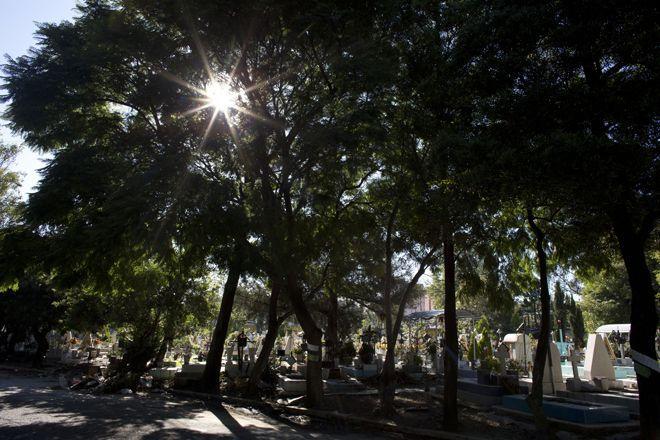
Edgardo Galvan watched as two gravediggers shoveled muddy soil from his father's grave until they reached a set of bones mixed with wood chips, the remnants of the coffin he was buried in seven years earlier.

The gravediggers placed the bones in a black plastic bag and handed them to Galvan, who planned to cremate them and put the ashes in a small crypt the family bought in a church.

"I've had to go through two difficult moments, first burying him and now unburying him," the 42-year-old carpenter said as he stood in the San Isidro cemetery in the Mexico City borough of Azcapotzalco.

Mexico's capital is rapidly running out of gravesites and many residents of this growing metropolis of 9 million people have to exhume the remains of their loved ones once the burial rights expire to make room for new bodies. Officials say there is no public land available for new cemeteries.

The lack of cemetery space has prompted the city's legislative assembly to propose a law that would reduce the time a body can remain in a grave and encourage people to cremate the bodies of their love ones, a move that critics say will threaten Mexico's long and rich traditions surrounding burying and celebrating the dead.

Assemblywoman Polimnia Sierra, who proposed the law, said the city's 119 cemeteries only have 71,000 gravesites available and that each year about 30,000 people die in the capital.

"In less than three years (the cemeteries) will be completely filled," said Sierra in defense of the law which was passed by the assembly this summer but sent back by Mayor Miguel Angel Mancera who wanted changes to its language. A vote on the revised law is expected soon.

It would require that the city government educate people about cremation as an option and build more crematoriums – there are currently just two public crematoriums. It would also lower the maximum gravesite tenure from 21 years to 15 years, as long as cemetery rights are paid.

Complicating matters is that the regulations aren't applied consistently, with borough officials administering and sometimes setting their own grave time limits in the cemeteries in their areas. Sierra said there have been cases of cemeteries exhuming graves to bury someone else in as little as one year.

Once exhumed, families commonly put the remains in above-ground niches offered by the cemetery, cremate them, bury them in a different cemetery or if no one claims the remains, they are re-buried at the same grave but underneath the coffin and tombstone of the new body.

While other countries around the world reuse graves, it is a sensitive issue in Mexico where celebrating the dead is still a living part of the culture.

The law has become a tug-of-war between government officials in the center of this sprawling metropolis, which is increasingly growing vertically, and residents of its outer, more rural boroughs who preserve pre-Columbian traditions.

The law's opponents say above-ground mausoleums and crypts don't allow for the traditional Day of the Dead celebrations on Nov. 1 and 2, when Mexicans honor the dead by building elaborate altars on their tombstones, laden with candles, flowers, colorful sugar skulls and the favorite food and drink of the departed. Entire families gather in cemeteries brightened by flickering candles to pray and share memories of their loved ones, whose photos sit on the graves.

Jesus Guzman, a member of the Autonomous Union of Native Towns and Neighborhoods of the Federal District, said many indigenous Mexicans prefer burial and are reluctant to accept cremation.

"Their worldview is not the same as ours," said Guzman of city officials backing the law. "Can you imagine that with the stroke of a pen they can erase All Saints Day and the Day of the Dead? They have no idea what they are doing."

In June, his group blocked a major avenue to protest the law.

In Mexico City's outer boroughs it's still common to see a nightlong wake being held on the patio of a home, then mourners carrying the coffin on their shoulders through traffic-clogged streets toward the cemetery. The processions are often accompanied by brass bands or mariachis.

"What really bothers us is that they don't respect our loved ones. They come a year or two after we bury them, take them out of the grave and bury whoever is next," said Jose Jimenez, who helps administer the San Francisco cemetery in the borough of Magdalena Contreras. "We won't allow them to take away our resources, our cemetery."

At the Azcapotzalco cemetery where Galvan's father was buried, 63,000 older gravesites are sold in perpetuity — burial time limits were established in 1984. Another 22,000 have limited tenure. Some graves have fresh flowers, but many others are overgrown with weeds. Records are kept in old ledgers, some barely legible, and officials say it's unclear how many graves have been abandoned.

Like many Mexicans, Galvan says mausoleums and crypts still seem like a foreign option to him.

His family has bought a crypt in a church in Mexico City's Tlatelolco neighborhood. Galvan said his mother wants her ashes, her husband's ashes, and two of her children's ashes, including his, to be in the same crypt.

"I told her that's fine, my ashes can be in that crypt but first I want to be buried, I want to be in the ground for at least a year," he said.

[readon1 url="http://latino.foxnews.com/latino/lifestyle/2014/10/28/mexico-city-running-out-cemetery-space-threatening-day-dead-traditions/"]Source:latino.foxnews.com[/readon1]

Blue-Label-Mexico

Telefonica Mexico has announced an agreement with the company Blue Label Mexico, owned by Bimbo Group, for the distribution and marketing of top-ups at over 70,000 points. The announcement of the recent agreement follows the start of an investigation by the Federal Telecommunications Institute (IFT) into suspected monopolistic practices in the market for distribution and marketing of electronic airtime top-ups. In view of the agreement, Telefonica Mexico informed the IFT that it is withdrawing an earlier complaint on the matter.

154390

Eleven exotic animals including African Lions and other large carnivores were transferred from Mexico to The Wild Animal Sanctuary in Colorado after the animals were confiscated from illegal or abusive situations. The Lions and other carnivores made the 1,700 mile journey to The Wild Animal Sanctuary where they will be rehabilitated and allowed to live the rest of their lives in large natural habitats.

Working in cooperation with a Mexican organization known as Bioparque Convivencia Pachuca, The Wild Animal Sanctuary began planning the rescue in late 2013. All eleven animals were rescued and sent to Bioparque's newly-renovated Captive Wildlife Way Station located approximately 150 miles northeast of Mexico City.

Once all the animals were at the single location, The Wild Animal Sanctuary coordinated with the US and Mexican Wildlife Authorities and the Way Station to transfer the animals to the Sanctuary's 720 acre facility in Colorado. To date, the Colorado non-profit organization has rescued over 30 exotic animals from various places within Mexico, and has plans to return in early 2015 to retrieve a number of rescued Tigers.

About The Wild Animal Sanctuary:
The Wild Animal Sanctuary is a 720 acre refuge for large carnivores that have been confiscated from illegal or abusive situations. The Sanctuary is located 30 miles northeast of Denver, Colorado near the town of Keenesburg. The non-profit organization currently cares for more than 350 Lions, Tigers, Bears, Wolves and other large carnivores and provides lifelong care for its rescued animals. The Sanctuary is the oldest and largest carnivore sanctuary in existence, having been in operation since 1980. The facility is distinctive among others in that it provides large acreage natural habitats for its rescued animals to live in and roam freely. The Sanctuary is open daily to the public for educational purposes and features an elevated "Mile Into The Wild" Walkway that visitors utilize to see the animals living in their habitats.

[readon1 url="http://www.prnewswire.com/news-releases/african-lions-rescued-from-mexico-981559336.html"]Source:www.prnewswire.com[/readon1]

140918-maria-echaveste-1619 991246db99e1e17e97331d3f9ac8094f

Maria Echaveste, a farmworker’s kid who served in the Clinton and Obama administrations, has been nominated as the next ambassador to Mexico. She would be the first woman to hold the post.

WASHINGTON — Lifelong high achiever Maria Echaveste, a farmworker’s kid shaped by California’s San Joaquin Valley, has been nominated for her biggest job yet, U.S. ambassador to Mexico.

If confirmed by the Senate, Echaveste, 60, would be the first woman to hold the high-profile post.

She would also be the first ambassador to have become a D.C. insider after spending formative time in Fresno County farm-labor camps.

“She’s a brilliant woman who understands the United States government, from her own time in the U.S. government,” Jeffrey Davidow, a former U.S. ambassador to Mexico, said in an interview. “And she knows a great deal about the Mexican government.”

President Obama nominated Echaveste on Sept. 18 for the position

The Senate Foreign Relations Committee could hold Echaveste’s confirmation hearing during the post-election session in November or December, though speed is not the Senate’s strong suit. About 40 ambassadorial nominees are awaiting Senate action. Some have waited more than a year.

“I feel special pride in this nomination and will do everything I can to help her get confirmed quickly,” said U.S. Sen. Barbara Boxer, D-Calif.

A possible complication would be Republicans regaining control of the Senate in next month’s elections, though there is no indication that GOP senators object to Echaveste specifically.

“Maria Echaveste brings a deep understanding of Washington and a long personal and professional history working on Mexican and Mexican-American issues, both of which will serve her well,” Council on Foreign Relations scholar Shannon K. O’Neil said in an email interview.

Echaveste declined to be interviewed.

Born in Harlingen, Texas, to migrant parents and the oldest of seven children, Echaveste moved with her family when she was young to Clovis, outside Fresno, Calif. When she was 12, the family moved again, to Southern California.

Now a policy adviser and a lecturer at the University of California, Berkeley School of Law, where she also was a student, Echaveste has risen steadily since her graduation from Stanford University and Berkeley. She previously served in the Clinton administration, eventually as the White House deputy chief of staff.

U.S. Rep. Doris Matsui, D-Calif., who worked closely with Echaveste in the Clinton White House, said, “Her professional, academic and personal experience makes her an outstanding nominee.”

For the Obama administration’s State Department, Echaveste was special representative to Bolivia.

She has been a regular donor to Democratic candidates, campaign records show, but her contributions have been modest, often several hundred dollars at a time.

As co-founder of Washington’s Nueva Vista Group, Echaveste registered as a lobbyist for the Blue Cross Blue Shield Association, the Association of Farmworker Opportunity Programs and the Coalition for Comprehensive Immigration Reform, among others. She is no longer a registered lobbyist, records show, but remains the company’s senior adviser.

Echaveste will need all her hard-won skills, first to navigate the confirmation process, and then to represent U.S. interests in what Davidow called a “very complicated relationship” between two countries that share a 2,000-mile border. Davidow, who was ambassador between 1998 and 2002, is now a senior adviser to the Cohen Group, a consulting firm.

“What the ambassador does is not only explain the U.S. government to the foreign government, but also explain the foreign government to the United States,” Davidow noted.

The U.S. presence in Mexico is one of the largest U.S. missions in the world, posing serious management demands. Twenty percent of all arrests of Americans abroad occur in the U.S. consular district in Tijuana, the State Department’s Office of Inspector General noted, while the Juarez consular office processes more immigrant visas than any other U.S. post in the world.

The job requires mastery of policies, including immigration reform, border control, and the struggle over drug trafficking. Two-way trade in goods and services between the countries surpasses $500 billion a year.

“She understands that the U.S.-Mexico relationship is not just about government-to-government relationship, but about managing the complex network of economic, social, and political engagements that happen every day between the two countries,” Andrew Selee, executive vice president of the Woodrow Wilson International Center for Scholars, said of Echaveste.

Echaveste would not be the first noncareer diplomat to head the embassy. Six of the past 10 U.S. ambassadors to Mexico came from outside the State Department. Their previous careers have ranged from movie actor and congressman to corporate executive and Texas lawyer.

The current ambassador, E. Anthony Wayne, is a Sacramento, Calif., native and career foreign-service officer. He also was nominated by Obama and took up his post in 2011.

maria-echaveste-bill-clinton-oval-office

RP DF

The year-to-date results were presented to the media; there were one-on-one interviews with journalists; Chef Betty Vázquez and Oster achieved cross marketing promotions.

Conscious of the fact that Mexico is the top producer of tourism to the region, the Riviera Nayarit Convention and Visitors Bureau (CVB) diversified its promotional efforts within Mexico City in order to attract more domestic tourism.

A press conference, one-on-one interviews and a cross marketing activity with the Oster brand and Chef Betty Vázquez, the Riviera Nayarit’s Culinary Ambassador, all served to strengthen public relations in the metropolitan area.

About 20 different media assisted the conference on October 6th, where the CVB presented the year-to-date results at Restaurante Estoril, where they also took the opportunity to talk about the upcoming International Gourmet Festival featuring Chef Thierry Blouet.

Some 22 articles have already been published to date about the event generating a total of approximately 100 thousand impressions. There were also one-on-one interviews with Darío Celis at Excélsior TV and Laura Rodríguez on Grupo Radio Imagen on October 7th.

Finally, a cross marketing activity took place with the Oster electrical appliances brand and Chef Betty Vázquez, where the Riviera Nayarit’s cuisine took center stage.

Accessories, cravings, releases, tastings, electrical appliances, festival, demos, culinary exhibits, gourmet, seafood and recipes were some of the elements that stood out during this timely promotional activity.


According to some of the articles that were generated as a result of this cross marketing effort: “The gastronomy of our country is recognized throughout the world. This is indeed the case with the Riviera Nayarit, which also boasts a privileged location. The climate is excellent and thanks to its abundant summer rains and its fertile terrain it’s possible to enjoy uniquely flavored produce, which is invariably showcased in its many recipes.”

b91934c4-4427-4147-a569-9f9e025affc5

CONFEX, Latin America’s leading LGBT conferences and Exhibitions Company has confirmed the city of Merida in Mexico’s Yucatan as the host of the Fifth edition of its LGBT Business Expo, Latin America's leading LGBT business event. The expo is scheduled to take place from September 18- 9, 2015.

The LGBT Business Expo is a B2B and consumer event targeting all elements of the LGBT community. Designed to maximize networking business and educational opportunities, the event has continually grown since its inaugural event in 2011 in Puerto Vallarta, doubling in scale with its 2012 edition in Cancun and continued its growth in 2013's International LGBT Business Expo in Guadalajara, Mexico and 2014’s edition in Vallarta-Nayarit.

In 2015, education presentations and workshops will be included from many leading global LGBT thought-leaders focusing in the platforms: Tourism, Corporate, Film, Academic, Entrepreneurs, Technology, and Media. It will also present a new academic platform entitled "International Congress on Sexual Diversity Studies" inviting leading researchers from universities worldwide.

LGBT Confex will be working with the city of Yucatan, its tourism and convention bureau, local entrepreneurs targeting the LGBT consumer and the State of Yucatan to feature the diversity of activities and services that the city has to offer for the LGBT Consumer.

CEO of LGBT Confex, Ruben Sandoval, said "We are very pleased and excited to have Merida as our host city for the Fifth Edition of the LGBT Business Expo as the city embodies Mexico’s Pre-Hispanic, Colonial and contemporary realities. It is a city unique in Mexico and one that has embraced the LGBT community.”

For more information about the LGBT Confex please visit: http://www.lgbtconfex.com/

Media Contact:
Carlos Lopez - This email address is being protected from spambots. You need JavaScript enabled to view it.

622x350

Interjet launched service from Houston's George Bush Intercontinental Airport to Monterrey, Mexico, on Oct. 23.

The inaugural flight arrived in Houston at 7:55 a.m. The Mexico-based airline will offer two daily nonstop flights Monday through Friday and one daily on Saturday and Sunday.

Monday through Friday, flights arrive in Houston at 7:55 a.m. and depart from Houston at 8:55 a.m. Additionally, Sunday through Friday, flights depart from Houston at 6:10 p.m. and arrive in Houston at 10:10 p.m. On Saturdays only, flights depart from Houston at 8:05 a.m. and arrive in Houston at 12:05 p.m.

Bush Intercontinental has added several new international flights over the past couple of years.

Scandinavian Airlines began nonstop flights from Houston to Stavanger, Norway, in August. Korean Air launched its Houston to Seoul service in May.

In April, Turkish Airlines expanded its Houston route to daily nonstop service on April 1, exactly one year after the airline's inaugural flight from Bush Intercontinental to Ataturk International Airport in Istanbul, Turkey.

Air China also expanded its Beijing route to daily service on March 28.

Houston's international passenger totals have increased more than 60 percent, rising to a record total of 9 million in 2013, according to the Houston Airport System.

olivia-pulsinelli-krang2013-white-backgroundOlivia Pulsinelli is the web producer for the Houston Business Journal's award-winning website. Follow her on Twitter for more.

102114 DGF Mexico 2075 605 1

Faust, officials, and alumni gather to celebrate longstanding ties

MEXICO CITY — In a building that originally housed a Jesuit college more than a century before the construction of Harvard’s Massachusetts Hall, alumni and friends of the University gathered yesterday in the heart of Mexico City for the latest event in the Your Harvard series. President Drew Faust, faculty members, and local alumni celebrated the many connections shared by Harvard and Mexico, some dating back more than a century.

Your Harvard is a global series of events organized by the Harvard Alumni Association (HAA) that will take place throughout The Harvard Campaign. Alumni have already convened in London, Los Angeles, and New York to hear about the future of the University and discuss cross-disciplinary perspectives with faculty on the challenges facing society.

More than 500 alumni came together last night at the Colegio de San Ildefonso, which was reopened in 1994 as a museum and cultural center that features some of the earliest examples of the Mexican muralist movement.

Gesturing over her shoulder to one such mural, “La Creation” by Diego Rivera, which framed the back of the stage, Harvard art curator Mary Schneider Enriquez reflected on Mexico’s tradition of blending art, education, and political discourse. The government’s decision in the 1920s to encourage artists to paint the inside walls of public buildings amounted to an effort to “educate through images.”

“Mexico has a very long history of art and politics being totally intertwined,” said Schneider Enriquez. “It is one of the great things about Mexico that I have always loved.”

She was a longtime resident of Mexico, and it was her unique perspective on Latin-American art, and Mexican art in particular, that she said led Harvard to hire her as Houghton Associate Curator of Modern and Contemporary Art for the Harvard Art Museums.

Faust noted in her address that she was the fifth consecutive president of Harvard to travel to Mexico, lauding the longtime connections between the University and a country that more than 1,200 alumni call home.

“The University’s increasingly global reach is exemplified by the students and faculty we now attract, and by expanding research and course offerings across the University,” said Faust. “The research interests that spark connections between Harvard and Mexico are extraordinarily varied — from archaeology to the arts, from education to public health, to economics, politics, [and] public policy.”

Strengthening that connection for the past quarter century, the Fundación México en Harvard, A.C. was established to provide financial support for residents accepted to graduate and postgraduate programs at Harvard. To date, nearly $12 million has been awarded to make Harvard a reality for hundreds of students from Mexico.

Students who receive a Fundación scholarship are required to return to Mexico after their studies to work in the country for at least two years.

Enrique Tellez Kuenzler, M.B.A. ’91, the Fundación’s president, celebrated the organization’s work by proudly noting that Mexicans now make up the largest number of Harvard students from Latin America. This past year alone, 98 Mexican students were enrolled at Harvard.

Faust also noted that digital learning is shrinking the distance between Mexico and Cambridge. Since the 2012 launch of HarvardX, more than 20,000 Mexican students have participated in the dozens of online courses created by faculty from across the University.

A diverse group of faculty similarly touched on innovation in education during the evening’s panel discussion.

“The key challenge of innovation is to integrate knowledge,” argued Julio Frenk, dean of the Harvard T.H. Chan School of Public Health and Mexico’s former Minister of Health. Universities, he noted, are drivers of innovation that produce a unique product: knowledge. “Knowledge is the most potent force we have for enlightened social transformation, and that is exactly what universities are there to produce, reproduce, recreate, translate, and lead. Therefore, the pathway [is there] for innovation to tackle the most important challenges.”

Jorge I. Domínguez, Antonio Madero Professor for the Study of Mexico and vice provost for international affairs, led the panel in a discussion that touched on a wide range of topics, including creativity in the arts, business, public health, and culture.

Other participants included Laura Alfaro, Warren Alpert Professor of Business Administration at Harvard Business School; and Alejandro Ramírez Magaña ’94, M.B.A. ’01, CEO of Cinépolis, the largest movie theater chain in Latin America.

Ramírez delivered the economic argument in favor of continued innovation in what he called the “creative industries.” Rattling off a host of statistics — including the fact that $1 trillion in U.S. economic activity is based in creative industries, 6.5 percent of the nation’s GDP — he highlighted the important role that innovation in the arts plays in the American economy.

“Sometimes people don’t realize how important creativity is to the economy and how much the creative industries contribute to economic growth,” Ramírez said. At a growth rate of 4.7 percent in recent years, he noted, the creative industries — from film to video games — have grown at twice the rate of the overall U.S. economy and now rank as the United States’ top export industry.

The liberal arts, he said, are critical to underpinning the creativity that enables that economic success.

“Something that I really valued from my College experience was the liberal arts curriculum,” Ramírez said, recounting how he looked through the course catalogue as a freshman and realized he’d never be able to take all the courses that interested him in four years.

As examples, he recalled an astronomy course in which he learned how telescopes work by visiting the Science Center, as well as a course called “Thinking About Thinking: Law, Science, and Philosophy,” co-taught by the late professor of geology Stephen Jay Gould, Harvard Law School Professor Alan M. Dershowitz, and philosophy Professor Robert Nozick.

“They would all tackle very moral questions, big dilemmas,” Ramírez said. “And each one would tackle it from a scientific, legal, and philosophical standpoint. And for me that’s one of the privileges of a liberal arts education, that you can actually open your mind and really change the way you see the world.”

The Your Harvard series continues later this week in Texas, where the Harvard Clubs of Dallas and San Antonio are both celebrating their 100th anniversaries. Events are also planned for Chicago and Seattle early next year.

Harvard President Drew Faust, University administrators, and faculty members are in Mexico this week for a series of meetings, tours, and alumni events. Read about Harvard’s deepening connections to Mexico in an ongoing Gazette series. Read vignettes showcasing the visit here.

Harvard-University-2013 1

[readon1 url="http://world.einnews.com/article/230581279"]Source:world.einnews.com[/readon1]

mexico-factory-homepage-highlight

Nestlé has opened its most water efficient factory in the world in Mexico, in a move that the company plans to replicate in other Nestlé factories globally.

Through new processes that deliver significant efficiencies, Nestlé’s Cero Agua dairy factory in the central, water-stressed state of Jalisco will move towards being a zero-water factory.

It will use mostly recycled water from its dairy operations.

‘Fragile resource’

The water resource savings are equivalent to the volume needed per day to fill an Olympic-size swimming pool, or enough water to meet the average daily consumption of 6,400 people in Mexico.

Over the past 60 years, the amount of water available for each person in Mexico has declined drastically due to population growth.

Saving groundwater is therefore important for the continued wellbeing of local populations.

"In Mexico, and around the world, water is a vital and fragile resource,” said Nestlé CEO Paul Bulcke.

“Due to the relevance of water in the production of food and its role in the preservation of life, Nestlé worldwide will continue to pursue initiatives that contribute to the maintenance and access to natural resources."

Reusing water

The Cero Agua dairy factory takes fresh cow’s milk, normally around 88% water, and heats it at low pressure to remove some of its water content.

The resulting steam is then condensed and treated and used to clean the evaporating machines themselves.

Once the machines have been flushed out, the water is then collected once more, purified and recycled a second time.

The water can then be reused for watering gardens or cleaning.

Reusing water from the milk in this way removes the need to extract groundwater for operations.

The amount of groundwater that the Cero Agua dairy saves each day, around 1.6 million litres, will amount to roughly 15% of the total water used by Nestlé in Mexico each year in its factories, operations and offices.

Cutting Nestlé water use

Such water savings are part of Nestlé efforts to promote the “conservation, treatment, recycling and water efficiency in our operations and among farmers, suppliers and other partners in our supply chain,” said Marcelo Melchior, who heads Nestlé Mexico.

The Cero Agua project is just one of a number of water-saving initiatives the company has introduced at its factories around the world in recent years.

These have allowed Nestlé to reduce total water withdrawal in absolute terms by almost one-third globally over the past 10 years, while increasing production; water use per tonne of product has fallen by half.

Worldwide, Nestlé aims to further reduce its water withdrawal per tonne of product by 40% by 2015, compared to 2005.

In 2013, Nestlé published its Commitments on Water Stewardship, highlighting the importance of water access and conservation.

These W.A.T.E.R. commitments are to:

*Work to achieve water efficiency across our operations
*Advocate for effective water policies and stewardship
*Treat effectively the water we discharge
*Engage with suppliers, especially those in agriculture
*Raise awareness of water access and conservation

Nestlé and water stewardship quick facts:

*Nestlé currently has more than 170 water-saving projects in its factories, saving 3.6 million m3
*6.7 million m3 of water was recycled or reused within our operations in 2013
*Nestlé has reduced water withdrawals by 33.3% per tonne of production since 2005
*Water discharges per tonne of product have been reduced by 48.5% since 2005

[readon1 url="http://world.einnews.com/article/230668711"]Source:world.einnews.com[/readon1]

TOYOTA

Toyota Motor Corp., the last major carmaker without a high-volume assembly plant in Mexico, said the group assessing whether to build a factory there is far from getting cleared by top management.

“There is a team studying it, but I’ll be honest with you, it’s still far from being an approved project,” Steve St. Angelo, head of Toyota’s Latin American operations, told reporters Wednesday in Tokyo.

Low labor costs and favorable trade accords with the United States and some Latin American countries are luring more foreign auto producers to Mexico.

Kia Motors Corp., BMW AG and a Daimler AG-Nissan Motor Co. venture have each announced $1 billion-plus factories since June, highlighting the lack of a comparable plant for Toyota.

President Akio Toyoda has stressed the need for the world’s largest automaker to exhaust all measures to boost output with existing factories. The grandson of the company’s founder is showing restraint after overexpansion contributed to a 2009 fiscal year loss and recalls of more than 10 million vehicles for unintended acceleration.

“Akio is very firm on us about growing in a sustainable way,” St. Angelo said. “He doesn’t want us to go through another recession and have to shut down plants.”

b-toyota-a-20141024-870x650

[readon1 url="http://www.japantimes.co.jp/news/2014/10/23/business/corporate-business/toyota-says-possible-mexico-plant-far-from-getting-presidents-approval/#.VEkM4PnF_UU"]Source:www.japantimes.co.jp[/readon1]

Poll-Should-Daylight-Savings-Time-Exist

A brief history and explanation of the annual madness that is daylight saving time.

To arrive at the right time for your Sunday activities, remember to turn your clocks back one hour if you are in most parts of Mexico.

Puerto Vallarta and Riviera Nayarit will gain an hour at 2:00 am on Sunday, October 26, 2014, by turning back clocks to Central Standard Time.

The majority of the remainder of the world that observes DST will turn their clocks back on Sunday, November 2, at 2:00 am.

Quoted from TimeTemperature.com: In 2010, ten Mexico municipalities which share a border with the United States began Daylight Saving Time three weeks earlier on the second Sunday in March and end on the first Sunday in November. Previously all of Mexico, with the exception of the state of Sonora which does not observe Daylight Saving Time, began and ended DST at the same time. The Congress of Mexico passed legislation in December 2009 which allowed these ten border cities to adopt a Daylight Saving Time pattern consistent with the United States. The municipalities which are now permitted by law to observe DST consistent with the United States are:

• Acuna, Coahuila
• Anahuac, Nuevo Leon
• Juarez, Chihuahua
• Matamoros, Tamaulipas
• Mexicali, Baja California
• Nuevo Laredo, Tamaulipas
• Ojinaga, Chihuahua
• Piedras Negras, Coahuila
• Reynosa, Tamaulipas
• Tijuana, Baja California

Mexico changed to DST on April 6, 2014, three weeks after the US and Canada changed their clocks on March 9. Now we're changing a week ahead.

The three weeks in the spring before Daylight Saving Time began in Mexico, and one week in the fall after Daylight Saving Time ends in Mexico, makes most of Mexico one hour out of sync with the corresponding US and Canadian time zones. Keep these time differences in mind when making your Mexico travel plans.

[readon1 url="http://pvangels.com/news/2926/fall-back-daylight-saving-time-ends-in-vallarta-nayarit-on-october-26"]Source:pvangels.com[/readon1]

key-west-81664 640-600x350

Six people were killed as tropical storm Trudy -- since downgraded to a tropical depression -- lashed Mexico, prompting evacuations and stranding 16 communities, authorities said Sunday.

The heavy rains caused a landslide on a farm in the indigenous town of Tlacoachistlahuaca in the southern state of Guerrero, killing a 23-year-old man, a civil protection official told local media.

Two children and a woman were crushed to death when a wall collapsed in a mudslide in Ometepec; another person was buried in Cochoapa by a caved-in wall; and a swollen stream swept away and killed a 70-year-old man, officials said.

Some 2,000 people were evacuated from three towns in the mountain region hardest hit by Trudy. Authorities urged residents not to return home for at least 48 hours, until the threat of landslides passed.

Another 300 people were evacuated Saturday night in three other Guerrero towns, where a river threatened to overflow and cause dangerous flooding.

Landslides and flooding also cut off access to 16 other towns and damaged a main road to Acapulco.

Last year, a twin hit from tropical storms battered both coasts, leaving 157 dead.

In September, Hurricane Odile killed six people and caused $1 billion in damage further north on Mexico's Pacific coast, wreaking havoc in the luxury resort area of Los Cabos.

[readon1 url="http://www.msn.com/en-us/news/weather/tropical-storm-batters-southern-mexico-coast-kills-one/ar-BBa1UIP"]Source:www.msn.com[/readon1]

afp-in-mexico-codex-exhibit-rethinks-moctezumas-death

Mexico's largest exhibit of Mesoamerican manuscripts features a codex made of fig tree bark suggesting that Aztec emperor Moctezuma was slain by a Spanish conquistador with a sword.

The piece is among 44 codices made by several pre-Columbian populations -- including the Mayas, Purepechas and Zapotecos -- on display at the National Museum of Anthropology.

Some of the pieces in the temporary exhibit, titled "Codices of Mexico: Memories and Wisdom," are as large as 10 square meters (108 square feet).

One cost the government $1 million to buy from the Bible Society in Britain.

"It's the biggest codex exhibit (in Mexico)," curator Baltazar Brito, director of the National Anthropology and History Library, told AFP.

The codices were written by tlacuilos, which in Mayan means a person who carves stones.

The ancient manuscripts present a vision of history from the point of view of "the people who were subdued after the conquest," Brito said.

"They are a very important demonstration of the knowledge acquired by Mesoamerican peoples throughout their history."

The collection's centerpiece is the Chimalpahin codex, which the government bought in May from the Bible Society to stop it from being auctioned off.

The manuscript was made by indigenous historians Domingo Chimalpahin (1579-1660) and Alva Ixtlilxochitl (1578-1650).

The piece recounts the daily life of Mexican society in the country's central regions as well as during colonial times under New Spain.

Another jewel in the museum's treasure trove is the Moctezuma codex, a two-meter (two-yard) long and 25-centimeter (10-inch) wide piece made with the bark of a fig tree.

Ancient chronicles say Moctezuma was stoned to death in 1520 by his own people, who considered him a traitor for surrendering to the Spaniards.

But the small drawings in the Moctezuma codex tell a different story of the final days of one of the last Aztec emperors.

"This codex shows us how he was captured by a Spaniard and then he is seen dead, bloodied with a sword," Brito said.

"This is another version of history that has a lot of value because the codices were considered works done by the people, for the people."

There are some 650 Mexican codices in museums around the world, and a third belong to Mexico's Museum of Anthropology.

The current exhibit, which runs through January, includes manuscripts describing plants and recipes that the Spanish crown forced the indigenous populations to elaborate after learning about their medicinal value.

The indigenous populations also used these manuscripts to appeal for their rights before the crown.

One codex was drawn on a nopal cactus to depict the family tree of the elite who lived in the ancient city of Tenochtitlan, where Mexico City lies today.

"The messages of the codices have yet to be completely deciphered," Brito said.

 [readon1 url="http://www.businessinsider.com/afp-in-mexico-codex-exhibit-rethinks-moctezumas-death-2014-10?utm_source=feedburner&utm_medium=feed&utm_campaign=Feed%3A+businessinsider+%28Business+Insider%29"]Source:www.businessinsider.com[/readon1]