







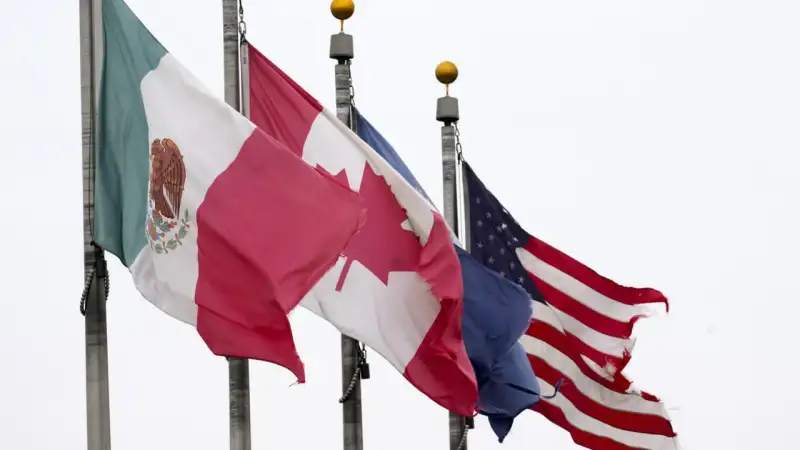
US and Mexican negotiators began bilateral discussions the week of March 16 as part of the formal joint review of the United States-Mexico-Canada Agreement, the US Trade Representative's office confirmed. Trade Representative Jamieson Greer and Mexican Secretary of Economy Marcelo Ebrard have instructed their teams to open scoping discussions focused on measures to ensure the agreement's benefits accrue primarily to the parties, including, specifically, by reducing dependence on imports from outside the region.
USMCA took effect on July 1, 2020, replacing the 1994 North American Free Trade Agreement. It was negotiated during the first Trump administration, with changes to automotive rules of origin, dairy market access, labour standards, and intellectual property protections among the key modifications. The agreement includes a built-in review mechanism triggered six years after entry into force, which falls in 2026.
The Trump administration's current review combines that scheduled joint review with the administration's broader trade policy orientation, which has involved tariffs on imports from multiple countries and a stated priority of reducing US trade deficits. USMCA goods that comply with the agreement's rules of origin are exempt from those tariffs, making the agreement's terms directly relevant to the economic architecture of the US-Mexico trade relationship.
The scoping discussion is the earliest formal stage of the review: it identifies the issues each party wishes to raise and sequences more detailed negotiations. It does not bind any party to specific positions. But it establishes the agenda for the process that will shape the July 1 notification to Congress.
The Third-Country Content Problem
The specific framing of the scoping discussion, ensuring benefits accrue primarily to the parties, including by reducing dependence on imports from outside the region, targets a concrete concern in US trade policy circles: that goods from China are being routed through Mexico or Canada to access USMCA preferences without genuinely meeting rules of origin requirements.
This concern is most acute in automotive. Rules of origin specify minimum regional content requirements for vehicles to qualify for duty-free treatment. If Chinese-made components are incorporated into vehicles assembled in Mexico and exported to the US as USMCA-compliant, the agreement's trade benefits flow to supply chains that were not the primary intended beneficiaries.
For Mexico, the framing creates both a challenge and a workable negotiating context. Mexico has significant interest in maintaining USMCA's tariff preferences and has been developing policy responses to the routing concern, investment attraction strategies oriented toward North American supply chain development rather than Chinese component assembly. The negotiation is therefore not simply adversarial.
The bilateral discussions with Mexico are running in parallel with separate US-Canada discussions that Greer indicated were also being planned. USMCA is a trilateral agreement, and modifications ultimately require agreement from all three parties, even as each bilateral relationship surfaces its own distinct issues.
What July 1 Actually Requires
The July 1 Congressional notification requirement does not mandate that modifications be agreed by that date, it requires that the administration declare its intentions. The administration can notify Congress that it plans to seek modifications, or indicate that no changes are being pursued. What it cannot do is leave the question open indefinitely.
For businesses operating under USMCA, the period between now and July 1 represents maximum uncertainty. Decisions about supply chain investment, manufacturing location, and sourcing are being made against an incomplete picture of what modifications, if any, the administration will pursue. The July 1 notification will provide considerably more clarity than currently exists, but it will not end the uncertainty, only reduce it.
Frequently Asked Questions (FAQs)
Q: What is USMCA and how does it differ from the original NAFTA?
A: USMCA (United States-Mexico-Canada Agreement) took effect in July 2020, replacing the 1994 North American Free Trade Agreement. Key differences from NAFTA include stricter automotive rules of origin requiring a higher percentage of regional content for vehicles to qualify for duty-free treatment, new digital trade provisions, stronger labour standards including minimum wage requirements for automotive workers, expanded US dairy market access in Canada, and a sunset clause with a built-in six-year joint review process that NAFTA did not have.
Q: Why does USMCA have a July 1 deadline for the Trump administration?
A: USMCA includes a built-in joint review mechanism that activates six years after the agreement's entry into force, which falls in July 2026. The Trump administration is required to notify Congress of its intentions regarding the agreement by that date. This creates a hard calendar constraint that structures the spring 2026 negotiating timeline: scoping and issue identification must be substantially complete before the July 1 notification, even if detailed renegotiation continues afterward.
Q: What does 'reducing dependence on imports from outside the region' mean in trade policy terms?
A: This language targets the concern that goods from non-USMCA countries, particularly China, are being incorporated into North American production chains in ways that allow the final product to qualify for USMCA duty-free treatment despite containing significant non-regional content. Tightening rules of origin to require higher levels of specifically North American content addresses this by making it commercially unattractive to route third-country goods through the region to access US tariff preferences.
Q: How does the US-Canada USMCA discussion relate to the US-Mexico talks?
A: USMCA is a trilateral agreement, and the formal joint review involves all three parties. The US is conducting bilateral discussions with Mexico and separately with Canada, with Greer indicating that US-Canada meetings were also being planned. The bilateral format allows each relationship's specific issues to be discussed without the three-way complexity of trilateral sessions, but modifications to the agreement ultimately require trilateral agreement since changes to a trilateral treaty cannot be imposed bilaterally.
Q: What sectors beyond automotive are most likely to be affected by USMCA modifications?
A: Automotive rules of origin are the highest-profile area given their direct relevance to the third-country content concern. Other sectors that could be affected include steel and aluminium, where existing tariffs and USMCA interactions create complex trade flows; agricultural products, particularly in the context of US-Mexico disputes over GMO corn and biotechnology; and digital trade provisions, where the agreement's current rules are more advanced than in many other trade agreements and may be subject to refinement.
Q: How are Mexican businesses responding to the uncertainty around USMCA's future terms?
A: Mexican businesses and foreign investors operating in Mexico are managing the uncertainty primarily by monitoring the negotiation signals closely and, where possible, deferring major supply chain investment decisions until the July 1 notification provides greater clarity on the administration's intentions. Some sectors, particularly automotive, have been engaging directly with both governments to provide input on rules of origin modifications. The nearshoring investment trend in Mexico has created additional complexity, as companies that relocated supply chain operations to Mexico partly in anticipation of USMCA stability are now factoring potential modifications into their planning.