







To understand why a limited-edition Hot Wheels model of a car that stopped being manufactured in 2017 can sell for the equivalent of a real used vehicle, you first need to understand what the Nissan Tsuru meant to Mexico, not as a product, but as a presence.
The Tsuru was not Mexico's fastest car, or its most luxurious, or its most technically advanced. It was its most everywhere. For more than three decades, it was the ambient backdrop of Mexican life: in driveways, in traffic, at taxi stands, outside schools, parked beneath market awnings in every city from the Sonoran desert to the Yucatan coast.
Its story begins in 1984, when Nissan introduced the sedan to the Mexican market under a name drawn from the Japanese word for crane, an elegant choice for a vehicle that would, over the following decades, prove almost as long-lived and adaptive as its avian namesake.
The Architecture of Ubiquity
The Tsuru's dominance was built on a straightforward proposition: maximum reliability at minimum cost. In a country with a large working-class population, limited access to credit, and road conditions that tested vehicles regularly, a car that could survive years of hard use without demanding expensive maintenance was not a minor advantage, it was a decisive one.
Nissan manufactured the Tsuru in Mexico continuously for 33 years, through several generational updates that retained the car's fundamental character: compact, sturdy, no-frills, affordable. By the time production ended in 2017, it had become a fixture of the Mexican automotive market in a way that few foreign-made vehicles achieve anywhere in the world. Outside of Germany's relationship with the Volkswagen Beetle, which achieved a comparable mythology in Mexico, the Tsuru stands as perhaps the most complete example of a foreign-origin car becoming a genuinely national object.
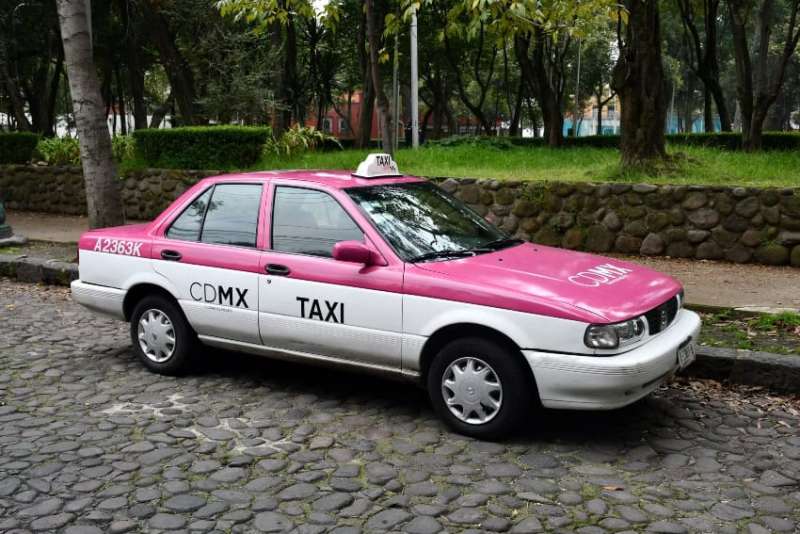
The taxi sector accelerated this process. Tsurus were not merely popular as taxis, they were, in many cities, the default assumption. The four-door sedan body was the right size for passengers with luggage. The engine was straightforward enough for independent mechanics to service. The parts were widely available and inexpensive. These were not glamorous qualities, but they were exactly the qualities a taxi driver operating on thin margins needed in a vehicle.
The Safety Controversy That Ended Production
The circumstances of the Tsuru's discontinuation in 2017 added a complicated chapter to its legacy. Independent crash safety tests conducted by organisations including Latin NCAP had, over the years, highlighted the vehicle's poor performance in frontal collision scenarios. The results were striking enough to attract significant media attention in Mexico and internationally, raising public debate about whether the car's affordability was coming at a hidden cost to driver and passenger safety.
Nissan's decision to end Tsuru production in 2017 was driven by multiple factors, updated safety regulations in Mexico, the age of the platform, and the reputational pressure created by the crash test coverage. The company chose not to invest in bringing the Tsuru's safety architecture up to modern standards, closing a production run that had lasted well beyond what most automotive platforms achieve.
After Production: The Myth Persists
What happened after 2017 is, in its own way, the most interesting part of the Tsuru story. The car did not disappear. Used Tsurus remained on Mexican roads in large numbers, maintained by a network of independent mechanics who had spent years learning the vehicle's idiosyncrasies. In a country where a significant portion of the population relies on affordable, second-hand vehicles, a Tsuru with 200,000 kilometres on the engine, but in good mechanical condition, remained a practical and valued option.
The nostalgia that found its expression in the Hot Wheels frenzy of late 2025 is not manufactured sentiment. It is the accumulated weight of a generation of Mexicans for whom the Tsuru was not a choice among many, but simply the car that their family drove, or that their city's taxis used, or that their first driving lesson took place in. When you next travel in Mexico, whether through a capital metropolis or a regional city hours from the nearest highway, try counting the Tsurus you pass. The number, even now, nearly a decade after production ended, will likely surprise you.
Frequently Asked Questions
Q: Why did Nissan stop making the Tsuru in 2017?
A: Production ended in 2017 due to a combination of factors including updated safety regulations in Mexico, the age of the vehicle's platform, and sustained criticism following independent crash safety tests that found the Tsuru performed poorly in frontal collision scenarios.
Q: How many Nissan Tsurus were sold in Mexico?
A: The Tsuru was one of Mexico's best-selling vehicles across its 33-year production run from 1984 to 2017, with millions of units sold. It consistently ranked among the top-selling cars in the Mexican market during that period.
Q: Was the Nissan Tsuru ever sold outside Mexico?
A: The car was sold in other Latin American markets, but not in the United States or Canada under the Tsuru name. Nissan marketed the equivalent vehicle in North America as the Sentra, which is why the Tsuru developed its particularly strong identity as a Mexican-specific product.
Q: What cars replaced the Tsuru as Mexico's most popular taxi?
A: After the Tsuru's discontinuation, taxis in Mexican cities have increasingly shifted to models such as the Nissan Versa and various Chevrolet and Volkswagen models. Some cities have also seen growth in ride-sharing platforms, though traditional taxis remain dominant in most regional markets.
Q: Why is the Tsuru compared to the Volkswagen Beetle in Mexico?
A: Both vehicles achieved an unusual cultural status in Mexico that goes beyond commercial success, they became associated with everyday working life, taxi culture, and accessible transportation for ordinary Mexicans across generations, giving them a mythological resonance that most vehicles never achieve.