







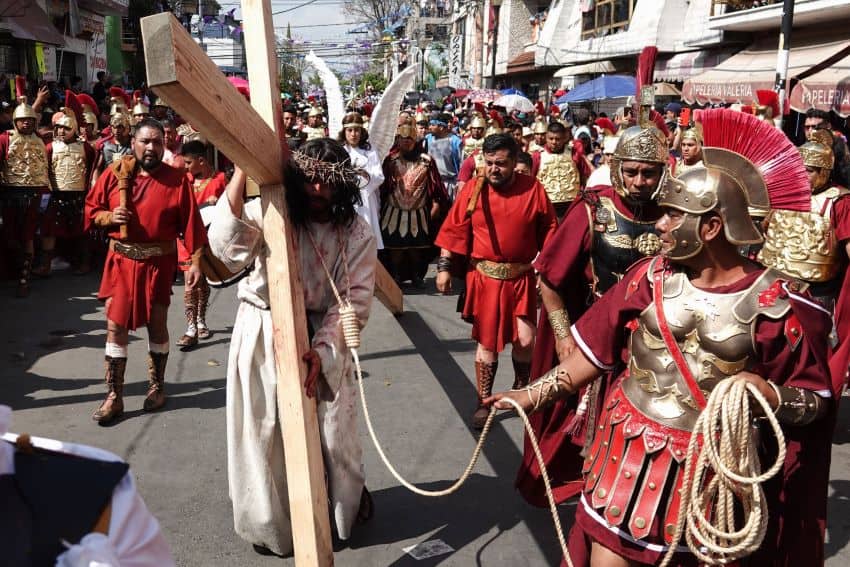
The Passion Play, a dramatic reenactment of the final days and crucifixion of Jesus Christ, is performed in communities across Mexico during Good Friday. The tradition has roots in the evangelisation strategies of the colonial Catholic Church. It has survived and evolved over five centuries into one of the most widely maintained public religious performances in the country.
Colonial Origins of the Form
When Spanish missionaries arrived in Mexico in the sixteenth century, they faced the challenge of communicating Catholic doctrine to populations with no prior exposure to the tradition and, in most cases, no shared spoken language. Theatre and dramatic performance had been central to pre-Hispanic religious practice across Mesoamerica. The missionaries adapted this existing cultural technology for their own purposes.
Religious plays, called autos sacramentales, were used to dramatise biblical narratives in ways that did not require literary literacy or shared vocabulary. The Passion narrative, with its clear sequence of events and strong visual elements, was among the most frequently performed. Performances were staged in open public spaces, often outside church atria, to accommodate large community audiences.
This approach was effective partly because it met the existing ritual framework of pre-Hispanic communities halfway. Communities that had already organised collective ceremonial performances found the form familiar even if the content was new. The result was a syncretic tradition that gradually took on local characteristics specific to each community.
Regional Variations Across Mexico
The most internationally recognised Passion Play in Mexico is staged in Iztapalapa, a borough of Mexico City. It draws audiences in the hundreds of thousands and is one of the largest annual public events in the capital. Iztapalapa's production has been performed continuously since 1833, a record of uninterrupted tradition that has made it a reference point for the form.
Outside the capital, Passion Plays vary considerably in scale, staging, and the degree to which they incorporate local cultural elements. Coastal tourist destinations like Puerto Vallarta have versions shaped by their specific community makeup, including a significant resident expatriate and visiting audience alongside local Catholic families.
In smaller communities, the performance may involve most of the neighbourhood's adult population in some capacity, whether as performers, costume makers, or organisers. The collective investment of preparation time, often spanning months before Good Friday, is itself a form of community cohesion distinct from the performance itself.
The Form in Puerto Vallarta's Context
Puerto Vallarta's Passion Play reflects the city's particular social character. A coastal city with a mixed population of long-term local families, internal migrants from elsewhere in Jalisco and Mexico, and a large international presence handles the tradition differently from a historically rooted inland community.
The performance in Puerto Vallarta moves through central public spaces and streets, which makes it accessible to visitors and casual observers alongside the practicing Catholic community for whom it carries full religious significance. This dual audience is characteristic of many Semana Santa observances in Mexican tourism destinations. The religious and the cultural tourism dimensions coexist without either entirely displacing the other.
Frequently Asked Questions (FAQs)
Q: Why did Spanish missionaries introduce Passion Plays in colonial Mexico?
A: Spanish missionaries needed to communicate Catholic doctrine to populations with no prior exposure to the tradition and no shared spoken language. They adapted the existing pre-Hispanic tradition of religious theatre, which was already central to community ceremonial life in Mesoamerica. Dramatic performances could convey biblical narratives without requiring literary literacy, making them effective evangelisation tools.
Q: What are autos sacramentales?
A: Autos sacramentales were religious plays used in colonial Mexico to dramatise biblical narratives for community audiences. Derived from Spanish religious theatre, they were adapted in Mexico to incorporate local performance traditions and staged in open public spaces outside churches. The Passion narrative was among the most frequently performed due to its clear sequence of events and strong visual elements.
Q: Where is Mexico's most famous Passion Play performed?
A: The most internationally recognised Passion Play in Mexico is staged in Iztapalapa, a borough of Mexico City. It draws audiences in the hundreds of thousands and has been performed continuously since 1833. The scale and continuity of the Iztapalapa production make it a reference point for the tradition, though Passion Plays are performed in communities across the country.
Q: How does Puerto Vallarta's Passion Play differ from those in inland communities?
A: Puerto Vallarta's performance reflects its character as a coastal city with a mixed population including long-term local families, internal migrants, and a large international presence. The reenactment moves through central public spaces accessible to casual observers alongside practicing Catholic community members. This dual audience is characteristic of Semana Santa in Mexican tourism destinations, where religious observance and cultural tourism coexist.
Q: How long do performers typically prepare for the Passion Play?
A: In many Mexican communities, performers prepare for the Passion Play throughout the year before Good Friday. In some communities, the preparation period begins immediately after the previous year's performance. The collective investment of preparation time across months, involving costume makers, directors, and the performers themselves, functions as a form of community organisation distinct from the performance itself.




 How to resolve AdBlock issue?