acIt’s been only three months since the launch of the two direct flights from Manchester and London to the Vallarta-Nayarit International Airport and already British tourists make up 3% of the total of visitors to the Riviera Nayarit. 

The first numbers are in and according to the statistics rounded up during the daily surveys conducted by the research department of the Riviera Nayarit Convention and Visitors Bureau (CVB), the Brits have responded magnificently to recent events: they already make up a full 3% of the total of tourists that have visited the destination.

The launch of the two weekly direct flights from Manchester and London to the Vallarta-Nayarit International Airport through the wholesaler TUI and Thompson airlines was the trigger that began the snowball, as every flight has arrived full or near to capacity.

Previously, tourists to the Riviera Nayarit were divided among Mexicans, Canadians and Americans, with 1% made up of other nationalities. During the first semester of 2013, this translated into 67% from Mexico, 25% from the United States and 7% from Canada, with the remaining 1% visiting from the rest of the world.

By 2014, the same time period showed that now, thanks to these flights, the influx of British tourists has increased over that of other countries that lack the facilities to travel to this destination. The percentages changed accordingly: Mexican tourists made up 66% of the total, those from the US made up 20%, Canadians 9%, Britons 3% with 1% remaining for the rest of the countries around the world.

Taking into consideration the number of passengers the two direct flights can fly in from England there could be a total of 600 visitors per week; this means that approximately seven thousand Britons have visited the region in the last trimester alone.

It’s important to point out that each British visitor represents an extended stay and increased income for the region; due to the logistics of the flights they stay in the destination for at least a week, though the majority opt for two weeks and, in some cases, even three or four weeks.

On the other hand, according to the Riviera Nayarit CVB survey takers, there are already a growing number of Colombian and Brazilian tourists to the region; eventually there will be statistics to reflect the advances the joint promotions have made within the emerging markets reached by the Vallarta-Nayarit campaign.


Logos1The largest travel agency in Brazil, SubMarino Viagens and several Brazilian media representatives will be arriving via Aeroméxico Airlines on a FAM trip coordinated by the Riviera Nayarit CVB and the Brazilian office of the MTB.

Aeroméxico Airlines is currently taking the largest Brazilian OTA, SubMarino Viagens, as well as several members of the Brazilian communications media, on a short promotional tour through Mexico.

The Riviera Nayarit Convention and Visitors Bureau (CVB) will coordinate their visit to Mexico’s Pacific Treasure from August 27-29, in order to give them the grand tour of the destination’s best attractions.

This activity is part of an arrangement by the Mexico Tourism Board (MTB) in Brazil; the tour includes Mexico City and Puerto Vallarta, among others.

The SubMarino Viagens OTA reports over 6 million monthly visits to its website, with over 30 page views per visit; 34% of its readers are 35 to 49 years old and 29% are between 25 and 34 years old.

The agency has over 2.3 million likes on its Facebook page and its Twitter account has over 124k followers; it also boasts over 29 million television subscribers on pay and satellite TV.

The five Brazilian communications media specializing in tourism and travel enjoying the FAM trip are: Brasil Travel News with a circulation of 40 thousand issues per month; the Revista Viajar Pelo Mundo with an equal circulation; MSN with 7 million unique monthly visitors and IG with 3.5 million unique monthly visitors.

The visitors will tour the Marietas Islands, one of the Riviera Maya’s iconic attractions; the “hippie chic” town of Sayulita, also known as the area’s Surf Capital; San Francisco, or San Pancho, called the Riviera’s Cultural Capital; and finally, La Cruz the Huanacaxtle, the Nautical Capital of the Riviera and its cutting-edge Marina Riviera Nayarit, the most modern marina in all of the Mexican Pacific.


R7

A representative from Brazil’s second-largest web portal, www.r7.com, came to the Riviera Nayarit on a FAM trip sponsored by the CVB; she has already published the first of two pieces online that will be viewed by millions of Brazilians.

The public relations activities accomplished by the Riviera Nayarit Convention and Visitors Bureau to expand the destination’s exposure in specific markets are targeted, effective, and meeting and exceeding goals.

Brazil is an emerging market and full of potential tourists to the Riviera Nayarit, so the recent FAM trip for Francine Costanti dos Santos, a journalist for www.r7.com, was right on the money, as her publications reach the entire country of Brazil and other Portuguese-speaking countries around the world.

The title of the article touting images of the enigmatic Marietas Islands states: “The Riviera Nayarit Charms With Its Vibrant Color And Natural Beauty.” The journalist introduces the destination to her countrymen saying: “The newest destination in Mexico attracts thanks to its crystal-clear beaches and luxury hotels.”

The article was posted on August 18th, and highlights the destination and its hotels; there is another in the works dedicated to the activities guests can enjoy while in Mexico’s Pacific Treasure. Francine’s trip was lengthy and filled with so many events that there’s a good chance she will publish more than the two she was currently assigned.

The investment made in the journalist’s trip was well worth the amount of impressions and views her articles will net for the destination.

The R7 website touts 47.1 million unique visitors per month, 77% of which belong to the A and B socioeconomic groups. R7’s Facebook account has nearly 8 million “likes;” on Twitter they have a little over 3 million followers and on Instagram another 30 thousand.

Last May, R7 published one of the releases sent out by the Brazilian PR agency handling the Riviera Nayarit CVBs account in that country. It was thanks to the extensive reach of this communication that the four continents where Portuguese is spoken were made aware of the destination.

This is the kind of ally the Riviera Nayarit is needs and is searching for in order to reach the markets it’s courting. This way, they can access as many people as possible while taking full advantage of the resources available.


To read the original pieces please click here: Entretenimento r7


 630x355

The Vallarta Nayarit ad campaign, which is co-sponsored by the Mexico Tourism Board, is gaining traction, with Puerto Vallarta and Riviera Nayarit recouping 100,000 of 400,000 air seats lost during the recession that began in 2008, said Richard Zarkin, public relations director for the Riviera Nayarit Convention and Visitors Bureau. “In 2009 the swine flu came, along with safety perceptions about Mexico, which didn’t help at all,” he said.

The tide, however, is now turning. “The Vallarta Nayarit campaign is working very well for both destinations,” Zarkin said. “Business, especially from Canada and the U.S. West Coast and Midwest, was really strong” during the first half of this year.

Specifically, business from California, Oregon, Washington, and the Denver and Chicago areas is on the rise, said Zarkin. In Canada high-performing destinations included the provinces of British Columbia, Alberta, Quebec and Ontario. “Calgary has grown very much along with Edmonton,” he said.

This winter, Alaska Airlines will add more lift from Portland, and Delta from Seattle and New York’s JFK. “We’re also seeing more flights and/or larger aircraft out of Phoenix, Dallas and Houston,” Zarkin said.

Mexican travelers serve as the No. 1 market to the region, followed by the U.S., which represents 20 percent of the market, and Canada, which represents 17 percent.

Business from the UK, meanwhile, which represents three percent of the market to the region, is also continuing to grow. The UK’s TUI Travel PLC this year began offering charters on Thomson Airways out of Manchester and London-Gatwick.

Business is also on the rise from the Latin American countries of Colombia, Peru, Chile, Argentina, and Brazil, said Zarkin. “We’ve not only diversified our market in Europe with the UK but we started to do public relations in South America,” said Zarkin.

On the hotel front, the 450-room Iberostar Playa Mita opened late last year in Litibu on the northern section of Banderas Bay. The RIU Jalisco reopened late last year following a $12 million in a renovation, the Palladium became a Grand Palladium and the Allegro the Occidental Grand, Zarkin said.

In other developments, Mexico’s National Trust for Tourism Promotion (Fonatur), which is responsible for the development of Cancun, Los Cabos, Huatulco and Litibu, is in the midst of creating Costacapomo, a tourism project located in Nayarit’s Compostela, said Zarkin. The development will include more than 3,000 hotel rooms, a Greg Norman-designed 18-hole golf course and two beach clubs.

The development goes hand in hand with a new Jala-Compostela-Las Varas-Bahía de Banderas highway whose construction be finished by the of 2015, as well as the transformation of the Tepic airport into an international one.

[readon1 url="http://www.travelpulse.com/news/destinations/the-vallarta-nayarit-campaign-is-gaining-traction.html"]Source:www.travelpulse.com[/readon1]


 VW-1940x1293

Over the last 20 years Mexico has emerged as a major automotive exporter. While Detroit has struggled to sustain itself as a world-leading automotive hub, Mexico has quietly become the world’s fourth largest automobile exporter. Chrysler builds HEMI engines and Ram pickup trucks in Saltillo, a city located 350 miles south of San Antonio in the Mexican state of Coahuila. General Motors builds Silverado pickup trucks in the state of Guanajuato, north of Mexico City. Mexico is actually home to North America’s largest car factory, a Volkswagen facility in Puebla that employs more than 16,000 people and produces more than 500,000 cars a year. Audi working on a billion dollar facility in Mexico. BMW and Nissan both have plans for billion dollar plants south of the U.S. border. Eric Farnsworth, the Vice President at the Council of the Americas in Washington D.C., told me “Investors see Mexico as an export platform with access to the United States.” While some observers may see Mexico’s auto industry as a threat to U.S. automobile production, a growing chorus of voices is advocating the concept of North American competitiveness.

As I explained in a recent article for Fox News Latino, “The simplest logic suggests that there is a zero-sum calculation that any new auto plant in Mexico means one less plant in the U.S. and that every job created means one fewer job in the U.S.”

Such analysis, however, misinterprets the benefits of cross-border, integrated production. Companies that coordinate operations on both sides of the border are proving that they can out-compete manufacturers in Europe and Asia.

“Mexico isn’t taking jobs from the U.S.,” Eric Farnsworth told me, “Because of integrated supply chains, up to 40 percent of the content of the products Mexico exports comes from the U.S.”

As I explained in my Fox News Latino article, “since NAFTA came into force in 1994, foreign direct investment (FDI) in North America has increased nearly sixfold from $110 billion per year in 1992 to $650 billion per year in 2010, and today more than $1 billion dollars of goods and services cross the U.S.-Mexico border every day.”

As Mexican President Enrique Peña Nieto explained in an editorial in the Dallas Morning News, the U.S. “sells more of its exports to Mexico than it does to Brazil, Russia, India and China combined. By increasing economic growth in Mexico, we create jobs in the U.S.”

“The North American automobile industry is one of the most compelling cases of economic integration in the world,” Tony Payan, director of the Mexico Center at the Baker Institute for Public Policy at Rice University, told me.

Ongoing Economic Challenges

Although Mexico is increasing its industrial output, the economic model the country has pursued since the mid 1980s has not yet translated into widespread prosperity. As I explained in my Fox News Latino article, “Mexico may be home to 16 billionaires, but more than 11 million of the country’s 120 and some million people live in extreme poverty. In 2013 the country’s economy expanded by only 1.1 percent, and growth in 2014 isn’t expected to top 3 percent.”

While Mexico has emerged as an ally for U.S. automobile producers, the country has not yet become a major market for new cars. In 2013 for instance, consumers in Mexico purchased justo over one million new cars. It was the first time since the outbreak of the global recession in 2008 that Mexico’s car sales exceded one million.

In the U.S., by contrast, consumers purchased 15.6 million vehicles last year. The U.S. population is just over three times as large as Mexico’s but people in the U.S. buy more than fifteen times as many cars as their counterparts in Mexico.

As I explained in my Fox News Latino article, “Fiat, the automaker that owns Chrysler and Jeep, reported 85,000 vehicle sales in Mexico—about three-quarters the amount the company sold in Argentina. Fiat sold nearly 1.9 million cars in the U.S. and 785,000 in Brazil.” Ford by itself sold 2.6 million vehicles in the U.S. last year, almost three times as many as the total number of vehicles sold in Mexico. By contrast, Ford sold only 91,000 vehicles in Mexico. Overall, Mexico exports eight out of every ten cars it produces.

Part of Mexico’s success has to do with labor costs. Workers in Mexico receive about a sixth of U.S. auto worker pay rates. And, within Mexico, automotive workers are a relatively well-payed segment of the economy.

“There’s a tension in Mexico that’s unsustainable. Mexico bills itself as a middle-class country but relies on low wages. You cannot be both a middle class country and a low-income country. Middle class implies consumption,” Tony Payan told me.

Within Mexico, critics such as failed presidential candidate Andres Manuel Lopez Obredor have long argued that Mexico’s export-oriented development model has failed to deliver real benefits to the bulk of the country’s citizens. Over half the country’s population works in the informal sector of the economy, after all. According to a study from Mexico’s national statistics institute, families in Mexico’s fifth wealthiest income decile earns an average of barely $8,800 dollars per year. The households in the second wealthiest income decile in Mexico earns on average less than $19,000. Mexico’s wealthiest income decile, a group that includes billionaires such as Carlos Slim, earn an average of only $40,661 a year. The great range that exists within Mexico as a whole and even within the top bracket is part of the reason why Mexico has the second most unequal income distribution of all OECD countries. The unbalanced nature of the economy also helps explain Mexico’s lackluster domestic car sales. Another hamper on growth that between 2010 and 2012 the bulk of Mexico’s middle class saw it’s income fall. Only the top ten percent of earners reported an increase in earnings during this period.

Signs of Hope

As industry continues to develop in clusters in places such as Puebla, Jalisco [where Honda has a factory], and Guanajuato [where GM has a major plant], the benefits of production and the demand for homegrown engineers will create a boost for Mexico’s domestic consumption. On August 13 President Peña Nieto gave a speech in which he promised that his government’s economic development program “will help unleash the potential of our country and allow us to build a new Mexico: a country with a future [with] bigger opportunities for all Mexicans.”

“You still have a relatively small middle class, but that’s going to grow,” Farnsworth told me.

“Companies no longer look at Mexico as an assembly country, a maquiladora. Mexico has educated a tremendous number of engineers and now design work and engineering takes place on both sides of the border,” he explained.

Mexico now has more engineers than Spain or Germany. As shipping costs rise and labor costs in China continue to inflate, Mexico, with its proximity to the U.S. and its well-established industrial sector, faces favorable prospects.

Furthermore, even if Mexico’s upwardly mobile consumer class is a relatively small percent of the population, the country’s top earners are already on the radar of many major companies, including luxury brands. Mexico’s top 20 percent of earners includes more than twenty-four million people, a market segment that is bigger than the entire population of Chile, Latin America’s most developed economy, and about the same size as the combined populations of Norway, Denmark, Finland and Sweden

Paul Lacy, an automotive industry analyst at IHS Global Insight told me “Mexico’s manufacturing continues to grow, and that will create economic growth.”

“We’re better off working with Mexico than we are without Mexico,” he added.

jeep-1940x1293

[readon1 url="http://www.forbes.com/sites/nathanielparishflannery/2014/08/18/is-industrial-mexico-a-friend-or-foe-to-the-u-s-auto-sector/"]Source:www.forbes.com [/readon1]


 

Sectur boletín baja

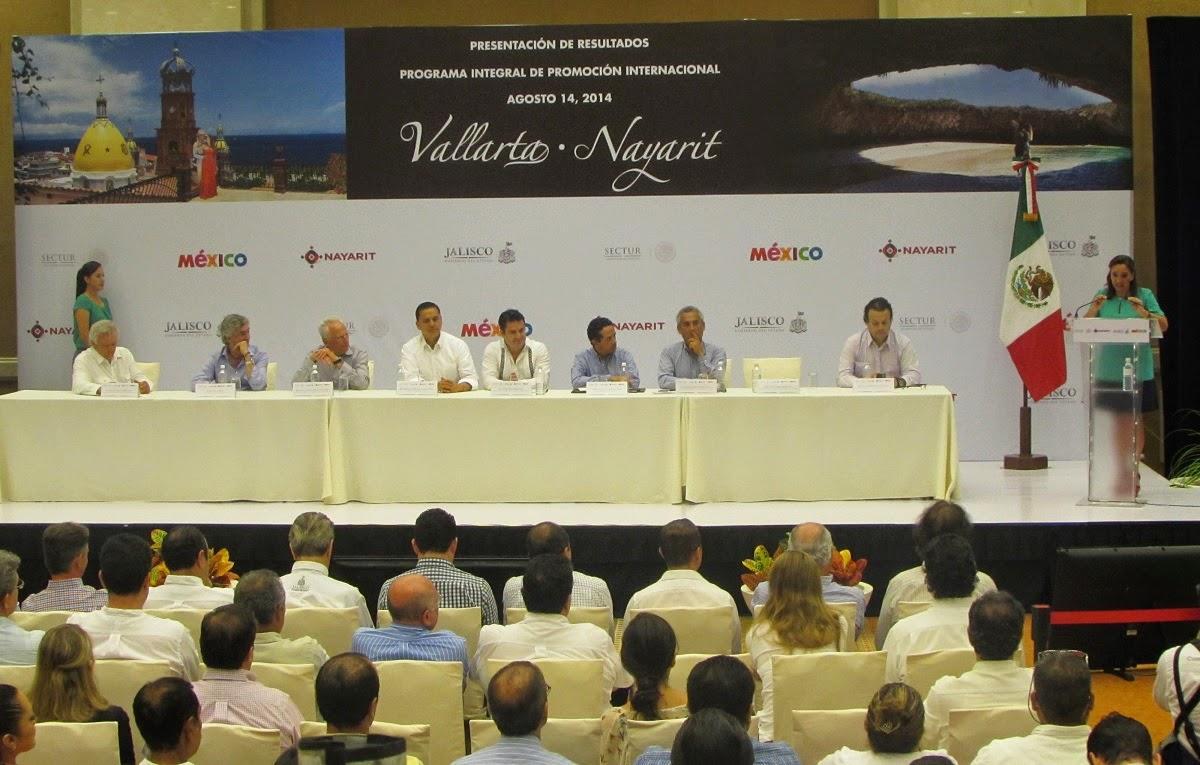
The official presentation of the excellent results obtained by the joint Vallarta-Nayarit campaign confirmed the over 130 thousand recuperated airline seats, the 18.4% increase in number of tourists and the $11 million dollar joint budget.

The Federal Tourism Secretary, Claudia Ruiz Massieu, endorsed the validity of the Vallarta-Nayarit joint campaign during the official presentation of the results of the comprehensive international promotion of said effort. This campaign has become a model for other destinations to follow, thus the $11-million-dollar joint budget will once again be made available.

Also present at the event were Rodolfo López Negrete, head of the Mexico Tourism Board (MTB); the governors of the states of Jalisco and Nayarit, Aristóteles Sandoval and Roberto Sandoval, respectively; the tourism secretaries for both states as well as representatives from the three levels of government, business owners and the promotion directors from both destinations.

Both governors confirmed their commitment to invest $1.6 million dollars per state to continue the joint promotion. They also agreed to continue their collaboration to ensure the safety of citizens and visitors.

Claudia Ruis Massieu announced that due to the collaboration between the states and its results, Nayarit and Jalisco are to be included for the first time into the travel industry’s National Infrastructure Program with multi-million dollar budgets. This will cover projects such as the new cruise port, the rehabilitation and construction of highways connecting to the coast and the investment in more infrastructures.

“We will continue to invest in the promotion of our destinations,” assured Ruiz Massieu. “For 2014 we have anticipated investing $80 million pesos for Nayarit and $100 million pesos for Jalisco.”

The VP of Grupo Velas, Juan Vela, who represented the regions’ hotel owners, acknowledged this long-term investment would attract even more investors, which equals more and better jobs for its citizens.

The flight capability towards the Vallarta-Nayarit International airport grew 17%, one of the best figures in the entire country with 133 thousand recuperated seats, all thanks to the campaign. 600 thousand international tourists arrived to the region during the first semester of the current year, representing an 18.4% increase over the first semester of the previous year.

The Bank of Mexico announced that from January through June of 2014 there was an increase of 17.6% in the influx of foreign currency to the country as compared to the same time period in 2013, representing over $8.4 billion dollars.


Click here for a podcast of the meeting


mexico-beach

From actors to supermodels, find out where the recent flock of A-listers have been holidaying this summer.

Riviera Nayarit and Puerto Vallarta, two stunningly diverse and picturesque regions on Mexico’s Pacific Coast, has been host to a number of well-known celebrities over the past few months, solidifying their reputation as preferential destinations for the showbiz world.

With a choice of exclusively luxurious resorts, stunning postcard-perfect landscapes and an endless list of adrenaline-fuelled activities to-do – it’s no wonder they’re becoming known as the playground for the rich and famous. And with the romantic backdrop of pristine sandy shores contrasted against rugged mountains, it’s only a natural choice for destination weddings and honeymoons too.

mexicobeach-1

Over the course of the summer the regions have seen countless big-name stars arrive and relax in style, including:

KIMYE
kanye-west-and-kim-kardashian-d8c9ee28d52d7489e45e1f71a1bbd3bdf03a8da0

Newlyweds Kim Kardashian and Kanye West enjoyed their second honeymoon in the exclusive resort of Punta Mita (Riviera Nayarit) in July this year. As no stranger to Instagram, Kim posted several photos of herself sunbathing by the pool at the exclusive ‘Casa Aramara’ of her close friend Joe Francis.

Her love for this slice of paradise has now extended to her virtual reality, as her Kardashian-themed gaming app now includes a ‘Party in Punta Mita’ themed version.

Jessica Simpson
jessica-simpson-and-eric-johnson-d7a722adb5d683a9968e2a6c975

Singer/actress Jessica Simpson followed suit in July, choosing Riviera Nayarit as the destination for her honeymoon with husband Eric Johnson.

The pair stayed at the Four Seasons Punta Mita, spending their time drinking cocktails and taking in the breath-taking views hand in hand.

The Jonas Brothers
the-jonas-brothers-c8580e75d14a33b137f37c35340a7725f2596706

In April, Joe Jonas was spotted in Punta Mita and Sayulita, Riviera Nayarit, attending the wedding of his friends and fellow celebrities Nick Lachey and Vanessa Minnillo.

The singer took to Instagram to showcase his holiday photos, including cruising along the beach accompanied by a small donkey (or ‘burro’).

Alessandra Ambrosio
alex

The Brazilian supermodel, previously the face of Giorgio Armani and Ralph Lauren, visited the Four Seasons Resort Punta Mita and enjoyed a relaxing family getaway with her two children on the ‘Glamour Peninsula’.

Bella Thorne
bella-thorne-9b6de2daf19f44b8b86d121a28cbb07ec641cf5d

American teen Disney star Bella Thorne was also seen on holiday in the region this summer, enjoying her time in the Hard Rock Hotel and relaxing on the beaches of Nuevo Vallarta in the Riviera Nayarit.

Eva Longoria
eva-longoria-at-the-global-gift-gala-presented-by-sheeva-jewelry-at-the-me-hotel-london-1

RPuerto Vallarta welcomed Desperate Housewives actress Eva Longoria in April, as she celebrated her 39th birthday in style at the Garza Blanca Resort’s grand penthouse suite. With a large group of friends she spent her time reclining on the beach and toasting her celebrations by the pool.

Joe Manganiello
joe-manganiello-16667dfa9773940c86d23fe48497de9b2d071fc0

Best known for his role in the HBO hit “True Blood”, Manganiello has become a regular in Puerto Vallarta, taking great pleasure in hiking and exploring the local fauna in the jungle, kayaking to the famous Los Arcos natural formation, practicing paddle board, snorkelling, and taking Mexican cooking lessons from local chefs. Manganiello´s most recent visit included an exclusive photo shoot for US-title, People Magazine, after being named Sexiest Bachelor 2014 by the celebrity news publication.

Vanessa Williams
vanessa-williams-awi-02-12

Before heading to New York for her return to Broadway with ‘The Trip to Bountiful’, actress, singer and model, Vanessa Williams experienced her own trip to abundance at Garza Blanca Preserve Resort & Spa, where the loving couple were delighted amongst the exotic Sierra Madre setting.

Chris Tucker
chris-tucker-b5c7b11b040d0a627d0749991fd37cb04720ab40

“Rush Hour” star Chris Tucker enjoyed a family holiday in the area, staying at Puerto Vallarta’s Casa Velas Resort. While there, Chris and his family partook in a range of water sports and on land adventure activities, making the most of the luscious, tropical surroundings.

The two regions are favoured for their exotic climate, adherence to tradition and luxurious amenities, such as world-class spas and golf courses. This makes it unsurprising that so many celebrities appear unable to resist the allure of this true heart of Mexico.

[readon1 url="http://www.easier.com/124830-mexicos-west-coast-is-fast-becoming-the-destination-for-the-stars.html"]Source:www.easier.com[/readon1]


vo

Nuevo Vallarta is mainstream, Bucerías is artistic and Sayulita is hippie chic—these are the “3 faces of the Riviera Nayarit,” which the inflight magazine details in its August issue with a circulation of more than 28 thousand.

The inflight magazine for Volaris airlines, V de Volaris, included in its August issue an eight-page long article with a dynamic proposal for its clients to visit the Riviera Nayarit.

This article was generated thanks to the work and attention given to the media by the Riviera Nayarit Convention and Visitors Bureau (CVB); in this case, to the North American press.

The article—“Las 3 caras de la Riviera Nayarit,” (“The 3 Faces of the Riviera Nayarit”)—was written by journalist Rosa Calderón. In it she creates an analogy between the more mainstream Nuevo Vallarta, the artistic Bucerías and the hippie-chic Sayulita.

“Like sisters who can’t belie their physical resemblance but who you can’t get to sit at the same table, the beaches of Nayarit share the best of their surroundings (the sun, the warm ocean, the spectacular sunsets and the sea turtles) but everything else seems to have been inherited from entirely different families,” writes the journalist.

The writer became interested in the destination thanks to the articles published by Huffington Post and Frommer’s in January, which placed the Riviera Nayarit at the top of the list of places to visit in 2014.

“Nuevo Vallarta and Sayulita are separated by a mere 50 kilometers along the shores of the Riviera Nayarit. The distance is not even a fifth of the state’s coastline; however, it’s enough for one to encounter beach destinations that are nearly opposite in character,” she continues.

Volaris is the second-largest airline in Mexico, covering the entire country and has flights to and from the United States. The magazine is bi-monthly and is published in Spanish, with a circulation of over 28 thousand issues.

Click the link to download the article in its entirety: V de Volaris - August Issue - Riviera Nayarit.pdf   


 cemex bruecke2 1

Mexico's Cemex, a global leader in the production and sale of cement, concrete and aggregates, said Thursday it will begin construction of a $340 million cement plant in Colombia.

The first phase of the project includes construction of a new grinding mill that will begin to produce cement in the second quarter of 2015, Cemex said in a statement, adding that the rest of the plant will be completed in the second half of 2016.

"We are proud to contribute to the development of Colombia and wish to continue to be a long-term partner on its path to a prosperous, sustainable future," Cemex CEO Fernando Gonzalez was quoted as saying.

The investment by Cemex Latam Holdings is expected to boost that unit's annual production capacity in Colombia from 4.5 million tons to nearly 5.5 million tons, the statement added.

The mill, to be built in the northwestern Colombian province of Antioquia, a region with high economic-growth levels, will create some 1,000 direct jobs in the construction phase and around 300 jobs once operations begin.

"The plant will operate using modern and efficient technology to comply with high quality and environmental standards," Cemex said.

Founded in 1906 in the northern Mexican city of Monterrey, Cemex is a global building materials company that provides services to customers in more than 50 countries.

[readon1 url="http://latino.foxnews.com/latino/news/2014/08/14/mexico-cemex-to-build-new-cement-plant-in-colombia/"]Source:slatino.foxnews.com[/readon1]


 3c2b73e

National attention in Mexico has focused on the country's shockingly low minimum wage after the Mexico City government suggested it could act to increase the local minimum.

The debate has highlighted widespread dissatisfaction with the minimum wage of 67.29 pesos per day, or about $5. But suggestions that it be raised have drawn howls of protest from business chambers, who say raising it would only spur inflation.

In a country where the Constitution says the minimum should be sufficient to provide for the basic needs of a worker and his or her family, today's minimum wage in fact buys about a single hamburger meal at a chain restaurant.

Mexico's minimum wage is among the lowest in the hemisphere, comparable only to Honduras, the poorest nation in Central America. However, lower food prices in Honduras make that wage go further there.

Experts say about 6.5 million workers in Mexico currently earn the minimum wage, or about 13 percent of the workforce. During the oil boom of the mid-1970s, those earning it almost made ends meet. But during economic crises in the 1980s, 1990s and in 2008, the government held down wage increases to revive the economy, something that has worked to some extent in sectors like Mexico's booming auto industry. Mexican autoworkers now earn less, in many cases, than their counterparts in China.

"We have fallen 35 years behind in terms of wages," Mexico City Mayor Miguel Angel Mancera said earlier this week, igniting the debate. "We can only buy 23 percent of what one could buy in the 1970s." While he acknowledged the city government can't set wage policy alone, Mancera said he would try to reach a voluntary agreement with businesses in the city to get wages hiked.

Many Mexicans who earn close to the minimum said Friday their lives are a struggle to make ends meet.

Martina Marin Espinosa, 50, a single mother with a 17-year-old daughter, works six days a week as a street sweeper in Mexico City's downtown district, and makes just over the minimum wage, about $5.70 per day. "I just work for my daughter, to get her ahead in life. I don't expect anything for myself," said Marin Espinosa.

Like most here, she is able to get by on such low wages only because of the country's fallback support system: the family. She lives rent-free with her two brothers in a slum on the outskirts of the city.

With only a grade-school education, she is now proud that her daughter is going to high school, though that brings up her biggest problem: clothes. "Girls that age like nice clothes," and Marin Espinosa.

Experts estimate the minimum wage would have to be at least $14.50 a day to provide food and basic necessities for an average family, and up to $41.50 if rent and other expenses are included.

Juan Pablo Castanon, the president of the national employer's federation, a business group, wrote in a statement that "we businessmen agree on the need to increase the real wages of workers, but we say the real discussion on how to do that has to do with getting more people into the formal sector," and out of the vast network of 'informal' work as street vendors and unregistered farm workers.

With wages low in formal jobs, most Mexicans opt to work under table, where they can earn as much in a few hours of hawking newspapers or pre-paid telephone cards, as a minimum-wage worker makes in a whole day. The business sector thinks the vendors hurt the economy, because most usually don't pay taxes.

Last month, the government released a study showing that almost 60 percent of Mexico's workforce was in the informal economy.

Gerardo Gutierrez Candiani, the president Mexico's Business Coordinating Council, says the worst thing that could happen would be an increase in wages by decree. "The two fundamental ingredients we need for growth is macroeconomic stability ... and sustained economic expansion," he wrote in a statement.

[readon1 url="http://abcnews.go.com/International/wireStory/mexico-opens-debate-low-minimum-wage-24909258"]Source:abcnews.go.com[/readon1]


 20130812T231829Z 1 CBRE97B1SQX00 RTROPTP 4 MEXICOREFORMS

For Mexico, constitutional reform was just the first step in the long process of opening up its energy industry to outside investment. Secondary laws must now be passed, and existing laws need to be modified to establish a framework for participation in the industry which, for 75 years, has been the exclusive domain of Petroleos Mexicanos (Pemex).

The degree of private participation will be influenced heavily by the contract models selected by the Mexican government, their fiscal terms, and the prospectivity of reserves open to investment.

"There is going to be a deep transformation in the industry, not just Pemex," Jordy Herrera, Mexico's former secretary of energy told Mayer Brown's Global Energy Conference in Houston.
Mexican President Enrique Peña Nieto in April submitted to the Mexican Congress a package of bills that calls for issuing nine new laws and amending provisions related to 12 existing laws needed to enable private participation in all areas of the energy business.

Included in the package are several laws pertaining to oil and gas exploration and production, such as the proposed Law of Hydrocarbons, the Law of Hydrocarbon Revenues, and the Law of Petroleos Mexicanos (Pemex). The legislation was slated to be debated in a special session of Congress in late June.

"It is up to Congress to determine under what terms and conditions" the private sector has to abide by, Jose Valera, partner in Mayer Brown's energy practice, told UOGR.

After laws are finalized, existing regulatory agencies must be configured to regulate private sector activity and grant permits. These agencies are accustomed to working exclusively with Pemex.
"It's a huge job," Valera said.

Round zero
Another pending step involves determining for which fields Pemex will hold exclusive development rights. The national oil company in March requested it be allowed to retain 100% of Mexico's producing areas, 83% of proven and probable reserves, and 31% of prospective hydrocarbon resources
.
The Ministry of Energy has until Sept. 17 to decide how much Pemex keeps. "My opinion is it is going to change a little," Herrera said. He expects Pemex will be allowed to keep about 75% of the country's known resources, and the remaining 25% will be opened up for competitive bidding.


Likely to end up on the auction block are some deepwater areas and areas prospective to shale development. Herrera said Pemex lacks the funds, technology, and experience to develop all of these challenging areas on its own.
Mayer Brown research suggests that some shallow-water areas, mature fields, and extra-heavy oil fields may also be made available for international bidders.

The Ministry of Energy will ultimately decide which geographic areas to make available for international bidding and when they will be unveiled. The ministry will also be responsible for deciding which contract types will be applied to which areas, evaluating bids, awarding contracts, and later monitoring exploration and production plans to ensure contract compliance and maximize productivity.

Contract models under consideration include production-sharing agreements, profit-sharing agreements, pure service contracts, and licenses but not concessions. For companies considering participation in the the first bid rounds, Valera said, the attractiveness of investment will be determined by the fiscal terms and conditions selected for the new contracts.

Bidding process
Bidding will be overseen by the National Hydrocarbons Commission. Mexico's government is targeting June 2015 for the first bid round, but Herrera does not expect the first round will occur until after the country's midterm elections for lower house lawmakers in July 2015.

"There is no official schedule. All of these dates are simply target dates," Valera told UOGR. The actual date of the bid round is contingent on how fast the country enacts laws and sets up regulatory agencies.
In areas where Pemex is granted exclusive development rights, the company is likely to convert some of its entitlement contracts into risk-sharing upstream contracts with private parties. Separate bid rounds may be held to determine what companies may work with the state-owned entity.

Oversight for that bidding would be managed by the National Hydrocarbons Commission. Technical and contractual guidelines would be established by the Ministry of Energy, and fiscal terms would be determined by the Ministry of Finance.

Impetus for reform
Declining oil and gas production and low reserve replacement rates were the impetus for the historic energy reforms.
Mexico's production outlook has deteriorated in the past decade as offshore production from the massive Cantarell field decreased and rising output from Ku-Maloob-Zapp and other fields did not offset declines (see figure).

Herrera said the county had appeared poised to become one of the largest oil producers in the world in 2004, when crude production peaked at around 3.4 million b/d. Output has since fallen to about 2.5 million b/d in 2012. Natural gas production has declined from a peak of nearly 8 bcfd to 5.6 bcfd in 2013, and increasing amounts of gas are being imported to meet domestic demand.

The rationale for reform was practical. "There was a realization that Mexico was going to begin losing money with this policy," Valera told UOGR.

Mexico is now a net importer of natural gas and refined products, bringing in roughly 1.4 bcfd of gas, 80,000 b/d of liquefied petroleum gas, and 400,000 b/d of gasoline.

Delia Maria Paredes Mier, executive director of economic analysis at Mexican bank Grupo Financiero Banorte, said about 20% of domestic gasoline demand is met by imports priced on the international market and sold to Mexican consumers at a discount. The program, now being phased out, is a substantial cost for Pemex.

Meanwhile, production is declining despite increased levels of capital investment as conventional reserves dwindle and unconventional resources prove costly and technically challenging to develop. Mayer Brown research shows that Mexico invested $26 billion in oil and gas in 2013, compared with $4.8 billion in 2001.

"The reforms have opened up a potentially huge pipeline of new investment," Mier said. But, she added, "it's going to take some time before we see the first drop of oil" from shale or deepwater fields.

[readon1 url="http://www.ogj.com/articles/uogr/print/volume-2/issue-4/investors-watch-wait-as-mexico-finalizes-details-of-energy-reform.html?utm_source=feedburner;utm_medium=feed;utm_campaign=Feed%3A+latest-news-ogj+(OGJ+-+Latest+News)"]Source:www.ogj.com[/readon1]


boleCompared to the same period in 2013, Aeroméxico’s statistics indicate an increase during the first semester of 2014 in the percentage of tourists that fly the airline to the region: 103% in Brazil, 83% in Colombia, 63% in Peru, 227% in Chile and 77% in Argentina.

The numbers are moving in a positive direction thanks to the promotion of the Vallarta-Nayarit brand undertaken by the Riviera Nayarit and Puerto Vallarta convention and visitors bureaus within the South American market as part of the joint campaign spearheaded by the Mexico Tourism Board (MTB).

The increase in the number of tourists from Brazil, Colombia, Peru, Chile and Argentina is visible and verifiable, as reflected in the statistics of Aeroméxico, the company with the most connectivity from the Southern Cone to the region.

The comparative analysis from the first semester of 2014 versus the same time period in 2013 presents a growing tendency in the flow of South American tourists to the Vallarta-Nayarit International Airport. This is specifically for tourists traveling on Aeroméxico.

The growth percentages indicate an increase of 227% in Chile, 103% in Brazil, 83% in Colombia, 77% in Argentina and 63% in Peru.

“It’s important to point out that exploration of the South American segment has begun only recently; it’s a new market that has shown a strong response to our primary efforts and has the potential to send us a growing number of tourists,” explained Marc Murphy, Managing Director of the Riviera Nayarit CVB.

This joint campaign began its promotional work in the five aforementioned countries approximately one year ago. It’s a combination of marketing, public relations, promotions and sales on the part of the Riviera Nayarit and Puerto Vallarta aimed at keeping these numbers in crescendo.

Short, medium and long term gains are reached any time media outlets, tour operators, hotels, travel agents and, obviously, the end consumer are included in these efforts, the latter being the main objective in every tactic and strategy.

As a point of perspective, 99% of the foreign tourists that visit the Riviera Nayarit arrive via air; the remaining 1% arrives by land, specifically from Canada and the United States.