








The Play Este Era Un Rey
Another Triumph for Alberto Fabián in Puerto Vallarta
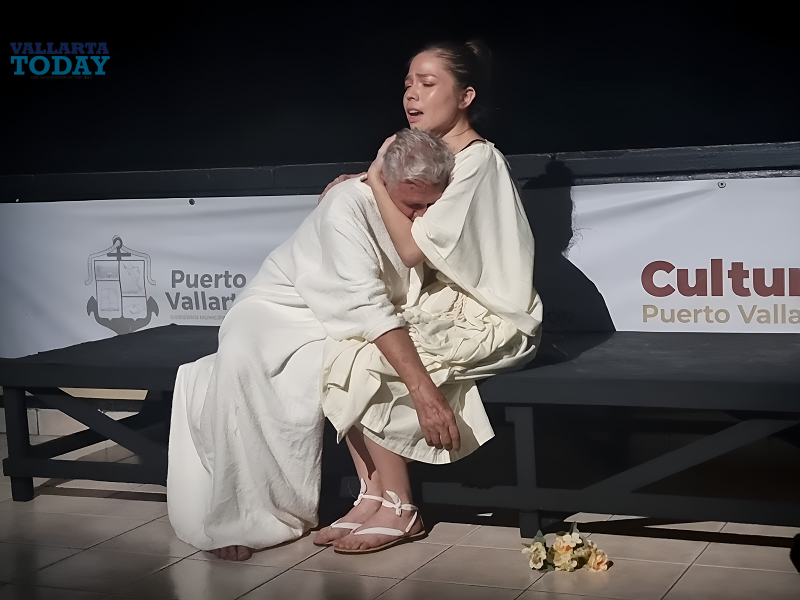
On the afternoon of Wednesday, September 25th, the final performance of the season for Este Era Un Rey was presented at the Vallartense Institute of Culture’s Forum, the Foro del Cuale. The great maestro Alberto Fabián and his stage partner Elisa Carolina brought this wonderful play to life, stirring deep emotions and touching the hearts of the audience. Without a doubt, it was a quality theatrical production that adapted well to the technical limitations of the stage.
The final performance of Este Era Un Rey, directed by maestro Alberto Fabián, took place at 8:00 p.m. in the iconic Foro del Río Cuale in Puerto Vallarta. This production, inspired by William Shakespeare’s King Lear, successfully created a moving atmosphere where two parallel realities were masterfully intertwined: a fictional one represented by King Lear and his tragic world, and a more tangible one embodied by the reader, who, like the audience, delves into the play to find a deep resonance with human emotions that transcend time.
Adapting one of Shakespeare’s most powerful tragedies is no easy task. King Lear, with its themes of betrayal, madness, filial love, and regret, has challenged generations of actors and directors. In this version, Alberto Fabián not only pays homage to the classic but also brings a modern and deeply introspective perspective. The play becomes a mirror, not only for the characters inhabiting the tragedy but also for the audience itself, who, through the reader, become active participants in the story.
The reader, portrayed by Alberto Fabián himself, symbolizes the bridge between what happens in fiction and the reality of those observing. In many ways, he is the voice that meditates on the universality of human feelings: the pain of losing a loved one, the pride that separates families, and the fragility of life. The reader doesn’t just read Lear’s story; he lives it, feels it, and through his eyes, the audience experiences it as well.
One of the most remarkable elements of this adaptation was the presence of Elisa Carolina, who played Cordelia, Lear’s youngest and most loyal daughter, as well as Lupita and Margarita, characters resonating on other levels of the narrative. This duality was no accident; it was an artistic choice that allowed the play to move between different emotional and temporal dimensions. With a brilliant and moving performance, Carolina embodied all these characters organically, creating an intimate connection with the audience.
Cordelia, who in King Lear represents unconditional love and integrity, is also Lupita, the reader’s protégé. This connection between daughter and reader reminds us that family bonds don’t only exist in fiction but are also part of our daily lives. Carolina alternates between a vulnerable Cordelia and an innocent Lupita who grows into a strong and arrogant being. In both cases, she demonstrated an acting maturity that allowed her to infuse her character with overwhelming emotional depth. Every word she recited, every poem she delivered as Margarita, reflected the sorrow of a daughter who suffers from distance and regret but ultimately seeks redemption. It’s worth noting that Elisa Carolina delighted the audience with her remarkable vocal abilities by performing a couple of songs that were beautifully sung and triggered many heartfelt tears.
The greatness of this play lies in its ability to reflect human emotions so clearly and powerfully that, despite the centuries separating Shakespeare from our time, the feelings remain the same. Betrayal, pain, guilt, and regret are universal themes that find an echo in any era. This play is not just an adaptation of King Lear, but a profound exploration of the human soul and its contradictions.
The central conflict between King Lear and his daughter Cordelia, who leaves only to return in repentance, is a powerful representation of how pride and misunderstanding can destroy the most sacred relationships. Lear, who starts as a powerful and arrogant king, ends as a fragile man, lost in his madness, but with the hope of redemption through his daughter’s forgiveness.
The staging of Este Era Un Rey was an artwork in itself. With a minimalist yet effective set design, the main focus was on the actors and the interaction between the interwoven realities in the play. The Foro del Río Cuale was transformed into an intimate and symbolic stage where every object and light had a specific purpose. The transitions between the fictional world of King Lear and the reader’s reality flowed naturally, thanks to the masterful direction of Alberto Fabián, who maximized the space and available resources.
Lighting played a crucial role in highlighting the most emotional moments of the play. The shadows and lights accompanying Lear on his journey into madness, or the flashes illuminating Cordelia as she recited her poems, added layers of meaning to the performance. This interplay of light and shadow also reflected the emotional tensions within the characters.
At the end of the play, the audience at the Foro del Río Cuale rose to their feet in a standing ovation. The performances by Alberto Fabián and Elisa Carolina touched the hearts of those present, who felt deeply connected to the story. The silence that followed the applause was a testament to the emotional impact the play had on each of the attendees.
Este Era Un Rey is not only a reflection on the destructive power of pride and the search for redemption, but also a celebration of theater as an art form that, through time, continues to be a space for introspection and connection with the most human emotions. The play, like life, reminds us that despite the falls and mistakes, there is always room for repentance and reconciliation.
Maestro Alberto Fabián and Elisa Carolina achieved, through Este Era Un Rey, a unique connection with the Puerto Vallarta audience. Once again, the magic of theater demonstrated its ability to transport viewers to a world where emotions transcend time, and fiction becomes a mirror of our own reality.