







Mexico's ability to cap gasoline prices well below what market forces would produce depends on three structural conditions: domestic crude production, a state-owned oil company that controls much of the supply chain, and a flexible excise tax that can absorb international price volatility. Each of these components plays a distinct role.
Pemex and Domestic Supply
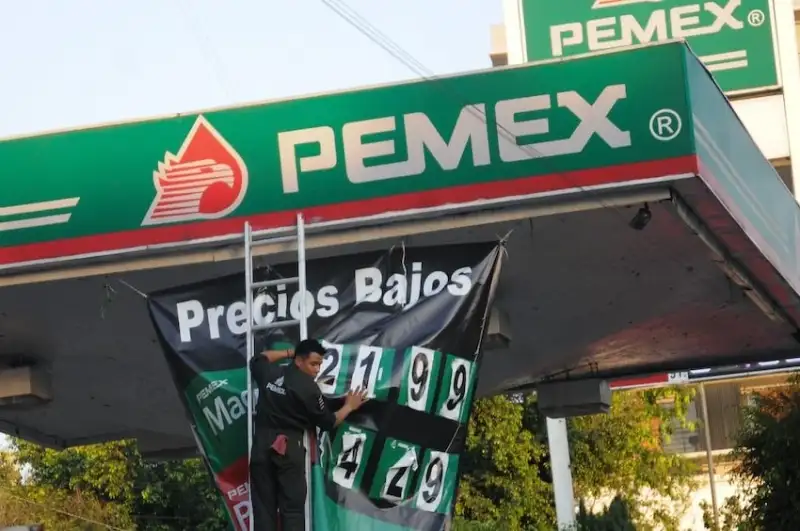
Petroleos Mexicanos, known as Pemex, is a state-owned oil company. It produces crude oil, operates refineries, and has historically dominated fuel distribution in Mexico. Gas stations branded as Pemex are operated by independent franchise holders. They source fuel from the Pemex supply chain. Private and independent chains, including OXXO Gas and Grupo Hidrosina, import or source fuel separately but operate in a market where Pemex pricing sets a significant benchmark.
Mexico produces crude oil domestically. Its refineries do not pay international import prices for raw material in the same way that fully import-dependent countries do. The domestic crude price tracks international benchmarks to a degree, but the relationship is not one-to-one. The government has tools to adjust the effective transfer price between Pemex production and Pemex refining.
This structural advantage is a prerequisite for price capping. A country entirely dependent on imported crude cannot easily decouple domestic retail prices from international markets without very large direct subsidies.
The IEPS as a Pricing Lever
The Impuesto Especial sobre Producción y Servicios is a federal excise tax applied to a range of goods including gasoline, tobacco, alcohol, and sugary beverages. For fuel, the IEPS can be positive, adding to the consumer price, or it can be set to zero or negative when the government wants to reduce retail prices without direct subsidy payments.
When international oil prices rise, the government can reduce or eliminate the positive IEPS on fuel. This offsets part of the cost increase that would otherwise pass to consumers. When international prices are low, the government allows the IEPS to be positive, generating excise revenue. This counter-cyclical use of the IEPS has been a recurring feature of Mexican fuel price management for over a decade.
The fiscal cost is real. Reducing the IEPS reduces federal revenue that would otherwise be collected. During sustained high oil prices, maintaining the IEPS at zero or near zero creates a revenue shortfall. That shortfall must be absorbed in the federal budget. The government's willingness to accept this cost reflects the political priority placed on fuel affordability during periods of global price volatility.
Voluntary Agreements With Private Operators
The price cap is a voluntary agreement between the government and private gas station operators, not a legally mandated price control. This distinction matters. Mandatory price controls require enforcement mechanisms, create compliance costs, and can produce shortages when the mandated price is too far below the market-clearing level.
A voluntary agreement sustained by 96 percent of operators is more flexible and avoids those distortions. Private operators participate because of implicit government support:
- IEPS adjustments that protect their margins
- Access to Pemex fuel supply
- Reputational benefits from cooperation with a consumer protection measure
The agreement is renewed periodically rather than operating on open-ended terms. This allows both sides to reassess the arrangement as market conditions change.
Frequently Asked Questions (FAQs)
Q: Why can Mexico cap gasoline prices when other countries cannot?
A: Mexico's price cap is feasible because of three structural conditions: domestic crude oil production through Pemex that partially insulates refining costs from international import prices, the IEPS excise tax that can be reduced or eliminated to offset consumer price increases, and a dominant state-owned company whose pricing sets market benchmarks. Countries entirely dependent on imported crude must use direct subsidies to cap prices, which is far more costly.
Q: What is the IEPS and how is it used to manage fuel prices?
A: The IEPS is a federal excise tax applied to fuel sales. For gasoline, it can be positive to generate revenue when international prices are low, or reduced to zero when prices rise to prevent full pass-through to consumers. This counter-cyclical use has been a feature of Mexican fuel price management for over a decade. The fiscal cost is a reduction in federal excise revenue during periods when the tax is reduced.
Q: What is the role of Pemex in Mexico's fuel market?
A: Pemex is Mexico's state-owned oil company, producing crude oil, operating refineries, and historically dominating fuel distribution. Pemex-branded gas stations are operated by independent franchise holders who source fuel from the Pemex supply chain. Private operators source fuel separately but operate in a market where Pemex pricing sets a significant benchmark.
Q: Why is the price cap structured as a voluntary agreement rather than a legal mandate?
A: Mandatory price controls require enforcement infrastructure, create compliance costs, and risk producing shortages when mandated prices fall too far below market-clearing levels. A voluntary agreement sustained by the majority of operators is more flexible and avoids those distortions. Private operators participate because of IEPS adjustments that protect their margins, access to Pemex supply, and reputational benefits from cooperation.
Q: How long has Mexico been using the IEPS counter-cyclically for fuel pricing?
A: Mexico has used counter-cyclical IEPS adjustments as a fuel price management tool for over a decade. The mechanism has been deployed during previous oil price spikes to prevent sharp retail price increases. The current renewal, in response to the Middle East conflict price surge, is consistent with established practice rather than a new policy approach.