







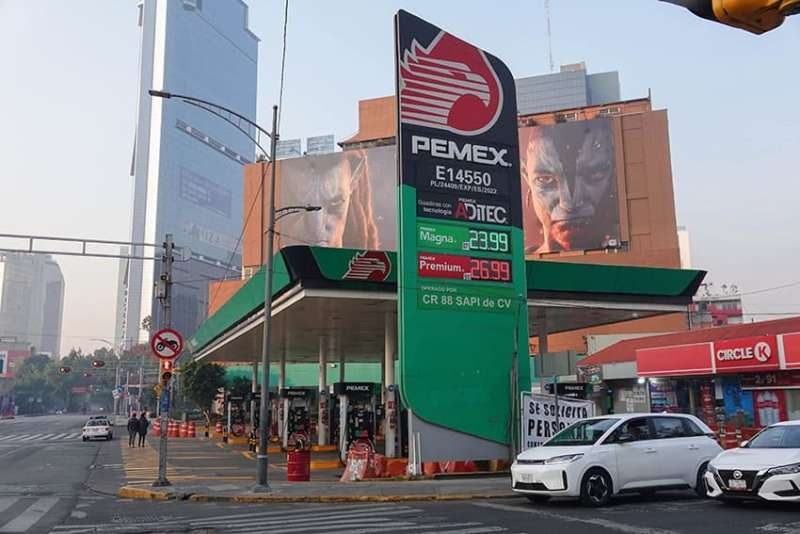
President Claudia Sheinbaum and Energy Minister Luz Elena González Escobar met with representatives from more than 20 gas station companies at the National Palace. The meeting resulted in a renewed voluntary price cap agreement on regular gasoline. Under the renewed pact, regular gasoline will remain below 24 pesos per liter for an additional six months. That is equivalent to approximately US$1.34 per liter or US$5.07 per gallon.
The Pressure Behind the Renewal
The renewal comes as global oil prices have risen sharply following the conflict in the Middle East. Brent crude briefly crossed $100 per barrel and was trading near $99 on Thursday, up nearly 8 percent on the day. Before the United States and Israel attacked Iran on February 28, Brent was selling for approximately $73 per barrel.
The Strait of Hormuz, through which around 20 percent of global oil supply normally passes, has been closed as a consequence of the conflict. This has created a significant supply constraint and driven price increases across crude benchmarks.
Mexico is not directly dependent on Persian Gulf crude for its domestic fuel supply. Pemex refineries process domestically produced Mexican crude. However, Mexican crude prices track international benchmarks. The broader energy cost environment affects the economics of fuel distribution and retail. The cap is designed to insulate domestic consumers from the full pass-through of international price increases.
Who Signed and What They Committed To
Representatives of 25 gas station companies voluntarily joined the renewed agreement. This is stated to represent 96 percent of service stations in Mexico. Named signatories include G500, Grupo Hidrosina, OXXO Gas, Servifácil, and Petrodiésel del Centro.
The CEO of Servifácil, Eugenio del Valle, spoke on behalf of the industry. He reiterated the sector's willingness to continue working in coordination with the Mexican government. The Energy Ministry framed the agreement around the principle that fuel should remain an engine of development and well-being for all Mexicans.
The cap applies to regular gasoline, known in Mexico as Magna. Energy Minister González stated it accounts for more than 85 percent of vehicles in Mexico. Pemex CEO Víctor Rodríguez Padilla indicated the government could negotiate a similar agreement for diesel, which is currently around 4 pesos more expensive per liter. He described a premium gasoline cap as unnecessary given its small market share.
The IEPS Lever
Sheinbaum indicated she was prepared to reduce or eliminate the IEPS excise tax on fuel if necessary to maintain the cap as oil prices continue to rise. The IEPS is a federal tax on fuel sales. The government can temporarily reduce or suspend it to create fiscal space for lower retail prices without requiring gas station operators to absorb additional margin pressure.
The mechanism gives the government a tool to maintain the cap even if international prices rise further. It comes at a fiscal cost. IEPS revenue foregone is a reduction in federal revenue that must either be offset elsewhere in the budget or accepted as a short-term deficit.
The IEPS has been used this way before. During previous oil price spikes over the past decade, the government reduced or zeroed out the fuel excise tax to absorb international volatility at the federal level rather than passing it to consumers. The current situation follows that established practice. The scale of the price increase, however, with Brent rising roughly $27 in a matter of weeks, makes it among the larger fiscal challenges the mechanism has had to absorb.
Frequently Asked Questions (FAQs)
Q: What is the current gasoline price cap in Mexico?
A: Regular gasoline in Mexico is capped below 24 pesos per liter, equivalent to approximately US$1.34 per liter or US$5.07 per gallon. The cap was renewed for an additional six months following a meeting between President Claudia Sheinbaum, Energy Minister Luz Elena González Escobar, and representatives of 25 gas station companies.
Q: Which gas station companies signed the renewed price cap agreement?
A: Representatives of 25 gas station companies voluntarily signed, stated to represent 96 percent of service stations in Mexico. Named signatories include G500, Grupo Hidrosina, OXXO Gas, Servifácil, and Petrodiésel del Centro. The agreement covers both Pemex-branded stations and independent operators.
Q: Why did Mexico renew the gasoline price cap now?
A: The renewal was prompted by a sharp rise in global oil prices following the conflict between the United States, Israel, and Iran. Brent crude briefly crossed $100 per barrel, up from approximately $73 before the conflict began on February 28. The closure of the Strait of Hormuz, through which around 20 percent of global oil supply passes, is a central factor in the price increase.
Q: What is the IEPS and how can it be used to control fuel prices?
A: The IEPS is the Impuesto Especial sobre Producción y Servicios, a federal excise tax applied to fuel sales in Mexico. The government can temporarily reduce or eliminate this tax to create fiscal space for lower retail prices without requiring gas stations to absorb margin losses. President Sheinbaum indicated she was prepared to reduce the IEPS if oil prices continue to rise and the cap comes under pressure.
Q: Does the cap apply to diesel and premium gasoline as well?
A: The current cap applies specifically to regular gasoline, known as Magna, which accounts for more than 85 percent of vehicle fuel demand. Pemex CEO Víctor Rodríguez Padilla indicated the government could negotiate a similar agreement for diesel, which is around 4 pesos more expensive per liter. A cap on premium gasoline was described as unnecessary given its small market share.