







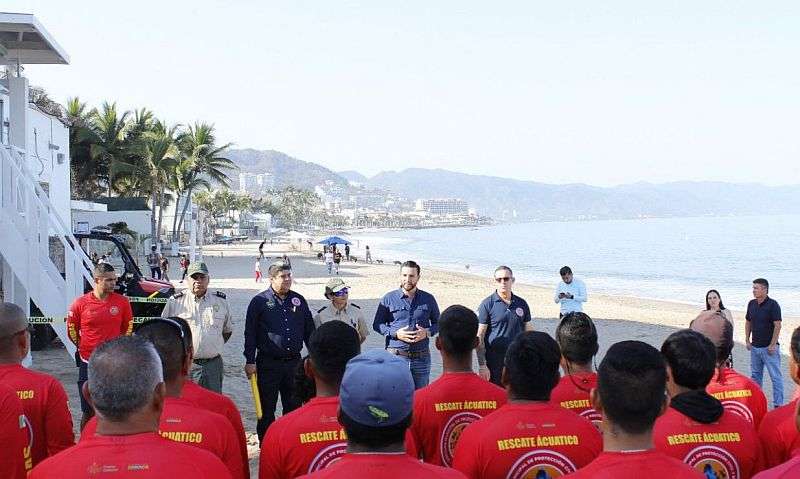
The Mexican Federation of Aquatic Rescue and Lifesaving, known by its Spanish acronym FESAME, administers the national certification programme that Puerto Vallarta's lifeguards recently completed. The federation sets standardised competency benchmarks for aquatic rescue personnel across Mexican beach destinations and oversees the evaluation process through which certifications are issued or renewed.
What the Evaluation Covers
National lifeguard certification in Mexico requires candidates to demonstrate competency across both open water and controlled pool environments. The two testing environments serve different purposes. Pool assessments measure baseline swimming ability, endurance over standardised distances, and precision in rescue technique under conditions that eliminate sea variables.
Open water assessments introduce the variables that pool testing cannot replicate:
- Rip currents and wave interference
- Reduced visibility at depth in natural water
- Variable distances to a distressed swimmer in real sea conditions
- Physical fatigue management across longer rescue scenarios
Physical endurance standards require candidates to complete timed swims and rescue simulations that reflect the demands of an actual ocean rescue rather than controlled conditions alone. Candidates who pass only one environment do not receive full certification.
Why Recertification Matters
Certification is not permanent. FESAME requires periodic recertification to ensure that active lifeguards maintain the physical conditioning and technical competency that initial certification established. The recertification cycle acknowledges that rescue skills degrade without regular practice and formal evaluation.
For a destination like Puerto Vallarta, where lifeguard teams operate continuously across a long annual tourist season, the gap between initial certification and recertification can cover changes in personnel fitness levels, technique refinement, and updates to rescue protocols. Recertification resets the verified baseline.
The involvement of FESAME president Ignacio González Martínez in the Puerto Vallarta evaluation adds institutional weight to the outcome. Federation-level oversight of a municipal recertification event is not standard practice for every coastal city in Mexico. It signals that the process met national rather than locally defined standards.
How Puerto Vallarta Compares to Other Mexican Beach Destinations
Beach safety standards vary considerably across Mexican coastal destinations. Some municipalities operate lifeguard programmes that function primarily as visitor-facing services without formal national certification. Others maintain certification requirements but rely on locally defined standards that may not align with the FESAME framework.
Puerto Vallarta's national-level recertification places it among the beach destinations with formally verified standards rather than those relying on internal evaluation alone. The distinction matters for liability, for inter-agency coordination with federal maritime authorities, and for the credibility of safety claims made to international visitors who may research beach safety before choosing a destination.
Frequently Asked Questions (FAQs)
Q: What is FESAME?
A: FESAME is the Mexican Federation of Aquatic Rescue and Lifesaving, the national body that administers standardised certification for lifeguard personnel across Mexican beach destinations. It sets competency benchmarks, oversees evaluation processes, and issues certifications that reflect national rather than locally defined standards.
Q: What does national lifeguard certification in Mexico require?
A: National certification requires demonstrating competency in both pool and open water environments. Pool assessments cover baseline swimming ability, endurance, and precision in rescue technique. Open water assessments introduce variables including rip currents, wave interference, reduced visibility, and fatigue management across realistic rescue scenarios. Candidates must pass both environments to receive full certification.
Q: Why is periodic recertification required rather than a one-time certification?
A: Rescue skills and physical conditioning degrade without regular practice and formal evaluation. FESAME's recertification cycle ensures that active lifeguards maintain the competency that initial certification established. For a destination with a long annual tourist season like Puerto Vallarta, recertification also captures changes in personnel fitness and updates to rescue protocols since the previous evaluation.
Q: Does every Mexican beach destination have nationally certified lifeguards?
A: No. Beach safety standards vary considerably across Mexican coastal destinations. Some municipalities operate lifeguard programmes without formal national certification or rely on locally defined standards that do not align with the FESAME framework. Puerto Vallarta's national-level recertification places it among the destinations with formally verified rather than internally evaluated standards.
Q: What role did FESAME president Ignacio González Martínez play in Puerto Vallarta's recertification?
A: González Martínez personally oversaw the evaluation process in Puerto Vallarta. Federation-level oversight of a municipal recertification event is not standard practice for every coastal city in Mexico. His direct involvement signals that the process was conducted against national rather than locally defined standards.