



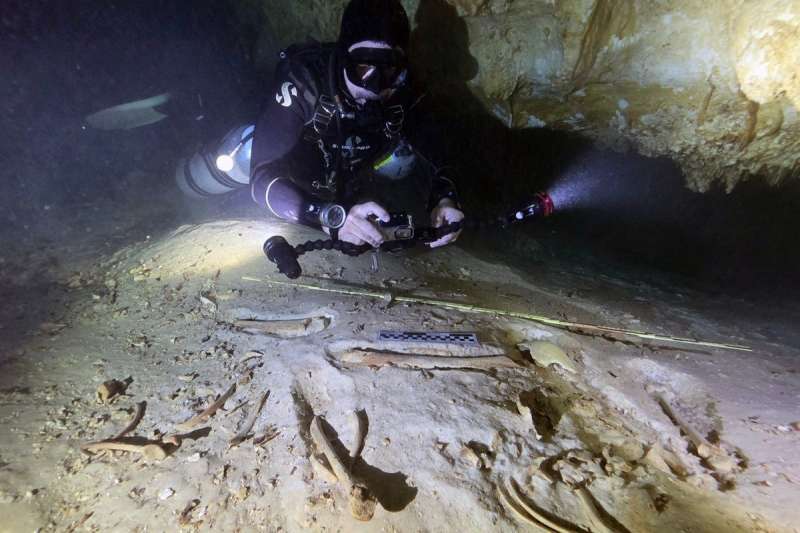
A prehistoric skeleton has been found deep inside a flooded cave system along Mexico's Caribbean coast, in an area that was submerged beneath rising seas at the end of the last ice age, approximately 8,000 years ago. The find was made by cave-diving archaeologist Octavio del Río, who collaborates with Mexico's National Institute of Anthropology and History (INAH), after swimming approximately 200 metres through a flooded passage and descending eight metres below the surface.
It is the eleventh such skeleton discovered in the cave network between the tourist destinations of Tulum and Playa del Carmen over the past three decades, a sequence of finds that has made this stretch of the Yucatán Peninsula one of the most extraordinary prehistoric sites in the Western Hemisphere. Some of the earliest skeletons recovered from these same caves date to approximately 13,000 years ago, placing them among the oldest human remains ever found in North America.
Where the Skeleton Was Found and What That Tells Us
The skeleton was recovered in late 2025 from a dune of sediments in a narrower interior chamber of the flooded cave, a location and context that its discoverers interpret as highly significant. 'It was a funereal deposit where the body was placed intentionally, perhaps as part of a ritual practice,' del Río said. The deliberate placement of a body so deep inside a cave system, far from the entrance and inaccessible without expert diving equipment even today, suggests that the people who carried out the burial went to considerable effort to place the deceased in a specific, meaningful location.
The logic of the find's age is straightforward but remarkable. The cave currently requires advanced diving equipment to access, it is 200 metres from the entrance and eight metres underwater. The only way a human body could have been placed there without diving equipment is if the cave was dry at the time of the burial. The cave system flooded approximately 8,000 years ago when rising sea levels following the end of the last ice age inundated the coastal lowlands of the Yucatán Peninsula. Therefore, the skeleton was placed there at least 8,000 years ago, most likely more, if it predates the flooding rather than precisely coinciding with it.
Del Río noted that even after three decades of making such discoveries, the moment still commands a visceral response. 'You can shout even under water,' he said, describing the feeling of encountering a prehistoric burial site 200 metres inside a flooded cave. 'You start picturing the cave, imagining how this person came to be there, thinking about the context.'
What the Yucatán Caves Are Telling Us About Early Human Migration
Luis Alberto Martos, director of archaeological studies at INAH, described the new find as a contribution to an evolving picture of how the first humans arrived on and settled the Yucatán Peninsula, which, at the time these people lived, looked nothing like it does today. Rather than the jungle and beach landscape familiar to modern visitors, the peninsula was a flat plain with cliffs and limestone cavern systems that formed natural shelter, water sources, and, evidently, sacred spaces.
The question of how the earliest inhabitants of the Yucatán arrived has several competing answers. DNA evidence increasingly supports the hypothesis that a significant migration route came from Asia across a land bridge that occupied the area now covered by the Bering Strait. But there are also genetic and archaeological clues suggesting the possibility of a secondary migration pathway from South America. 'The puzzle of Yucatan prehistory is becoming better understood,' Martos said, each new skeleton adding data that helps researchers choose between, or combine, these competing models.
The skeletal remains recovered from the Yucatán caves are not simply burial evidence. Because they have been preserved in a sealed, flooded environment for thousands of years with no exposure to surface conditions, they often retain DNA, bone density, and dental evidence that yields far richer scientific information than remains found in open-air contexts. The sequence of eleven skeletons across three decades of cave diving represents a cumulative scientific resource of unusual quality.
The Cave System as an Archaeological Window
The prehistoric human remains are the most dramatic finds from the Yucatán cave system, but they are not the only ones. Martos described the caves as 'archaeological windows', environments that have preserved artefacts from multiple periods of human activity alongside the prehistoric remains. Other discoveries have included a small cannon and 19th-century rifles, evidence that the caves were known and used by people in far more recent historical periods as well.
Divers who explore the caves continue to find fossils of extinct megafauna, large animals that inhabited the Yucatán before the end of the last ice age, though archaeologists have not yet been able to begin the systematic recovery of these finds. The sheer scale and complexity of the cave network means that the pace of discovery has been limited by the number of skilled cave divers willing and able to work in these conditions, and by the logistical challenges of conducting rigorous archaeological work in a flooded underground environment.
The skeleton is now being analysed by INAH researchers. The analysis will include DNA profiling, isotopic studies of diet and migration history, and dating confirmation. Its results are expected to contribute to the ongoing reassessment of early human migration routes into and through the Americas, one of the most actively debated questions in New World archaeology.
Frequently Asked Questions
Q: How old is the skeleton found in the Yucatán cave?
A: The skeleton is at least 8,000 years old, based on the geological evidence that the cave flooded at the end of the last ice age approximately 8,000 years ago. Since the body could only have been placed there when the cave was dry, the burial must predate the flooding. Earlier skeletons in the same cave network have been dated to approximately 13,000 years ago.
Q: Where exactly were the caves where the skeleton was found?
A: The caves are part of an extensive underwater cave system along Mexico's Caribbean coast, in the area between Tulum and Playa del Carmen on the Yucatán Peninsula. The specific cave location has not been publicly identified in detail, in part to protect the site from unauthorised disturbance.
Q: What does the placement of the skeleton suggest about the people who lived there?
A: The skeleton was found on a sediment dune in a narrow interior chamber, 200 metres from the cave entrance and eight metres below the water surface. Archaeologists interpret this as an intentional funereal deposit, a deliberate burial in a specific, meaningful location requiring significant effort to reach. This suggests a society with ritual practices around death and the afterlife, and the cognitive and organisational capacity to execute a complex burial deep inside a cave system.
Q: Are these the oldest human remains found in the Americas?
A: The Yucatán cave skeletons include some of the oldest human remains found in North America, with earlier finds in the same system dating to approximately 13,000 years ago. This places them in the timeframe of the earliest known human presence in North America, and they are among the oldest skeletal remains found in the Western Hemisphere, though not necessarily the oldest overall.
Q: How is the skeleton being analysed and what might we learn from it?
A: INAH researchers are conducting DNA profiling, isotopic analysis of dietary and migration history, and radiocarbon dating on the skeleton. These analyses can reveal information about the individual's ancestry, where they spent their childhood (through strontium isotopes in teeth), what they ate, and how they relate genetically to other early American populations, all of which informs the broader question of how the Americas were first settled.
Q: Can tourists visit the cenote cave system where prehistoric remains have been found?
A: The specific caves where prehistoric skeletons have been found are not open to general tourist access, they require expert cave-diving certification and specialised equipment to reach, and are protected research sites. However, the Yucatán Peninsula has hundreds of publicly accessible cenotes in the Tulum and Playa del Carmen area where recreational divers and snorkellers can experience the extraordinary beauty of the cave network.