







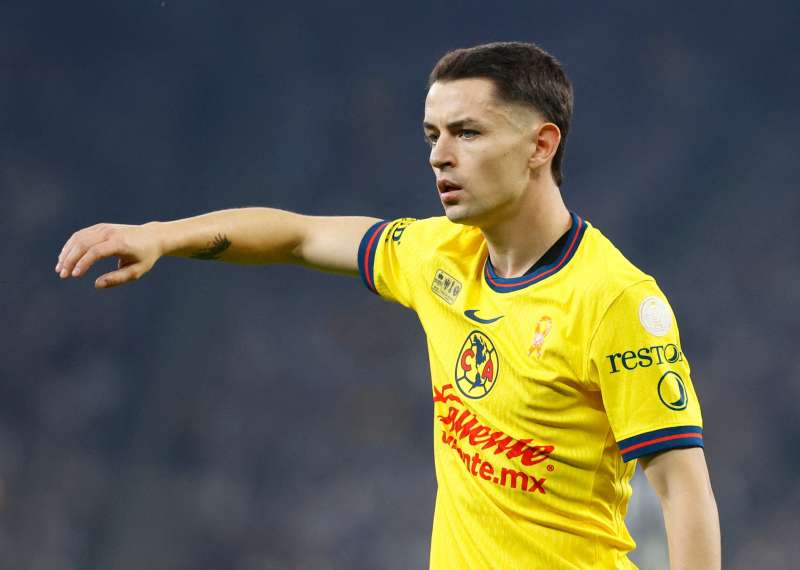
Álvaro Fidalgo's first call-up to Mexico's national team follows a career trajectory that runs from Spain through Mexican club football and back to Spain. His selection is the product of both a deliberate eligibility decision and the specific injury circumstances that created an opening in Aguirre's midfield at the moment his citizenship process was completing.
Three Liga MX Titles With Club América
Fidalgo joined Club América from Celta Vigo in 2021 and became one of the most consistent midfielders in Liga MX over the subsequent years. He was a key contributor to three consecutive Liga MX championship seasons, a run that established América as the dominant force in Mexican club football during that period.
His role at América was primarily as a controlling central midfielder: technically assured, capable of dictating tempo, and consistent in his defensive positioning without sacrificing his contribution to ball circulation. These qualities are what made him attractive to Real Betis, and they are precisely what Aguirre's midfield lost when Ruiz sustained his ACL injury.
How He Qualifies and What He Gives Aguirre's Midfield
Fidalgo was born in Spain and played for Spanish youth teams. To represent Mexico at senior level, he needed Mexican citizenship and confirmation that he had not appeared for another national team in a competitive senior match. FIFA eligibility rules allow players with a qualifying national connection to switch allegiance under those conditions. Friendly matches do not trigger the restriction.
His citizenship was completed earlier this year. The timing meant his first call-up coincided with a specific need rather than arriving in a routine window.
Mexico's midfield has been rebuilt since Aguirre took charge in August 2024. The manager favours players who combine defensive discipline with the ability to connect play through midfield. Fidalgo's profile fits: three Liga MX seasons produced a player accustomed to Mexican football's physical demands, while his European background means he is not unfamiliar with the intensity Portugal and Belgium will bring.
Frequently Asked Questions (FAQs)
Q: How did Álvaro Fidalgo become eligible to play for Mexico?
A: Fidalgo obtained Mexican citizenship earlier in 2026 and confirmed that he had not previously represented Spain or any other national team in a competitive senior FIFA match. FIFA's eligibility regulations allow players with a qualifying connection to a country to switch allegiance under those conditions. Friendly appearances do not trigger the restriction, only competitive matches.
Q: What did Fidalgo achieve at Club América?
A: Fidalgo joined Club América from Celta Vigo in 2021 and was a key contributor to three consecutive Liga MX championship seasons. His role was primarily as a controlling central midfielder, contributing to tempo management, ball circulation, and defensive positioning.
Q: Why did Fidalgo move from Club América to Real Betis?
A: Fidalgo signed with Real Betis last month, marking a return to Spanish football after his years in Liga MX. The specific terms and motivations of the transfer have not been detailed publicly. His consistent performance at América across three championship seasons would have generated interest from European clubs.
Q: What does Fidalgo's playing style bring to Mexico's midfield?
A: Fidalgo is primarily a controlling central midfielder with technical assurance, the ability to dictate tempo, and consistent defensive positioning. This profile matches the qualities Aguirre has favoured since taking charge in August 2024. His Liga MX experience also means he is accustomed to the physical demands of Mexican football specifically.
Q: Is Fidalgo the first Spain-born player to represent Mexico?
A: No. Mexico has a long history of fielding players born in Spain or with Spanish heritage who gained Mexican citizenship and chose to represent El Tri. The pathway is well established in Mexican football and has produced several players who became key contributors to the national team across different eras.