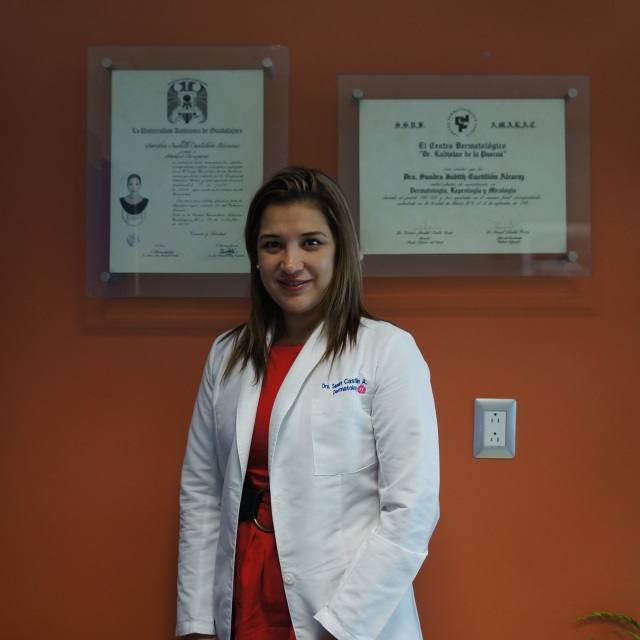








An Interview with Dr. Sandra Castillon Alcaraz
What is your specialty?
I am a dermatologist, and a specialist of skin, hair and nail diseases. I graduated from the Pascua dermatological center of Mexico City.
Are you certified by an association?
I am certified by the Board of Dermatology and I update myself each year on my specialty through courses.
What kind of treatments do you see in your specialty?
I perform beauty treatments, fillers, Botox and I detect cancer or skin conditions in a timely manner, which is paramount.
How do you detect a problem of skin cancer?
First we make a diagnosis. A biopsy is sent to a dermato-pathologist, who is a specialist that guides us towards a diagnosis, both clinical and pathological, so that we can see what type of cancer the patient has. The type of surgery that is done is according to type of cancer. There are three types of cancer: basal cell, squamous cell and melanoma. This last one carries the worst prognosis and we can detect it but we need the help of an oncologist, because it is metastatic, that is to say, it goes to other areas of the body.
What technology do you use in your specialty?
The intense pulsed light is a device that controls injuries such as stains, and the damage that is caused by the aging in our skin.
What type of diseases do you take care of in your specialty?
Skin diseases, and mental health and psychosomatic diseases, such as fictional dermatitis, which the patient makes to himself. It is very important to seek help, in the later case with a psychologist or psychiatrist, following a treatment that goes in hand with the type of condition that is being suffered.
What are the problems of foreigners in terms of health?
When we see a foreign patient we face the problem that they already come with a list of the diseases that they have, the medicines or alternative treatments they have investigated, and they have us as an optional doctor, not their main doctor. Here we orient the patient by giving them options according to their skin type and their condition, not all the treatments work for everyone.
How many years are needed to be a dermatologist?
To be a dermatologist you need to study internal medicine and then specialize in dermatology. There are those who call themselves dermatologists but who don't do a specialty, in reality only taking courses for six months.
How do TV commercials influence people in recommending products for skin treatments?
On television there is a lot of publicity, it is a constant barrage, especially in the dermatology area. There are many miracle products with an emotional appeal, telling them that they will improve their acne condition, but they really need to be looked at by a dermatologist. Patients often come here who self medicate, who have moles and treat them as warts. They get a treatment that will burn injuries but all they do is burn the skin around the injury while the treatment needs to be another, and so on top of their injury they come with a burn. They apply POINTS (for warts) to burn through cold but they only hurt themselves, it is very common.
What is the process to follow in a skin lesion?
First you make a mycological study because mycology shows the type of injury. A mold culture is grown to see if it is a fungus or if its another disease. Many times the clinical study involves a KOH scraping in the lesion site. Under a microscope we can see if the SIFAS are present in the fungus. But it is not always a fungus, it could be a condition such as SORIASIS. You also have to take into account the clinical history of the patient.
Can warts be skin cancer?
Some warts are contagious and can spread throughout the body. But they also can be a type of cancer that that is confused for warts.
Have you participated in charitable programs?
I see patients that have no resources or that have to make big sacrifices to look for support. But life ends up rewarding you, helping other people who don't have resources is very rewarding for us doctors.
Do you have a message for the tourists coming for vacations to our shores?
When you visit Puerto Vallarta feel confident that you can find a good dermatologist who is certified. I am originally from PV. I studied at the University of Guadalajara and later for two years in internal medicine plus 3 years of dermatology. In Puerto Vallarta it is common to not get enough protection from the sun, but it is important to emphasize the use of a good sunscreen. People want to tan, but especially white skin does not have the necessary melanin to offer enough protection from the sun.
What hygiene measures do you recommend to avoid contracting skin infections such as fungi and skin cancer?
Wear cotton socks and if you go out to jog, then change your clothes afterwords because the sweat favors the fungus created by moisture. Don't expose yourself so much to sunlight when the radiation is high in order to avoid cancer. Use sunglasses and hats, and don't stop using sunscreen to prevent solar lentigines, which are stains caused by solar radiation, and melasma which is what people know as the mask of pregnancy.
Dermatology
- Details
- Santini Bracho
Typography
- Smaller Small Medium Big Bigger
- Default Helvetica Segoe Georgia Times
- Reading Mode