







In the bowels of Teotihuacan, a mysterious, ancient Mexican city whose history has eluded experts for more than a century, an archaeologist made a toxic and potentially tremendous discovery: liquid mercury.
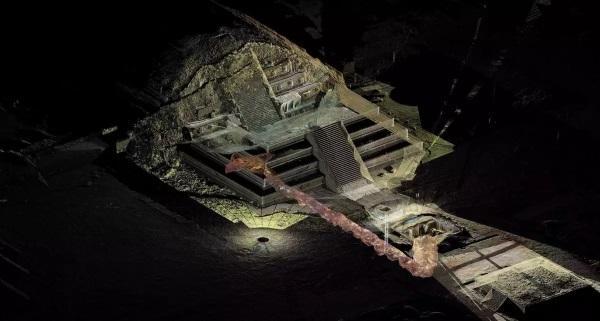
Project leader Sergio Gomez came upon “large amounts” of the silvery stuff in an underground chamber beneath the Quetzalcoatl Temple, one of several sacred pyramids at the site 30 miles from Mexico City.
Though the site has been excavated since the 19th century, little is understood about its leaders and inhabitants. No royal tombs have been found there, and until this month, neither had mercury — a chemical whose presence at a few other ancient sites usually indicated that the place had religious or royal significance.
Visitors look on at the archaeological area of the Quetzalcoatl Temple near the Pyramid of the Sun at the Teotihuacan archaeological site. (Henry Romero/Reuters)
The mercury “completely surprised us,” Gomez told Reuters, and it’s still not clear why the chemical was put in the chamber. Rare, difficult to mine and dangerous to handle, he knows that liquid mercury was prized for its reflective properties — perhaps it was supposed to represent a river or lake to the underworld.
Gomez has been excavating the 1,800-year-old Teotihuacan tunnel for nearly six years in search of a royal tomb. Last fall his team uncovered three previously unexplored chambers nearly 60 feet below ground — in them, he hoped to find human remains that could offer some clues about the ancient city.
“If they are there, they must be from someone very, very important,” Gomez told the Associated Press in October.
The discovery of mercury this month makes it even more likely that the chambers house something — or someone — significant. Gomez hopes to finish excavating them by October, he told Reuters.
If he finds what he has been looking for, Gomez will resolve one of the central mysteries of Teotihuacan: how it was governed.
Developed around 100 A.D. by a still-unnamed civilization, the city’s influence extended as far as Guatemala until it collapsed midway through the 7th century, according to UNESCO. Like so much else about the city, the cause of its downfall remains uncertain. The Aztecsrediscovered the abandoned site when they swept through Mexico half a millennium later — awed by what they saw, they named it “Teotihuacan,” or “abode of the gods.”
Until 1400, Teotihuacan was the largest city in the Western Hemisphere, home to as many as 200,000 people and pyramids that rivaled those in Egypt. But the 14-square-mile site lacks fortifications and military structures — unusual for a city of its size and significance. It also contains little evidence of its rulers — no palace, no pictures of a powerful king — leaving scholars speculating about who ran the city and how it was able to persist for nearly 600 years.
Mexican archaeologist Linda Manzanilla told Reuters she believes that the city was ruled by a council of four lords, and that Gomez will find the remains of one of them in his chambers.
The discovery of a royal tomb would be a remarkable way for Gomez to cap off his 6-year study, which has yielded thousands of relics ranging from centuries-old seeds to strange yellow spheres made of glittering pyrite.
But with three whole chambers and six months left to explore, U.S. archaeologist George Cowgill, who has spent more than four decades excavating Teotihuacan, said that the odds of finding a tomb are still “very uncertain.”
“That is what keeps everybody in suspense,” he told Reuters.
National Institute of Anthropology and History archaeologists work at a tunnel that may lead to a royal tombs. (Reuters)
Sarah Kaplan is a reporter for Morning Mix.
A Chemical Clue in One of Mexico’s Biggest Archaeological Mysteries
- Details
- Vallarta Today Staff Editor
Typography
- Smaller Small Medium Big Bigger
- Default Helvetica Segoe Georgia Times
- Reading Mode
 National Institute of Anthropology and History archaeologists work at a tunnel that may lead to a royal tombs. (Reuters)