







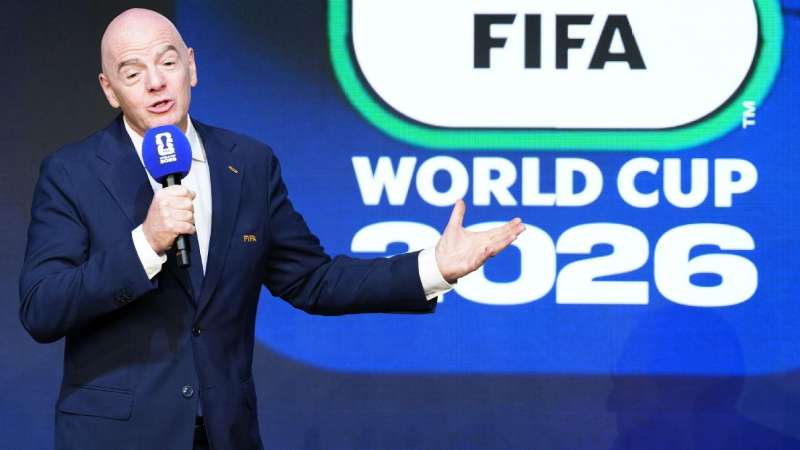
FIFA president Gianni Infantino has publicly reaffirmed his organisation's full confidence in Mexico as a co-host of the 2026 FIFA World Cup, following a direct call with Mexican President Claudia Sheinbaum. 'I reiterated our full confidence in the host country and look forward to it staging all scheduled matches there at what will be the most inclusive and the greatest FIFA World Cup ever,' Infantino said. Sheinbaum echoed the commitment: 'We continue working as usual to successfully host the 2026 FIFA World Cup. We reaffirm our confidence in the country.
The exchanges came during a period of heightened international attention on Mexico following several days of disruption across multiple states in late February. FIFA's explicit, high-level reassurance, delivered at presidential level by both parties, carries significant weight for the sporting, commercial, and hospitality ecosystems that have been building toward the tournament for years. The message from both governing body and host government is unambiguous: the matches will be played, the schedule stands, and Mexico's role in football's largest event is not in question.
What Mexico Is Hosting and Why Guadalajara Is the Centre of Attention
Mexico is scheduled to host 13 of the 48 World Cup matches, with four of those taking place in Guadalajara, the capital of Jalisco state and Mexico's second-largest metropolitan area. Guadalajara's Estadio Akron, home to Club Deportivo Guadalajara (Chivas), is one of the designated match venues, and the city is also scheduled to host an international playoff in late March, when New Caledonia will play Jamaica for the right to face Congo for a tournament berth.
The concentration of matches in Guadalajara makes the city one of the most commercially significant host locations in the entire tournament. Four group-stage World Cup matches, an intercontinental playoff, and the associated arrival of international football federations, media, sponsors, and spectators represent a compressed period of economic activity that the city and its hospitality sector have been preparing to accommodate for years.
The other Mexican host city is Mexico City, where matches will be played at the iconic Estadio Azteca, one of only two stadiums in history to have previously hosted a World Cup final. The combination of Guadalajara and Mexico City as host venues gives Mexico two of the most recognisable football settings in the world, and the logistical and commercial infrastructure of both cities has been substantially upgraded in preparation.
International Federations Are Monitoring, and That Is Normal
The Jamaica Football Federation confirmed that it is closely monitoring the situation in Mexico ahead of the Reggae Boyz' scheduled international matches in late March. The Portuguese football federation noted earlier in the week that it was watching the situation carefully ahead of a friendly against Mexico's national team in Mexico City. These statements reflect standard due-diligence practice by national governing bodies responsible for the safety of their athletes and staff, not signals of withdrawal.
FIFA itself visited Mexico to assess World Cup security and mobility arrangements following the February disruption period. The outcome of that assessment, as signalled by Infantino's public statement, was continued confidence. The governing body has significant institutional, financial, and reputational investment in the success of the 2026 World Cup, and its public positioning reflects a considered judgment that Mexico's hosting preparation is on track.
A contextual point worth holding: the cancellation of the World Aquatics Diving World Cup stop in Zapopan, a Guadalajara suburb, in the same period was cited by some observers as a parallel negative signal. FIFA and World Aquatics are separate governing bodies with different security assessment frameworks, different athlete populations, and different event profiles. The two situations are not directly comparable, and FIFA's explicit reaffirmation post-assessment is the relevant signal for the World Cup specifically.
What the Hosting Commitment Means for Mexico's International Standing
Hosting 13 matches of the FIFA World Cup is not merely a sporting assignment. It is an extended, high-visibility demonstration of a country's capacity to welcome the world, to provide safe, functional, enjoyable experiences to hundreds of thousands of international visitors over a multi-week period. Mexico has hosted World Cup matches before, in 1970 and 1986, and its football culture is among the deepest and most passionate in the world.
The 2026 tournament is co-hosted with the United States and Canada, which means Mexico's hosting performance will be evaluated in direct comparison to two highly organised, well-resourced co-hosts. That context raises the stakes for Mexico's logistics, hospitality, and security preparation, but it also means that any shortfalls will be contextualised against the performance of the overall tri-nation hosting structure rather than attributed to Mexico in isolation.
For investors, tourism operators, and businesses planning around the World Cup, FIFA's confidence reaffirmation is the most operationally relevant signal available. It confirms that the planning assumptions underlying World Cup-related investments and bookings remain valid, that the match schedule has not changed, and that the window of opportunity represented by 13 international football matches in Mexico's two largest cities is intact.
Frequently Asked Questions
Q: How many World Cup matches will Mexico host in 2026?
A: Mexico will host 13 matches in the 2026 FIFA World Cup, which is co-hosted with the United States and Canada. Four of those matches will be played in Guadalajara at Estadio Akron, with the remaining matches in Mexico City at Estadio Azteca. FIFA has confirmed that all scheduled matches will proceed as planned.
Q: Which stadiums in Mexico will host World Cup matches?
A: The two Mexican host venues are Estadio Azteca in Mexico City, one of only two stadiums to have hosted a previous World Cup final, and Estadio Akron in Guadalajara, home to Club Deportivo Guadalajara. Both venues have undergone significant upgrades in preparation for the tournament.
Q: When are the World Cup matches in Mexico scheduled?
A: The group-stage matches in Mexico are scheduled for June 2026, with the tournament running from June through July. Guadalajara is also scheduled to host an intercontinental playoff in late March 2026, when New Caledonia faces Jamaica for a tournament berth. Specific match dates and kickoff times will be confirmed by FIFA closer to the tournament.
Q: Is it safe to travel to Mexico for the 2026 World Cup?
A: FIFA has explicitly reaffirmed its full confidence in Mexico as a host country following its own security and mobility assessment. President Sheinbaum has stated there is no risk for visitors, and both Mexican federal authorities and local host city governments have made extensive security and logistics preparations. As with any major international event, visitors should follow standard travel safety practices and monitor official guidance from their home country's foreign ministry.
Q: What other football events are happening in Mexico ahead of the World Cup?
A: Guadalajara is scheduled to host an intercontinental World Cup qualification playoff in late March 2026, when New Caledonia plays Jamaica. The winner will face Congo for a tournament spot. Mexico's national team also has a friendly scheduled against Portugal in Mexico City. These pre-tournament matches are part of the broader build-up to June's main event.
Q: How does Mexico's World Cup hosting compare to 1970 and 1986?
A: Mexico previously hosted the World Cup in 1970, won by Brazil, and in 1986, when Argentina won the title. Both tournaments were considered successes and cemented Mexico's reputation as a capable and passionate football host. The 2026 tournament represents Mexico's third hosting role, making it one of only a handful of countries to have hosted the World Cup three times.