







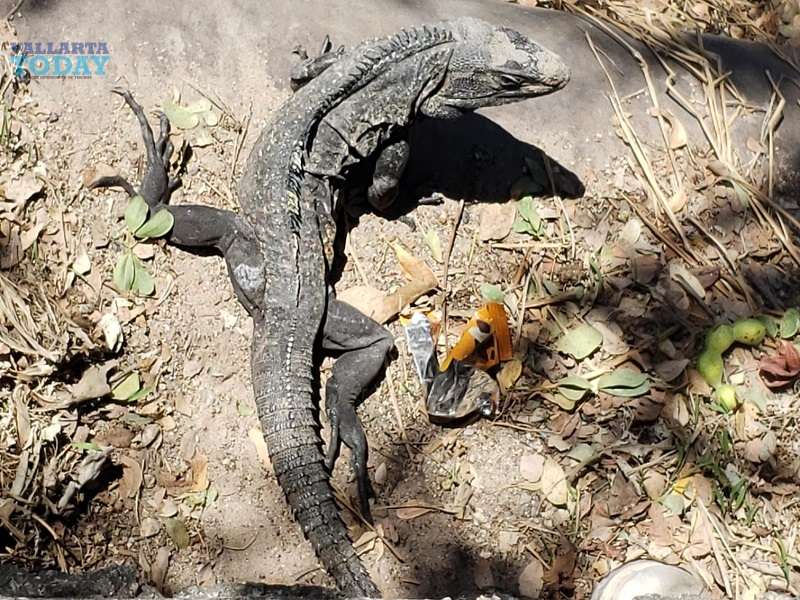
The most famous Black Iguana of Puerto Vallarta.
Along the trails, amidst the mountains, and even on the beach, next to the sea, we've seen these specimens filled with wonderful naturalness. The scientific name of this beautiful species of iguana is "Ctenosaura pectinata," better known as "Garrobo" or "Black Iguana," completely endemic to Mexico, and Puerto Vallarta is one of its favorite homes.
In the wild, its preferred habitats are lowland and mid-elevation deciduous forests and thorny scrub. Thanks to the great diversity of nature in Puerto Vallarta, it is clear that this beautiful iguana has chosen Puerto Vallarta as its preferred home. The conservation of the species is a priority in Puerto Vallarta since it is considered a threatened species due to its exploitation as a source of meat and the destruction of its habitat with the excessive construction of hotels.
"Garrobos" are known as spiny-tailed iguanas, due to the different quilled scales on their long tails. It is one of the largest species in its genus, reaching lengths of up to 1.3 m, somewhat less in the case of females, which reach 1 m. Its head is elongated and flat at the front, covered with hexagonal scales and smaller quilled scales. The black iguana is generally brown or grayish-brown, in contrast to a yellowish belly surface. The offspring are often bright green without any pattern on the skin, which darkens as they grow. Although not known exactly, it is estimated that this iguana in the wild lives around 10 years.
In Puerto Vallarta, we are fortunate to have thousands of species, although it is very important that the population commits to caring for and protecting the habitat and ecosystem of these animals for the good of all. It may seem that these iguanas are troublesome because they have a fondness for feeding on flowers and ornamental shrubs, nesting birds, and sea turtle eggs. Among other difficulties, they have been observed chewing on electrical and telephone cables. They are also often carriers of salmonella, and their appearance is known to intimidate some Vallarta residents. Adult animals are mainly herbivores, feeding on a variety of flowers, leaves, fruits, and stems. But they are opportunistic animals that sometimes become predators of chickens, mouse pups, eggs, and anthropods.
Let's take care of the "Garrobos" of Puerto Vallarta.