flightsfront1December is one of the best times of the year to visit Riviera Nayarit, and Interjet, Southwest Airlines and American Airlines are making it even easier for Californians get there! With new routes and more nonstop service, it only takes a few hours to be tanning on beautiful beaches with a chilled cerveza (beer) in hand as you watch humpback whales playing in the Banderas Bay.

rewrite puertovallarta

I’ve been doing a lot of thinking these days about what corner of the world I might want to move to should the unthinkable happen this coming Election Day. My wife and I have given some thought to Greenland. I, however, have had an allergic reaction to whale blubber since childhood. We considered Mongolia before I realized that yak milk is pink and I made a devout promise to myself years ago to never drink anything the color of baby clothes. New Zealand was on our radar for a bit, but since being traumatized by a Haka dance as a child it would be all I could do to not bite the head off an emu.

So, in our never-ending search to find a Trump-free utopia, we find ourselves this week in San Miguel Allende, Mexico. This is a city unique in many ways. To begin with it’s in the mountains, so while the beach towns of Puerto Vallarta and Acapulco hover somewhere around the “broil” mark temperature-wise, San Miguel is at 6,000 feet altitude, where the days are warm and the nights require a comforter or at the very least, a large dog.

The other unique thing about this quaint Mexican artist’s town is that ex-pat Americans seem to outnumber the Mexican population about dos to uno. This in itself is enough for us to reconsider Greenland.

Tonight, we look forward to experiencing a true Mexican tradition. Hamburger Night at a restaurant called — are you ready? — The Restaurant. It’s OK. When I was a kid there was a highly successful commercial campaign, which touted Tuesday as Red’s Tamale Night. Well, it was big in our house. Red has long since left the building. Rumor has it he’s pushing hamburgers Thursday nights at The Restaurant in San Miguel Allende. Hopefully they’re better than his tamales.

It’s easy to spot the ex-pats in this town. They’re the ones wearing the serapes and Indian jewelry and speaking a form of Spanish wherein if the word can’t be properly pronounced, say it louder. The locals speak perfect English.

The fact is, this place was on Conde Nast’s top 10 list of where in the entire world to visit. And with good reason. It’s a place you don’t just happen by. It’s an hour and a half from the closest airport and as a result it doesn’t have the frenetic pace and hysteric energy of its coastal cousins. There aren’t a dozen guys who look like they’ve just come from the Running of the Bulls accosting you to invest in time-shares as you leave the airport.

The locals here are sincerely proud of their city and I don’t think we’ve been asked to buy a single wicker tote by a street peddler or been touted on a “great” taco place just up the street.

The taxi drivers are polite and helpful, the merchants are welcoming without being overbearing, the bartenders and waiters are efficient and friendly, and you get a heck of a lot of bang for your pesos.

As my mother used to say, “What’s not to like?”

Our search for desirable living should the ridiculous happen this November has been narrowed. We’re down to staying put in Sausalito or crossing the border before the wall’s built and settling in San Miguel Allende. Two things can sway our decision: the election — and Hamburger Night.

100Barry Tompkins is a longtime sports broadcaster who lives in Marin. Reach the author at This email address is being protected from spambots. You need JavaScript enabled to view it.

Bay Area sportscaster Barry Tompkins, seen on Monday, Aug. 22, 2011, in Fairfax, Calif., began his career in San Francisco in 1965 and has worked for HBO and Fox Sports Net. He is known for his work as a boxing commentator, but has covered football and other sports. He lives nearby in Ross. IJ photo/Frankie Frost


VALLARTASOURCE


REPORT

GetImage1

#11 Seed Piotr Kantor/Bartosz Losiak of Poland start off the night session with a Pool B match against #14 seed Markus Bockermann/Lars Fluggen of Germany in the Olympic debut for all four players.

Head to Head

The two teams have split their four meetings on the FIVB World Tour with Bockermann/Fluggen winning the first two meetings and Kantor/Losiak claiming victory in the last two. The Germans were forced to forfeit their only meeting in 2016 in the Bronze Medal Match at the Qatar Open in April. The other three meeting have all been in the round of 16 and have all needed a third set with Kantor/Losiak winning 18-21, 28-26, and 15-10 in one hour in Antalya in October, 2015 and Bockermann/Fluggen claiming the other two, 21-15, 20-22, and 15-10 in 57 minutes in Puerto Vallarta in October, 2015 and 23-25, 21-16, and 15-12 in Rio in September, 2015.

Historically the #11 seed has won three of the four meetings in the Olympic Games, including the last three. Two of the three wins were in straight sets with Cuba's Juan Rossell/Francisco Alvarez pushing Germany's Christoph Dieckmann/Andreas Scheuerpflug to the tie-breaking set in Athens, 21-19, 19-21, and 15-10 in 64 minutes. In Sydney, Russia's Sergey Ermishin/Mikhail Kouchnerev upset Argentina's Mariano Baracetti/Jose Salema, 15-4 in 30 minutes.

Piotr Kantor/Bartosz Losiak, Poland, Seed #11, Pool B, Qualified 11th with 5,180 Points in the 2015-16 Olympic qualification period
• Piotr: May 3, 1992 (24y3m3d), 200 cm (6'7"), 90 kg (200 lbs.), Hometown Sosnowiec, 56th FIVB World Tour event, one gold medal, $182,775 career winnings
• Bartosz: May 14, 1992 (24y2m23d), 190 cm (6'3"), 86 kg (191 lbs.), Hometown Jastrzebie Zdroj, 57th FIVB World Tour event, one gold medal, $194,775 career winnings
• Piotr and Bartosz have been playing together since 2009. They are playing in their 56th FIVB Beach Volleyball World Tour tournament together (ranks 48th), one gold medal, $365,550 career winnings (ranks 51st).
• Piotr has played in six FIVB World Tour final fours with one gold, one silver, and four bronze medals.
• Bartosz has played in seven FIVB World Tour final fours with one gold, one silver, four bronze medals and one 4th place finish.
• Piotr and Bartosz have played in five Final Fours in 2015-2016 (Silver Stavanger Major 2015, Bronze Kish Island Open 2016, Gold Rio de Janeiro Grand Slam 2016, Bronze Doha Open 2016, Bronze Moscow Grand Slam 2016).
• Piotr and Bartosz finished 17th in the FIVB World Championships in 2013 (Stare Jablonki).
• Piotr and Bartosz are currently ranked 4th in FIVB World Tour points in 2016 with 4,760 points and 6th in winnings with $139,750.
• Piotr and Losiak have a career 124-95 (56.6%) match record in FIVB World Tour Events and a 83-48 (63.4%) record in the 2015-16 Olympic qualification period.
• Piotr and Bartosz won the gold medal at the U19 World Championships in 2010 (Porto, Portugal).
• Piotr and Bartosz won the silver medal at the U21 World Championships in 2011 (Halifax, Canada) and the gold medal in 2012 (Halifax, Canada).
• Piotr and Bartosz won the gold medal at the U23 World Championships in 2013 (Myslowice, Poland).

Markus Bockermann/Lars Fluggen, Germany, Seed #14, Pool B, Qualified 15th with 4,850 Points in the 2015-16 Olympic qualification period
• Markus: January 14, 1986 (30y6m23d), 198 cm (6'6"), 95 kg (211 lbs.), Hometown Hamburg, 68th FIVB World Tour event, two gold medals, $147,800 career winnings
• Lars: May 24, 1990 (26y2m13d), 192 cm (6'4"), 80 kg (178 lbs.), Hometown Berlin, 36th FIVB World Tour event, two gold medals, $113,475 career winnings
• Markus and Lars have been playing together since 2015. They are playing in their 24th FIVB Beach Volleyball World Tour tournament together, two gold medals, $151,750 career winnings.
• Markus has played in seven FIVB World Tour final fours with two gold, three silver medals and two 4th place finishes.
• Lars has played in eight FIVB World Tour final fours with two gold, four silver medals and two 4th place finishes.
• Markus and Lars have played in seven Final Fours in 2015-2016 (Gold Fuzhou Open 2015, Silver Rio de Janeiro Open 2015, Silver Xiamen Open 2015, 4th Puerto Vallarta Open 2015-16, Gold Doha Open 2015-16, 4th Doha Open 2016, Silver Antalya Open 2016).
• Markus finished 9th in the FIVB World Championships with Mischa Urbatzka in 2013 (Stare Jablonki).
• Markus and Lars are currently ranked 13th in FIVB World Tour points in 2016 with 3,930 points and 19th in winnings with $81,750.
• Markus and Lars have a career 78-46 (62.9%) match record in FIVB World Tour Events, all in the 2015-16 Olympic qualification period.
• Markus won the silver medal at the European (CEV) Baden Masters with Mischa Urbatzka in 2013 (Baden, Austria).
• Lars won the silver medal at the CEV Novi Sad Masters with Alexander Walkenhorst in 2013 (Novi Sad, Serbia).
• Lars had knee surgery in April forcing him to miss several FIVB World Tour events


VALLARTASOURCE


REPORT

574c60ed160000ab02f94c7f

Surfing and skateboarding are among sports that will debut in Tokyo.

After two years of vetting extreme sports for the Olympics, the International Olympic Committee on Wednesday formally approved the inclusion of surfing, skateboarding, karate, rock climbing, baseball and softball for the 2020 summer games in Tokyo.

The new sports, according to a press release, were chosen in hopes of attracting a younger crowd.

“We want to take sport to the youth,” Thomas Bach, IOC president, said in the release. “With the many options that young people have, we cannot expect any more that they will come automatically to us. We have to go to them.”

It makes sense, then, that some of the world’s most notoriously “cool” sports ― surfing and skateboarding, in particular ― made the cut.

But some athletes have mixed feelings about their sport entering one of the world’s most visible arenas.

Surfing, perhaps one of the most difficult sports to assimilate into the Olympics, because it relies on unpredictable ocean conditions and will take place at a beach (not an artificial wave pool) during the Tokyo games. It will only include shortboard surfing, Surfer Magazine reports.

”It definitely puts surfing on another level,” said three-time women’s world champion of surfing Carissa Moore.

“Winning a gold medal in the Olympics is the epitome of sports, as I see it,” Moore told The Huffington Post. “I’m just really excited that more of the world will get to share in such a cool sport that I love.”

Jamie Owens, the editor-in-chief of Transworld Skateboarding Magazine, wasn’t as thrilled to see skateboarding on the Olympic list.

“It’s not a big deal to us at the mag,” Owens told GrindTV. “They need skateboarding more than we need them. They just want to make money off of something we love and live for.”

Although most of the new sports are making their Olympic debut (baseball was included in previous Olympic games), this announcement only secures their spot in the Tokyo games and does not guarantee inclusion in future games.

We’ll just have to wait four years to see how these extreme sports hold up in the world of Olympians.


VALLARTASOURCE


REPORT


dino print

A team of paleontologists found a fossilized footprint measuring 1.15 meters – about 3 feet, 9 inches – of a bipedal, carnivorous dinosaur that lived in what is now southern Bolivia about 80 million years ago.

It is the largest such footprint ever found to date in the landlocked South American nation, the scientists said.

The Abelisaurus footprint – which was found in the Maragua zone, about 40 miles from city of Sucre – could be one of the largest footprints of this species ever found anywhere in the world, paleontologist Omar Medina, of the Bolivian Paleontology Network, told EFE.

Medina said that the footprint is 78-80 million years old and emphasized the importance of Maragua for paleontology, given that thousands of other footprints and tracks of other dinosaurs – both carnivores and herbivores - have been found nearby.

Argentine paleontologist Sebastian Apestiguia, who verified the find, told the daily La Razón that the print "is much larger" than others of the same species that had been found to date.

He added that the dinosaur could have measured more than 39 in length, while other carnivorous dinosaurs from the end of the Cretaceous Period in South America normally attained a maximum size of about 29.5 feet, meaning that the recently-found print would set "a record."

The most complete Tyrannosaurus Rex skeleton ever found, housed at the Field Museum of Natural History in Chicago, measures 40 feet in length.

Paleontological guide Grover Marquina found the Abelisaurus footprint about two weeks ago while exploring the zone to design a tourist route at the behest of the Sucre city administration, a project in which Medina participated as part of the Viceministry of Science and Technology.

More than 10,000 dinosaur footprints have been found in the Cal Orck'o region in the Sucre municipality.


VALLARTASOURCE


REPORT


download1This marks the 14th consecutive month of record-breaking global temperatures.
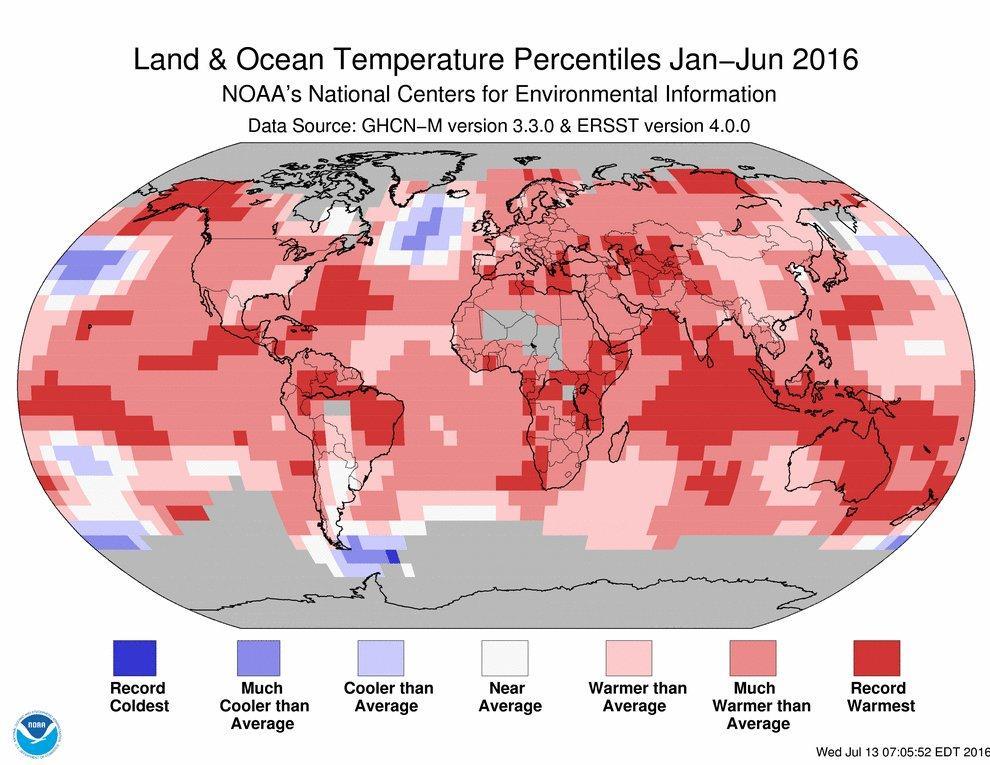
The heat wave continues.

Last month was the hottest June ever recorded, according to both NASA and the National Oceanic and Atmospheric Administration (NOAA). This marks the 14th month in a row that global heat records have been broken. It’s the longest streak of record-breaking temperatures since reporting began in 1880.

Global average temperatures in June were 0.9 degrees Celsius hotter than the average for the 20th century. These temps broke the previous record, set last year, by 0.02 degrees Celsius.

The planet is well on track to surpass 2015 as the hottest year ever recorded.

“2016 has really blown that out of the water,” said Gavin Schmidt, director of NASA’s Goddard Institute for Space Studies, per NPR.

578f08bc1300002c0005ed6d
NASA/GODDARD INSTITUTE FOR SPACE STUDIES

The scorching temperatures of the past several months were partly fueled by this year’s powerful El Niño. However, these effects have been fading in strength, clearly revealing the impact of global warming.

“While the El Niño event in the tropical Pacific this winter gave a boost to global temperatures from October onwards, it is the underlying trend which is producing these record numbers,” Schmidt said in a statement this week.

NASA noted that rising global temperatures were further exacerbated by extreme regional warming in the Arctic.

“It has been a record year so far for global temperatures, but the record high temperatures in the Arctic over the past six months have been even more extreme,” Walt Meier, a sea ice scientist at the agency, said. “This warmth as well as unusual weather patterns have led to the record low sea ice extents so far this year.”

Arctic sea ice now covers 40 percent less of the Earth than it did in the 1980s, NASA said.

CnvJcsnWcAAFNXc

Scientists have expressed concern at the rate of warming.

“I’m just in shock,” Astrid Caldas, climate scientist with the Union of Concerned Scientists, told HuffPost in May. “I think most climate scientists are surprised at the speed that it’s happening. But at the same time, with emissions peaking again last year... everything was pointing to an increased temperature. It’s the amount by which the records are being broken, not the fact that the record’s being broken, that’s really striking.”


VALLARTASOURCE


REPORT

577c2c721800002400fa405c

Construction on the Five-hundred-meter Aperture Spherical Telescope, or FAST, began in 2011. Workers installed the last of 4,450 panels on Sunday and operations are scheduled to begin in September.

The Chinese government has finished building the world’s largest radio telescope — a $180 million monster that will be used in the search for extraterrestrial life.

The last of the 4,450 panels that make up the telescope’s reflector, which is some 30 football fields in size, was hoisted into position Sunday morning, according to a press release from the Chinese Academy of Sciences.

The Five-hundred-meter Aperture Spherical Telescope, or FAST, is located in the country’s southwestern province of Guizhou. Its completion comes just months after authorities announced plans to relocate 9,110 people from their homes to make way for the giant.

“As the world’s largest single aperture telescope located at an extremely radio-quiet site, its scientific impact on astronomy will be extraordinary, and it will certainly revolutionize other areas of the natural sciences,” Nan Rendong, the project’s chief scientist, told China’s state-owned Xinhua News Agency.

Unlike optical telescopes, which gather and focus light, radio telescopes detect radio frequencies, including those from pulsars, or rotating neutron stars, and active galaxies. With a diameter of about 1,640 feet, FAST dwarfs Arecibo Observatory in Puerto Rico, the previous record holder with a diameter of about 1,000 feet.

Tim O’Brien, a professor of astrophysics at the University of Manchester in the United Kingdom, told New Scientist that the telescope’s size is key to its potential impact on scientific exploration.

FAST will allow astronomers to “survey hydrogen in very distant galaxies, detect molecules in space, search for natural radio wave emissions from planets orbiting other stars and help in the search for radio signals” from alien civilizations, O’Brien told the publication.

Construction work on FAST began in 2011, and operations are expected to start in September.

“FAST’s potential to discover an alien civilization will be 5 to 10 times that of current equipment, as it can see farther and darker planets,” Peng Bo, of the National Astronomical Observation, told Xinhua.

If E.T. phones home, FAST will be listening.

Workers lift the last panel to install into the center of a Five-hundred-meter Aperture Spherical Telescope (FAST) on July 3.


REPORT


VALLARTASOURCE