







By the last week in October, we had seen a bit of variety during our little getaway: the eastern Baltic Sea, the North Atlantic Ocean, a bit of the Caribbean Sea and the Gulf of Mexico, and now the vast Pacific Ocean was pulling us through the Central and North American tropics.
Copenhagen, our voyage starting point, lies on the Baltic Sea, at 55.7 degrees north latitude, and Cartagena, our southern-most stop, lies at nine degrees north; that's a difference of 46.7 degrees, or 52 percent of the latitudes between the North Pole and the Equator.
When you sail those vast distances, you get to see so much: changes in the color of the water, dramatic effects of various climate conditions on the sea's surface, aquatic animals' daily activities in the ocean. You can learn for yourself the difference between bays and oceans and seas, follow your course on a maritime chart, and of course sample the sights in the many strange lands along the way.
Living in Turkey is the greatest adventure of my life; the land, culture and history here are so absorbing that it's easy to forget there is another world out there, maybe not so ancient or distinguished, but pretty awesome, nonetheless. I don't think anything (easy to do and non-lethal, anyway) shows that as distinctly as a long sea voyage.
After our canal adventure, and the ill-advised (but exciting) Costa Rica rainforest zip-lining frolic that followed, our by-now-homey ship turned at last for its final northwest climb through the Tropic of Cancer; we wouldn't be out of the tropics for several more days, but now, slowly, slowly, we traveled north, with no more southern swoops and storms, nor nighttime views of Cuban and Haitian shores. As we left behind the Central American coast at the border of Guatemala and officially entered the Northern American waters of Mexico, we looked forward to visiting our other favorite country, besides Turkey and the US.
Like both of those countries, Mexico is home to more cultures than you could shake a stick at, and its history has involved invasions by land and sea going back thousands of years, all of which have left their mark on the culture today. Also like Turkey, it boasts a varied and distinctive cuisine that is for some reason usually overlooked in culinary journals, although its use of chili peppers, corn and tomatoes has influenced just about every “popular” cuisine in the world; there's a lot more to Mexican food than refried beans. (Nonetheless, when enjoyed with a stack of warm tortillas, frijoles refritos are hard to beat.)
Mexico resembles its northern neighbor in many ways, too, perhaps because the part of today's US that used to belong to Mexico is bigger than Mexico is today! What is now the state of Texas was forcibly invaded and annexed in the early 19th century by Northern American settlers and speculators backed by government troops (“Remember the Alamo!”), and the area covering most of present-day Arizona, California, Nevada, New Mexico and Utah, plus parts of several other states, were “ceded” to the US in 1848, not-so-coincidentally the year gold was discovered in northern California.
While the “new” lands greatly enhanced America's ideal of a Manifest Destiny, the same could not be said for Mexico's end of the deal; this was not one of America's finer moments, to say the least. But I digress.
Puerto de Chiapas
Chiapas is the Mexican state that sits above the Guatemalan border. It was from a village in Chiapas that José Salvador Alvarenga left in December of 2012 for a three-day fishing trip. He wasn't seen again until he washed up on the beach in the Marshall Islands (South Pacific) 13 months later.
Chiapas is arguably the most naturally beautiful state in Mexico, as well as its (inarguably) poorest one. Like so many cash-strapped countries, various governments in Mexico have grasped at tourism as the panacea for financial problems, and under the presidency of the reform-minded (but largely ineffective) Vicente Fox, millions of pesos were lavished on Chiapas to build a port capable of berthing large cruise ships.
Unfortunately, following the lead of his little friend George W. Bush, who was the US president at the time, Fox chose to ignore the outcry of local residents, who didn't want cruise ships or tourists in their little corner of the world: Chiapas contains several revered sites of an ancient civilization (Mayan) as well as at least a dozen different indigenous cultures, most of which still practice, to varying degrees, the “old ways.”
Even though the local rainforest has long since been destroyed to support agriculture and ranching, Chiapas today is still densely wooded in many places, and so full of birds that it is downright spooky in places. There are other spooky things about Chiapas, like the continued unrest regarding the mysterious disappearance-by-police of 43 university students, along with the discovery of several mass graves in the vicinity of their last known whereabouts.
That was probably the explanation for the full-court police escort provided to our silly little tour bus, although we never did get an answer as to that.
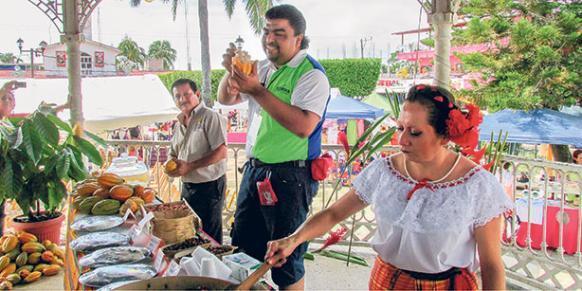
All the weirdness aside, Chiapas is drop-dead beautiful, the people are lovely, small and friendly, and they make chocolate from the local cacao beans in cheerful demonstrations for tourists. We'd definitely go again.
Hualtuco
The next day we stopped in Hualtuco, located in Oaxaca (Wahl-too-coh in Wah-ha-cah). Oaxaca is the fourth poorest state in Mexico (out of 32 states), and is also trying to encourage tourism.
Your reporter was a little under the weather that day, and we didn't have any big adventures. We did, however, notice a lot of construction of villas and condos along the heretofore magnificent coastline of the city. Right on cue, we met an American couple in town who had just closed the deal on a purchase of a condo there. They had lived for 15 years in Mazatlán, further up the coast; they said there were too many people there now, and recommended living in Huatulco to any interested parties.
Puerto Vallarta
Our third Mexican port was in Puerto Vallarta, located in the state of Jalisco (the 19th poorest, or, actually, the 13th richest!). The splendors of Puerto Vallarta -- wild jungles meet black sand beaches -- were first revealed to a mass international audience with the release of the John Huston film “Night of the Iguana,” in 1963, starring Richard Burton, the talented British actor who was then having a torrid affair with Elizabeth Taylor; needless to say, the press had a heyday during the entire shoot.
The resultant “elevation” of what had been up until then an established vacation spot for Mexican tourists resulted in its being chosen to host then-US President Richard Nixon for a treaty signing, which in turn led to the hasty construction of an international airport; and that's, as they say, all she wrote.
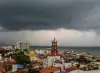
The gracious, poignant charm of the pre-1970s Puerto Vallarta is very nearly gone, but a first-time traveler wouldn't know the difference, as long as they didn't approach by sea: The first view the passenger has of this near-legendary tropical Empyrean is a spectacular composite landscape containing a Galleria mall, a Sam's Club and a Walmart, nestled artfully below towering-but-tacky high-rise buildings.
Fortunately, a couple of American expats living in PV had asked us to join them ashore for lunch and a look at their homes, so we were able to scoot past the quayside abominations and go straight to town, where, I am happy to report, things were much different.
Even though the city has grown enormously (over 250,000 fulltime occupants), the individual neighborhoods have retained much of their culture and atmosphere. The art-colony atmosphere is a little over the top for me, but I'm sure its influence has contributed greatly to the maintenance of Puerto Vallarta's still powerful beauty and charm. Both Jennifer and Helen, our expat hosts, live alone in safety and comfort, in large, tasteful apartments that are equally comfortable and exciting, while completely different one from the other.
We lunched in a lovely hotel with a view of the entire city, dining on the delicious Mexican food we had been craving. The lady whose hotel it was is also an expat who, with her husband, built up the business over several years; her husband died a few years ago, and she runs the place herself now. We were there for day one of the Mexican Day of the Dead holiday (Oct. 31 to Nov. 2), and it was a mixed-cultural treat to see the ofrenda (private altar) the hotel had constructed in the restaurant in memory of the deceased patron: a purely Mexican customary tribute to a foreigner who came to a strange land, and stayed.
Cabo San Lucas
After crossing the bottom of the Gulf of California (Sea of Cortez), we came to the southernmost point of the state of Baja California Sur (the sixth richest). Baja is a desert, and probably the most interesting thing in Cabo is the desert rocks that march out to land's end in dramatic style, observably dividing the warm waters of the Sea of Cortez from the cold currents of the Pacific.
If game fishing in overfished bays, hanging out in solid-block condo complexes, hiring a camel and guide for a “real” caravan experience (in Mexico??) and partying from dusk until dawn are your thing, then Cabo San Lucas is for you. It is not, however, for us, but we knew that, so we weren't disappointed. We did, however, gorge on -- yes, Mexican food -- until we nearly dropped.
That evening, we finally set sail for Los Angeles, California, and our American family; it was getting hard to wait.
Puerto Vallarta
Puerto Vallarta ofrenda (private altar)
This email address is being protected from spambots. You need JavaScript enabled to view it.
This email address is being protected from spambots. You need JavaScript enabled to view it.
[readon1 url="http://www.todayszaman.com/expat-zone_taking-a-break-6-the-fragile-fascinating-mexican-riviera_369765.html"]Source:www.todayszaman.com[/readon1]
The Fragile, Fascinating Mexican Riviera
- Details
- ELSIE ALAN
Typography
- Smaller Small Medium Big Bigger
- Default Helvetica Segoe Georgia Times
- Reading Mode