solar

SolarWorld supplies complete 1.16-MW system for Plantronics' Tijuana factory

HILLSBORO, Ore.--(BUSINESS WIRE)--June 23, 2014--
An audio-headset factory in Tijuana, Mexico, is now home to the largest, privately owned roof-mounted solar installation in all of Latin America. The 1.16-megawatt system features solar panels, racking and system engineering from SolarWorld, the largest solar manufacturer in the Americas for nearly 40 years.

A photo taken using a fish-eye lens shows a portion of a 1.16-MW solar system in Tijuana, Mexico, the largest system of its kind in Latin America. The systems features solar panels, racking and system engineering from SolarWorld, whose distributors and sales representatives have operated in Latin America since the late 1970s. (Photo: Business Wire)

The system will power the Mexico operations of Plantronics, a global producer of audio communications headphones. The project is the second of SolarWorld solar panels at a Plantronics facility. In 2011, the headset manufacturer installed 608 kilowatts of roof-mounted and carport-mounted solar arrays at its headquarters in Santa Cruz, Calif.

"Being responsible with the environment is not a luxury, it is a commitment," said César López, director of government relations for Plantronics Tijuana. "As part of that commitment, it was important to us to select SolarWorld solar panels and racking, which are manufactured in North America according to the highest standards of quality, safety and sustainability."

Developed and installed by 3Tek Solar, a solar integrator based in Tijuana, the system is composed of 4,284 high-performance SolarWorld solar panels. About 1.14 megawatts of those panels are mounted on the factory's industrial metal-seam roof using SolarWorld's Sunfix Plus racking product. An additional 20 kilowatts are installed atop a covered walkway at the factory's entrance. The system also features SMA Sunny Central inverters.

The installation is expected to produce 1.9 gigawatt hours of renewable energy each year. The power output will offset about 70 percent of Plamex's energy needs at the Tijuana plant and save nearly 3 million pounds of carbon dioxide.

"Industrial building design is all about maximizing long-term operations by reducing energy costs and managing natural resources," said Hector Montoya, director of 3Tek Solar. "3Tek Solar has supplied Plantronics with design-build services for the past 15 years. We are grateful to Plantronics for trusting 3Tek Solar to successfully deliver a project of this magnitude -- the largest of its kind in Mexico -- on schedule and within budget."

SolarWorld has supplied solar panels, mounting solutions and complete solar systems for both on- and off-grid applications to customers in Latin America since the late 1970s. Through its Solar2World program, which supports community rural-electrification projects in developing economies, SolarWorld also has donated panels to power hospitals, medical clinics and water-treatment facilities in Haiti, Peru, Mexico and Honduras.

"As a company with business ties to Latin America dating back more than 30 years, SolarWorld has long understood that solar power is an essential part of the region's energy mix," said Mukesh Dulani, U.S. president of SolarWorld. "We're pleased to team with longtime partners, like 3Tek SOLAR and Plantronics, to expand the reach and profile of solar energy in Mexico's fast-emerging market."

About SolarWorld

SolarWorld AG manufactures solar power systems and in doing so contributes to a cleaner energy supply worldwide. The company, located in Bonn, employs approximately 2,500 people and carries out production in Freiberg, Germany, and Hillsboro, USA. From raw material silicon to the solar module, SolarWorld manages all stages of production -- including its own research and development. Through an international distribution network, SolarWorld supplies customers all over the world with solar modules and complete systems. The company maintains high social standards at all locations across the globe, and has committed itself to resource- and energy-efficient production. SolarWorld has been publicly traded on the stock market since 1999. More information at www.solarworld-usa.com.

About 3Tek Solar

3Tek Construction is a recognized contractor in the Baja region that has been serving its clients, both industrial and commercial, for 20 plus years. Their solar integrator division -3Tek SOLAR- was created to serve Mexico's ever growing demand for sustainable energy options.

3Tek SOLAR offers Integrated EPC Service that ensures its client's satisfaction from beginning to end. Their all encompassing technical support includes project development and permit procurement from government agencies.

3Tek SOLAR possesses the know-how and experience to serve all solar energy needs with the added benefits of builder knowledge and expertise.

About Plantronics

Plantronics is a world leader in personal audio communications for professionals and consumers. From unified communications solutions to Bluetooth headsets, Plantronics delivers unparalleled audio experiences and quality that reflect our nearly 50 years of innovation and customer commitment. With offices in 20 countries Plantronics is used by every company in the Fortune 100 and is the headset of choice for air traffic control, 911 dispatch and the New York stock exchange.

Plamex, Plantronics' Tijuana-based manufacturing plant for over 31 years, employs 3,000 people and is regarded as an example to plants worldwide. It has won many awards including the coveted "Best place to work" in 2011 and is widely recognized for its environmental leadership and commitment. In 2003, Plamex achieved the Certification for Excellence in Safety and Environmental Practices awarded by Mexico's Federal Ministry of Labor. Plamex is certified in ISO 9001, ISO 14001, CTPAT, FAST, PAPS, DOT and CHP. Plamex has received numerous awards and commendations for its excellence in environmental matters, community work, customer satisfaction and work safety.

CONTACT: SolarWorld Industries America Inc.
Devon Cichoski
Corporate Communications Manager
Office: 805-388-6388
Cell: 805-377-2905
This email address is being protected from spambots. You need JavaScript enabled to view it.


[readon1 url="http://online.wsj.com/article/PR-CO-20140623-905594.html"]Source:online.wsj.com[/readon1]


RR

The 10.1bn-peso (US$780mn) project includes building a route between Observatorio in Mexico City and Zinacantepec in Mexico state (Edomex) operated by electric trains that will travel at speeds of up to 160km/h. The line will have four stations and two main terminals, including a stop at Metepec, close to Toluca international airport.

The consortium got the highest score in the tender, although it did not submit the lowest economic bid.

The project has been divided into a series of separate tenders, with the construction contracts open to Mexican companies only.

A consortium consisting of Caabsa Constructora, Omega Construcciones and Mexicana de Presfuerzo submitted the highest bid at 11.1bn pesos, while a consortium led by Tradeco Infraestructura presented the lowest bid at 7.4bn pesos.

Many of Mexico's largest construction firms submitted bids as a consortium, with ICA teaming up with Grupo Carso.

SCT has yet to award two other stretches.

[readon1 url="http://www.bnamericas.com/news/infrastructure/mexico-awards-key-railway-project"]Source:www.bnamericas.com[/readon1]

gcm1

Three golf journalists in the United States visited the greens in the Riviera Nayarit in order to promote them to over a million fans of this “gentleman’s sport.”

The Riviera Nayarit Convention and Visitors Bureau (CVB) hosted a FAM trip for three North American journalists specializing in the game of golf so they could become acquainted with and play on the courses hosted by the destination.

The trip was held at the end of May and extended into the first days of June; it was justified by the importance this gentleman’s game holds for the captive market the United States represents for the Riviera Nayarit.

The sum total of impressions generated by the publications the three reporters write for surpasses one million golf lovers.

Jason Deegan, a reporter who specializes in luxury hotels and everything golf around the world, writes for the Golf Channel and its Worldgolf websites: www.golfchannel.com, www.Travelgolf.com and www.worldgolf.com.

He’s also editor of Michigan Golf Magazine and a principal contributor to Athlon Sports Annual, one of the top ten golfing magazines in the United States. The reach of his posts just on the Golf Channel surpasses 800 thousand followers.

Danny Freels currently writes for GolfTime Magazine, published twice a year in Chicago and the western United States. It has a print run of 60 thousand issues per edition and is distributed in more than 450 golf clubs. Freels has worked as a freelance journalist for many years and is considered a top source for the sport.

Erik Hart was golf director for the Hacker’s Guide, which classifies golf state by state within the United States. He’s currently a writer for Golf Gateways Magazine, a specialty publication with a circulation of 230 thousand issues.

The writers visited El Nayar Vidanta Golf Club, Nuevo Vallarta, El Tigre Golf Course, Nuevo Vallarta, Flamingos Golf Course, Flamingos, Litibú Golf Course, Punta Mita Bahia Golf Course and the Punta Mita Pacifico Golf Course.

It’s a well-known fact that many players from the U.S., both amateurs and professionals, love visiting the Riviera Nayarit for its golf courses. In fact, many spend the winter season in Mexico’s Pacific Treasure playing on a daily basis.

MN

TOKYO -- Nissan Motor and German carmaker Daimler AG have decided to jointly produce luxury subcompact cars in Mexico beginning in 2017 in a bid to cut investment costs and export luxury models to the U.S. market, people close to the matter told The Nikkei on Saturday.

The two automakers will likely finalize the deal soon and are expected to announce their decision by the end of this month, these people said.Under the plans, the companies will set up a joint venture firm and spend tens of billions of yen (tens of millions of dollars) to set up a new production line in Nissan's passenger car plant in Mexico's central state of Aguascalientes. They will likely turn out a total of 100,000 to 150,000 units a year.

They will manufacture front-wheel-drive luxury subcompacts using Daimler platform. The joint venture firm will start producing Nissan's luxury Infiniti model first in 2017 and then Daimler's Mercedes-Benz. The two carmakers will sell jointly produced vehicles under their respective brands.

In 2010, the Japanese and German automakers formed a capital tie-up. Nissan has since acquired engines for luxury cars, among other things, from Daimler, but this will be the first time the two companies will work together to produce finished cars.

Since Daimler has solid know-how on luxury car production, Nissan aims to boost its cars' brand appeal through this joint venture. Meanwhile, Daimler seeks to acquire the capacity to produce luxury subcompacts for the U.S. market by using Nissan's large production base in Mexico.

[readon1 url="http://asia.nikkei.com/Business/Deals/Nissan-Daimler-to-finalize-deal-on-Mexico-joint-venture"]Source:asia.nikkei.com/[/readon1]

shutterstock 64355314

Mexico’s central bank sees no need for additional reductions in borrowing costs following a surprise cut earlier this month as analysts forecast a recovery in the economy.

Policy makers voted 3-2 to reduce the key interest rate a half point to a record low 3 percent on June 6, the central bank said in the minutes published today. Following a 1.8 percent expansion in the first three months of 2014, growth will accelerate to 4 percent in the fourth quarter, according to analysts surveyed by Bloomberg.

The three central bank board members who voted in favor of reducing rates said further cuts wouldn’t be advisable in the foreseeable future, the minutes said. Banco de Mexico Governor Agustin Carstens, who has reached the 3 percent inflation target in only one month since taking office in January 2010, is adding stimulus to an economy where growth has missed analyst forecasts in seven of the past eight quarters.

“The arguments against further cuts are very strong in the minutes,” Marco Oviedo, chief Mexico economist at Barclays Plc, said in an e-mailed response to questions. “If the economy is recovering, there is no further need” to cut rates.

The peso strengthened 0.1 percent to 13.0095 per U.S. dollar at 10:51 a.m. in Mexico City. The yield on Mexico’s fixed-rate government peso bonds due in 2024 fell one basis point to 5.74 percent.

Lower Growth

The Banco de Mexico’s rate cut on June 6 surprised all 20 economists surveyed by Bloomberg, who had forecast no change. Slack in the economy has increased and inflation (MXCPYOY) isn’t under pressure from aggregate demand, the majority of central bank board members said in the minutes.

“The majority of the members stressed that the unexpectedly low dynamism of the first quarter this year leads to forecasts that for 2014 economic growth will be less than what was expected just two weeks ago,” policy makers said in the minutes.

Inflation slowed from an eight-month high of 4.48 percent in January to 3.51 percent in May as the effect of new taxes waned. Mexico on Jan. 1 raised the sales tax along the U.S. border and in some coastal areas to 16 percent from 11 percent and implemented a new 1-peso-per liter duty on soft drinks. Policy makers target inflation of 3 percent, plus or minus one percentage point.

The first-quarter expansion of gross domestic product was less than the 2.1 percent year-on-year median forecast of analysts surveyed by Bloomberg. Compared with the previous quarter, the economy grew 0.3 percent, the statistics agency said May 23.

To contact the reporters on this story: Eric Martin in Mexico City at This email address is being protected from spambots. You need JavaScript enabled to view it.; Brendan Case in Mexico City at This email address is being protected from spambots. You need JavaScript enabled to view it.

To contact the editors responsible for this story: Andre Soliani at This email address is being protected from spambots. You need JavaScript enabled to view it. Philip Sanders, Harry Maurer

[readon1 url="http://www.bloomberg.com/news/2014-06-20/mexico-sees-no-further-rate-cuts-as-economy-poised-to-recover.html"]Source:www.bloomberg.com[/readon1]

chil

Chilean President Michelle Bachelet on Friday proposed a September gathering between officials and business leaders from Mercosur and the Pacific Alliance in hopes of creating a tie-up between the two Latin American trade groups.

Speaking alongside Mexican President Enrique Pena Nieto, Colombian President Juan Manuel Santos and Peruvian President Ollanta Humala, Bachelet suggested that foreign ministers from the two blocs should also meet to form a working agreement aimed at developing stronger links.

"I think that beyond the differences, it's perfectly possible in the future to create agreements between the countries of the Pacific Alliance and Mercosur," she said at the official start of the Pacific Alliance summit in the western Mexican coastal state of Nayarit. "It's not just possible, it's necessary."

The Pacific Alliance, created in 2011, is an economic bloc that includes Mexico, Peru, Colombia and Chile, and represents about 35 percent of Latin America's gross domestic product.

The Mercosur bloc includes regional heavyweights Brazil and Argentina, but Chile is only an associate member.

Bachelet, who returned to power in Chile in March, has criticized the previous conservative administration for neglecting relations with South America's more left-leaning countries and said she wants the Pacific Alliance to be more inclusive.

On Thursday, Mexico's stock exchange said it will connect with bourses in Chile, Colombia and Peru by year-end through the Latin American Integrated Market, or MILA, in the latest example of regional integration.

MILA was formed in 2011 to boost market liquidity within the Pacific Alliance trade grouping, and the tie-up aims to create more business for the financial markets in the region.

[readon1 url="http://www.reuters.com/article/2014/06/20/us-mexico-chile-trade-idUSKBN0EV24820140620"]Source:www.reuters.com[/readon1]

PromocionVerano HomeING

Discounts, free nights, kids stay free and special amenities are all on the agenda in order to increase the influx of tourists during the summer season, as well as position the destination through its varied activities.

The Riviera Nayarit Convention and Visitors Bureau (CVB) has teamed up with the destination’s hotels with the clear objective of increasing the number of tourists during the summer season through different promotions that extend from June through August.

Visitors can choose from among several offers, including discounts from 20 to 35 percent, free nights or kids stay free, as well as a slew of special amenities.

To date there are 15 participating hotels: Hotel Villa Varadero, Grand Velas, Samba Vallarta, Occidental Grand, Villa La Estancia, Villa del Palmar Flamingos, Marival Resort, Marival Residences, Rancho Banderas, Bel Air, Riu Jalisco, Riu Vallarta, Riu Palace, Hard Rock Hotel and Dreams Villamagna.

As more participants are added the information will be disseminated via the destination’s social media accounts. Travelers can take advantage of these great offers from June 17th through August 18th. You can find all the details at http://www.rivieranayarit.com/seasonal_deals.

The recent Spring Offers that ended just last month increased sales for May 117 percent more over sales during that same month in 2013. This immediate return on investment is a motivating factor for this new campaign to exceed the summer sales numbers from last year.

“Even though summer is our high season, there’s always room for growth,” said Liliana Lara, Marketing Manager for the Riviera Nayarit CVB. “We want to exceed those occupancy rates and reach out not only to our domestic market, but also to the foreign ones. We believe we can motivate them to visit us during this time of the year as well, not just during the winter.”

According to the 2013 Annual Poll conducted by the Riviera Nayarit CVB, last summer’s occupancy rate averaged 69.45 percent during June, July and August, with July topping out at 80.63 percent.

All of the most important information regarding the different activities to be held in the micro destinations of the Riviera Nayarit for families as well as those aimed at the different market segments will be announced on the CVB’s official websites and social media accounts.

fibra inn

At the Holiday Inn Express Guadalajara Autonoma hotel, Ps. 80.3 million was invested in the construction of 99 additional rooms, following the acquisition of this property on May 20, 2013. These new rooms were put into operation on June 2, 2014. At the Holiday Inn Express Playa del Carmen hotel, Ps. 38.5 million was invested in the addition of 51 rooms which became operational on April 1, 2014. This hotel was acquired on May 24, 2013.

Deutsche Bank Mexico, S.A., Banking Institution, Trust Division F/1616 or Fibra Inn (BMV:FINN13), a Mexican real estate investment trust specializing in the hotel industry serving the business traveler, announced today that it completed the construction of additional rooms at two of its properties.

At the Holiday Inn Express Guadalajara Autonoma hotel, Ps. 80.3 million was invested in the construction of 99 additional rooms, following the acquisition of this property on May 20, 2013. These new rooms were put into operation on June 2, 2014.

At the Holiday Inn Express Playa del Carmen hotel, Ps. 38.5 million was invested in the addition of 51 rooms which became operational on April 1, 2014. This hotel was acquired on May 24, 2013.

Fibra Inn has another 259 rooms currently under construction at the Camino Real Guanajuato, Marriott Puebla and Holiday Inn Altamira hotels. This is in addition to the 540 rooms that will be added with the development of three hotels.

Fibra Inn is a Mexican trust formed primarily to acquire, own, develop, operate and rent a broad range of hotel properties in Mexico. Headquartered in Monterrey, Fibra Inn has a portfolio of high-quality hotels and geographically diverse located in 13 states throughout Mexico, comprised of 23 hotels and 3 under development.

The Company has signed Franchise Agreements with IHG to operate its global brands Holiday Inn, Holiday Inn Express, and Holiday Inn Express & Suites; with Hilton to operate its brand Hampton Inn by Hilton; and is in the process with Starwood Hotels & Resorts Worldwide to operate the brand Aloft.

Additionally, Fibra Inn has agreements with IHG, Marriott International and Wyndham Hotel Group. These hotels enjoy some of the industry’s top loyalty programs and, offer attractive hotel options for businesses travelers. Fibra Inn recently listed its Real Estate Trust Certificates (Certificados Bursátiles Fiduciarios Inmobiliarios or “CBFIs”) on the Mexican Stock Exchange and trades under the ticker symbol “FINN13”.

fachada-1

[readon1 url="">http://www.hotelnewsresource.com/article78482.html"]Source:www.hotelnewsresource.com[/readon1]

GAP

Grupo Aeroportuario del Pacifico SAB is topping the global airport industry as it posts the fastest passenger growth in Mexico and billionaire real estate investor Sam Zell builds a footbridge to lure U.S. passengers to Tijuana.

The airport operator known as GAP has returned 36 percent this year, the most among the 20 biggest global airport services companies by market value, according to data compiled by Bloomberg. GAP is benefiting from Mexico’s record air travel and an airline price war that has boosted traffic at Guadalajara and Tijuana, its two biggest hubs.

Zell is betting that the air-traffic rush continues. He’s part of a group planning a sealed pedestrian walkway spanning the U.S.-Mexico boundary so travelers can park in San Diego, stroll over a highway that separates the two countries at that point, and walk into the Tijuana airport. After crossing the border with a boarding pass, they can make connections to Mexico City, Puerto Vallarta and Monterrey -- or even Asia.

“We see a lot of potential in the Tijuana airport and we think the market is not giving that the importance it deserves,” Santiago Perez Teuffer, a Credit Suisse Group AG analyst with an outperform recommendation on the shares, said in a telephone interview from Mexico City. “We also like GAP’s exposure to domestic traffic as more bus passengers switch to air travel.”

idoThe Guadalajara, Mexico-based company posted an 11 percent passenger gain during the first five months of the year, surpassing growth at the other two publicly-traded airport operators and Mexico City’s government-run airport. Excluding dividends, GAP (GAPB)’s advance this year was the third-biggest gain on Mexico’s benchmark IPC index of 35 stocks.

Record Passengers

Even after the rally, its share price is only 21 times net income during the last 12 months, a 38 percent discount to the worldwide average, according to data compiled by Bloomberg. Free cash flow reached an all-time high during the first three months of the year.

“The first quarter was strong and the outlook is positive,” Miguel Aliaga, GAP’s chief of investor relations, said in a telephone interview from Guadalajara.

Mexico’s three publicly-traded airport operators profit from the fast-growing air-travel industry with less exposure to the fuel-price volatility and fare competition that airlines contend with. Grupo Aeroportuario del Sureste SAB manages a hub in Cancun and others in the southeast. Grupo Aeroportuario del Centro Norte SAB’s airports include Monterrey and Acapulco

Nationally, the number of fliers climbed 8.3 percent to a record 61.5 million last year before increasing another 9.8 percent in the first four months of 2014, according to the Communications and aidoTransportation Ministry. Adding to the traffic gains was a price war pitting Grupo Aeromexico SAB (AEROMEX*), the nation’s largest airline, against No. 2 carrier Volaris.


Consumer Rebound

While Aeromexico and Volaris have said average fares per mile are starting to rebound, airports will continue to fill with travelers as the Mexican economy strengthens, said Corporativo GBM SAB analyst Bernardo Velez. GAP investors also got a boost this year as the company paid a record amount in dividends and capital returned to shareholders, he said.

“The price war is winding down but we’re probably going to see a general improvement in consumer spending,” Velez, who has a hold recommendation on GAP, said in a telephone interview from Mexico City. “That will help support traffic growth without the airlines having to be so aggressive in pricing.”

More fliers translates into higher sales for the airport operators, which collect landing fees and rents from restaurants and retailers on site. GAP’s earnings before interest, taxes, depreciation and amortization amounted to 62 percent of sales last year compared with 19 percent for Aeromexico excluding aircraft leasing costs.
Larrea Dispute

Passenger growth may slow in the second half of the year and expand at an annual pace of about 8 percent, GAP’s Aliaga said. GAP may have limited room for further share gains after the recent rally, according to Fernando Abdalla, a JPMorgan Chase & Co. analyst who cut his recommendation to underweight from neutral last month.

Another drag on GAP is the long-running legal battle with Grupo Mexico SAB (GMEXICOB), the mining and railroad company controlled by billionaire German Larrea. Grupo Mexico sought to take control of the airport operator in 2011 and currently owns a 25 percent stake. GAP says its bylaws bar non-controlling investors from holding more than 10 percent of the shares.

The three-year dispute is currently before the nation’s Supreme Court and a ruling may come by October or November, Aliaga said. A change of ownership may not have a drastic effect on GAP’s operations since its actions are highly regulated by the Mexican government, he said.
Foot Traffic

Behind the growth in Mexico’s air traffic is a shift to planes from luxury bus passengers, Credit Suisse’s Perez Teuffer said. Routes connecting Mexico City, Guadalajara and Monterrey - - the nation’s three biggest metropolitan areas -- are a particularly ripe market for airlines to win over bus passengers, he said.

In Tijuana, Mexico’s sixth-largest metropolitan area and where GAP handled 4.27 million passengers last year, Zell’s footbridge could bring in another 600,000 in 2016 as some travelers choose it over San Diego, Perez Teuffer said. GAP has been in touch with Asian airlines about opening flights, in addition to existing Aeromexico flights to China and Japan that stop in Tijuana, Aliaga said.

Estate planning trusts associated with Zell are partial owners of the project, which includes a $60 million investment on the U.S. side and $15 million by GAP. Zell’s office referred questions to bridge partnership Otay-Tijuana Venture LLC, which also includes Mexican shareholders in GAP. Otay-Tijuana’s owners were not available for comment, according to an e-mailed statement from the company.

While a toll has yet to be determined, the 390-foot walkway will open next year in May, according to GAP.

“All GAP has to do is win the traffic between Mexico and San Diego,” Perez Teuffer said. “The effect will be immediate.”

To contact the reporter on this story: Brendan Case in Mexico City at This email address is being protected from spambots. You need JavaScript enabled to view it.

To contact the editors responsible for this story: Ed Dufner at This email address is being protected from spambots. You need JavaScript enabled to view it. Molly Schuetz, James Callan

[readon1 url="http://www.bloomberg.com/news/2014-06-19/zell-s-bridge-buoys-rally-in-gap-shares-corporate-mexico.html"]Source:www.bloomberg.com[/readon1]

acifical

Punta Mita (Mexico) (AFP) - Latin America's Pacific Alliance trade bloc agreed Thursday to allow citizens to live and work in any of the four member countries for a year.

The "Working Holiday Program" was signed by the foreign ministers of Chile, Colombia, Mexico and Peru during a presidential summit on Mexico's western coast.

The program, due to come into effect next August, aims to allow people aged between 18 and 30 to "visit and at the same time get paid for activities that will help cover their stay," the Mexican foreign ministry said in a statement.

Each country can issue up to 300 of these year-long visas, based on application requirements that have not yet been announced.

Previously, visitors from any of the four Pacific Alliance countries could visit for up to 90 days without needing a visa, but were required to obtain one to work, usually needing to be sponsored by a local company.

[readon1 url="https://au.news.yahoo.com/thewest/business/world/a/24279957/pacific-alliance-inks-work-visa-deal-in-latin-america/"]Source:au.news.yahoo.com[/readon1]

edificio-audi-bolsa-de

Mexico's stock exchange said on Thursday it will be connected to bourses in Chile, Colombia and Peru by year-end through the Latin American Integrated Market, or MILA, nearly doubling the size of the bloc.

MILA was formed in 2011 to boost market liquidity within the Pacific Alliance trade grouping, and the tie-up aims to create more business for the financial markets in the region

"The Pacific Alliance will have in MILA's bourses an effective instrument of economic integration," said Luis Tellez, head of Mexico's bourse.

At the end of last year, the combined valued of the four countries' stock exchanges was $1.1 trillion, Tellez said.

According to the World Federation of Exchanges, Mexico's stock market is nearly as big as those of the three Andean countries combined.

MILA works, for example, by allowing a Colombian investor to buy shares in a Peruvian-listed firm using a broker in Bogota.

Countries maintain regulatory authority over their respective trading, but the ability to make the cross-border purchases increases volumes, a key component to attracting future stock listings by companies inside and outside of the region.

Experts say MILA should create a "virtuous circle" by lowering exchange costs, raising analyst coverage and clearing a path for investment to head to smaller companies.

Traders across the region, however, said that hurdles remain in order for MILA to live up to its potential.

"I think the project is still in diapers," said Gerardo Roman, head of stock trading at the Actinver brokerage in Mexico City, highlighting tax, currency and trading systems as key issues holding MILA back.

Roman added that MILA's success would also depend on the liquidity generated by larger institutional investors, such as Mexico's local pension funds, or "afores," which helped power a record year of stock offerings there in 2013.

The S&P MILA 40 index, which tracks the top 40 issues from the three Andean exchanges, is up more than 4 percent so far this year, while Mexico's IPC index has gained just 0.5 percent.

"As a bourse, (MILA) hasn't brought many benefits, in my opinion," said Daniel Ramos, a trader with Diviso Bolsa in Lima. "I think with Mexico it will be the same."

The announcement came as a Pacific Alliance summit kicked off in the western Mexican coastal state of Nayarit, near the beach resort of Puerto Vallarta.

The Pacific Alliance, created in 2012, is an economic bloc that includes MILA's members and represents about 35 percent of Latin America's gross domestic product. (Reporting by Gabriel Stargardter in Puerto Vallarta, Rosalba O'Brien in Santiago, Mitra Taj in Lima, Tomas Sarmiento and Alexandra Alper in Mexico City; editing by G Crosse and Steve Orlofsky)

[readon1 url="http://www.reuters.com/article/2014/06/19/mexico-mila-idUSL2N0P015H20140619"]Source:ww.reuters.com[/readon1]

Alianza-del-Pacífico-punta-mita-3

The Foreign Ministry’s Undersecretary for Latin America and the Caribbean, Vanessa Rubio Márquez, said Tuesday that her country “receives a strong Alliance Pacific, with a broader and deeper international projection,” adding that a great forward impetus is desired because it is a fundamental foreign policy tool for Mexico.

During a conference prior to the work of the IX Pacific Alliance Summit to be held from June 18th to the 20th in Punta Mita (in the Mexican Pacific coast), in which the President Enrique Peña Nieto will receive from Colombia the Pro Tempore Presidency of this mechanism of regional integration, Rubio Márquez added that in just three years, the Pacific Alliance has broken milestones in trade, labour linkage, cooperation and financial markets.

Accompanied by the Undersecretary of Foreign Trade of the Secretariat of Economy, Fernando De Rosenzweig, Rubio defined the Pacific Alliance as a deep, open and pragmatic process of integration.

Deep, because it goes beyond free trade and includes subjects like immigration, financial, cultural and educational cooperation; it is an open process not only because of the link between the four member countries (Chile, Colombia, Mexico and Peru) but because it maintains a relationship with its 32 observers countries, and it is pragmatic because it is expected to generate concrete results for the member countries.

On the other hand, Undersecretary De Rosenzweig emphasized the importance of the ongoing work that the Pacific Alliance is making in terms of trade. He added that work is under way to “incorporate the Small and Medium Enterprises (SMEs)”. De Rosenzweig said that they are seeking for support from the Organization for Economic Co-operation and Development (OECD) and from the Inter-American Development Bank (IDB).

He added that the Pacific Alliance represents 50% of the trade in the region, which is a positive sign for free trade within Latin America and that it is also an integration platform in the Pacific Rim.

[readon1 url="http://alianzapacifico.net/en/mexico-receives-from-colombia-a-strong-pacific-alliance/"]Source:alianzapacifico.net[/readon1]

- 1146 623215 0 14103997 500

Mexico is working hard to create the best possible site for global manufacturing companies. It is building its energy infrastructure, expanding its international presence and eliminating monopolies at home.

Making energy big business
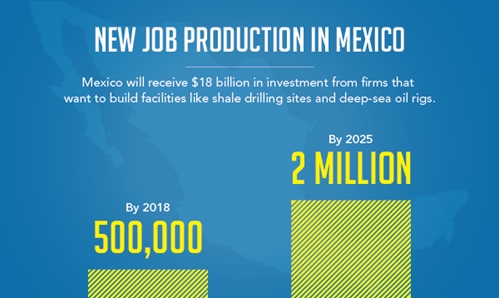
Mexico is on the cusp of a major energy expansion through the investment of foreign energy companies, according to Business News Americas. The country will receive $18 billion dollars in investment from firms that want to build facilities like shale drilling sites and deep-sea oil rigs. They will also build infrastructure like new electric power lines and gas pipelines.

This investment, the article cited, will produce 500,000 new jobs in Mexico by 2018, and 2 million by 2025, according to a press release be the Business Coordination Council of Mexico.

The additional oil and gas pumped out of the now untapped sites will enrich Mexico with more energy than it has now, which will reduce energy costs.

Pemex leads the way
Petroleos Mexicanos, or Pemex, has been on the forefront of this work. The state-owned energy company is encouraging foreign investors to buy up sites where oil and gas can be drilled, and it is also beginning to expand its exports. Not only has the company started exporting to the U.S. West Coast and Hawaii again, but it is also exporting to Switzerland's Cressier refinery, according to Fox News.

According to a press release, Pemex will begin shipping in July and continue for six months, Fox News reported.

Pemex's goal is to diversify and branch into other foreign markets. In 2013, it exported an average of 1.24 million barrels of oil per day in 2013, which generated revenue of $52.58 billion.

Pemex will begin shipping high-grade crude to Europe by January 2015, according to the source.

Other signs that Mexico is expanding its networks
The Mexican government has also continued on its road to making connections with cities and countries around the globe, with a delegation from Mexico City sent to Chicago on May 19 to discuss plans for how to strengthen ties between the two cities.

"Cities and mayors need to act like businesses … and create partnerships that support the way economic development is done," said Amy Liu, a Brookings Institution senior fellow. "It will be good for both markets."

Mexico City and Chicago already have strong ties. The two cities Chicago trades with the most are Mexico City and Toronto. Additionally, Chicago Mayor Rahm Emanuel has already signed a deal with Mexico City Mayor Miguel Angel Mancera that will further the economic relationship of the sister cities. The deal calls for joint initiatives in trading, investments and innovations – particularly in regard to manufacturing.

"For Chicago to remain a world-class city and to keep our economy competitive, we must strengthen ties with our largest trading partners and create new opportunities for businesses to thrive," Emanuel said in a statement.

Mexico is breaking up its oligopolies at home to open up foreign investments
Mexico is not only working abroad, but it is also making improvements at home to encourage trade and the development of key industries. It has recently passed laws that would make it difficult for large monopolies to exist as they have. For one example, Carlos Slim, owner of América Móvil​, is now facing challenges from AT&T, which recently announced that it would sell its $6 billion stake in América Móvil​, according to The Wall Street Journal. Slim, the second-richest man in the world, has a monopoly over much of the telecom industry in Mexico, but Mexican President Enrique Peña Nieto, has been choosing to support smaller companies for a long time. Recently, according to Forbes, the Mexican government rejected by a bid by Slim's construction company, even though it offered the best deal out of all the bids for a public works project.

"The first public work bidding under President Enrique Peña Nieto … bears what seems to be the hallmark of the current presidency: a blow against businessman Carlos Slim," wrote columnist Raymundo Riva Palacio in Mexico's leading financial daily El Financiero, Forbes reported.

When it comes to AT&T's deal with Slim, it had to sell its stock with Slim's company of América Móvil "to facilitate the regulatory approval process in Latin America," AT&T said.

What this means for those who want to offshore to Mexico
The net result of Mexico's work on all fronts to make connections between foreign countries and end long-standing monopolies on the home front is this: a place where U.S. companies can build factories and make money exporting their products around the world.

Foreign companies have already begun to take advantage of Mexico's advantages by building facilities there. For one example, CertoPlast, a German adhesive tape company, has announced that it will build a new factory in Las Cruces. It is building in Mexico to take advantage of its Foreign Trade Zone designation, which reduces tariffs on items sent to Mexico for manufacturing at maquiladoras.

U.S. companies can take even greater advantage of other trade agreements. For example, the North American Free Trade Agreement allows almost all goods to be shipped tariff-free between Canada, Mexico and the U.S.

For those who considering expanding to Mexico, an offshore shelter company may make the process easier. offshore shelter companies will work with U.S. manufacturers to find the best places to manufacture and cut through any red tape.

[readon1 url="http://offshoregroup.com/2014/06/19/mexico-works-internationally-domestically-to-build-the-best-place-for-manufacturing/"]Source:offshoregroup.com[/readon1]