avion-interjet.650px

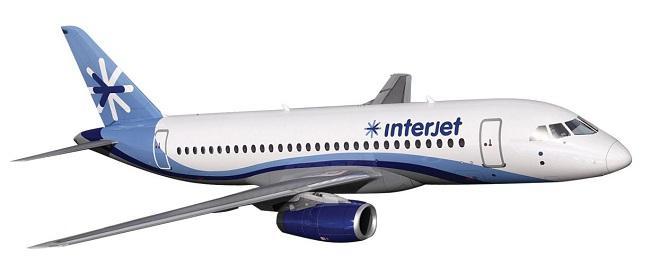
Interjet said it would begin offering a new route linking Guadalajara, the capital of the western Mexican state of Jalisco, to the Pacific resort city of Puerto Vallarta.

The new flights start on Thursday, the Mexican carrier said in a statement.

Service will be offered on Thursday and Sunday afternoons, the airline said.

"With this new flight, we are serving an important market in the western part of the country and strengthening tourism activity," Interjet CEO Jose Luis Garza said.

The airline plans to use Superjet 100s to carry passengers between Guadalajara and Puerto Vallarta.

Interjet currently operates eight Superjet 100s and is awaiting the delivery of 12 more of the planes, which are joining a fleet of 41 Airbus A320s.

Interjet, which began operating in December 2005, has a 24 percent domestic market share and serves about 40 cities and tourist destinations, as well as eight foreign destinations. EFE [readon1 url="http://latino.foxnews.com/latino/news/2014/07/14/interjet-to-start-operating-new-route-in-western-mexico/"]Source:latino.foxnews.com[/readon1]

buick

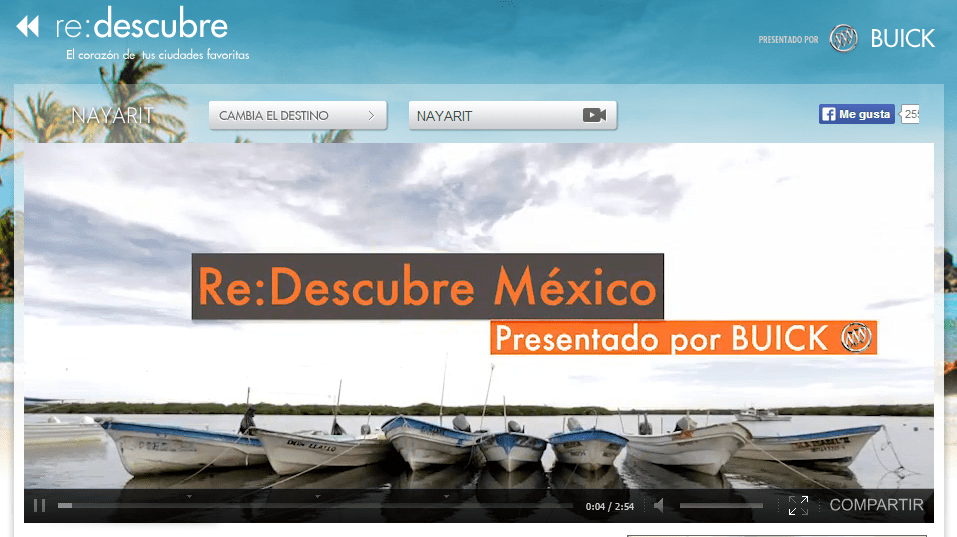
Buick Mexico’s new campaign called “Re: Descrubre México” (“Re: Discover Mexico) seeks to promote the brand’s vehicles by transporting them to amazing locations. During this first phase they brought their cameras to San Blas and other areas of the Riviera Nayarit.

The Buick Mexico brand began an advertising campaign called “Re: Discover Mexico” in order to showcase its vehicles in fabulous locations. Thanks to the strong positioning of the destination as well as Chef Betty Vázquez’s popularity, Buick couldn’t resist including San Blas in its first phase of production.

This is a brand new campaign, which began with trips to Baja California, Guanajuato, Yucatán and now Nayarit. They shot four different spots in Nayarit: the area’s culture and nightlife, both shot in Tepic; and ecotourism with guide Francisco García as well as gastronomy with Chef Betty Vázquez in the area of San Blas.

This is the same Chef who strongly supports these types of private enterprise campaigns, where the marketing strategy also promotes the beauty of Mexico and, in this particular case, the Riviera Nayarit. On this occasion, Buick is also seeking an alliance with MSN in order to expand their reach.

It’s thanks to this mega network, which is linked around that world, that so many people are talking about the Riviera Nayarit on a domestic and an international level during the month of June. By the way, the culinary spot was the only one that included a published written interview as well as the video.

“We need to understand that one can’t walk alone anymore, life happens within a society. These alliances are going to allow us to more easily reach our goals within a shorter period of time and with a broader vision. And thanks to them, we’re all going to benefit,” said Betty Vázquez.

The spots from the Riviera Nayarit highlighted by these promotional videos inc luded La Tovara, Playa Las Islitas, Mexclatitlán Island, the Marietas Islands, Punta de Mita and, of course, a fair bit of surfing and the waves.

This campaign has already been running in the United States for the past four years; now in Mexico it’s scheduled to continue until Buick has driven the entire country.

Here’s a link to the videos: http://buick.prodigy.msn.com/city/263728578/video/36.

630x355

The Pulse: Carnival returns to year-round Mexican Riviera cruises.

Why it Rates: Love for the West Coast! The Carnival Miracle now will operate weekly Mexican Riviera cruises year-round from Long Beach, Calif., starting in October, the first such deployment since 2012. Westerners have long been asking for the longer cruises all year from the Los Angeles area, especially in the peak summer travel season. The new itineraries also mark a return to Mazatlán, as well as calls to Puerto Vallarta and Cabo. Along with the two- to four-night getaways offered by Carnival Imagination and Inspiration, Carnival now will carry about 600,000 passengers annually from the West Coast. — Theresa Masek, TravelPulse cruise editor

Carnival Cruise Lines has made two exciting enhancements to its West Coast cruise operations, deploying two highly attractive Spirit-class ships featuring a variety of Fun Ship 2.0 innovations as well as a huge number of balcony staterooms.

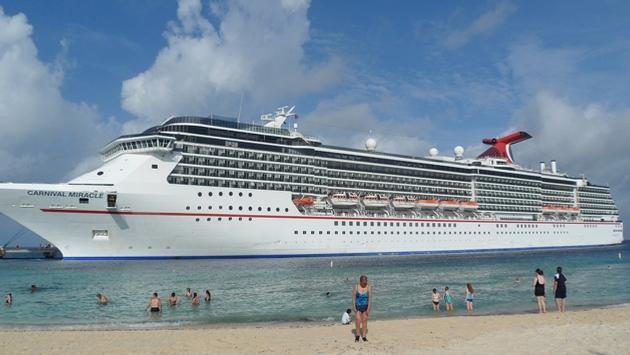
The new deployments include Carnival Miracle introducing year-round seven-day Mexican Riviera departures from Long Beach, Calif., beginning in October 2014, and Carnival Legend operating the line’s Alaska program from Seattle in May 2015.  Carnival Miracle and Carnival Legend will also offer four Hawaii cruises in 2015-16.

Carnival Legend recently underwent an extensive makeover that added a host of new features, including WaterWorks, highlighted by Green Thunder, the fastest and steepest water slide at sea,  and the RedFrog Pub, a Caribbean-inspired watering hole serving the line’s private label draught brew, ThirstyFrog Red. The full-service Bonsai Sushi restaurant offering Asian specialties and Cherry On Top, a confections and novelty store, were added, as well.

Carnival Miracle also offers a wide range of innovations, including the Serenity adults-only retreat featuring its own pool and full bar service, the Punchliner Comedy Club presented by George Lopez with up to 20 family-friendly and adults-only shows each week, a wedding chapel, a luxurious 14,500-square-foot health and wellness facility, and an enclosed corkscrew water slide full of exhilarating twists and turns.  Carnival Miracle will also undergo a dry dock in March 2015 that will add a huge variety of additional Fun Ship 2.0 features.

Carnival Miracle and Carnival Legend each offer fun, supervised programs for children ages 2-17, as well as nearly 850 ocean view and balcony staterooms – perfect for viewing the beautiful passing scenery.

“Carnival is the leader in West Coast cruising with more ships and itineraries than any other cruise operator. With these new deployments, we’re providing two spectacular Fun Ship 2.0-equipped ships with even more fantastic features for our guests to enjoy, as well as additional opportunities to experience the rich diversity of this popular sailing region,” said Gerry Cahill, Carnival president and CEO.  “Our travel agent partners have expressed an interest in a greater variety of West Coast options so we are very pleased to provide these attractive, value-packed ‘Fun Ship’ cruises to market to their clients,” he added.

Year-Round Mexican Riviera Cruising

Carnival Miracle will introduce year-round Mexican Riviera cruising from Long Beach on Oct. 4, 2014.

The program will encompass three different week-long itineraries, including a new three-port, seven-day cruise featuring Mazatlán on the majority of departures.  In addition to the call in Mazatlán, the new three-port itinerary will feature the stunning Mexican resort destinations of Cabo San Lucas and Puerto Vallarta.

The full day call at Mazatlán will provide guests with ample opportunities to explore this scenic seaside destination, which features world-class beaches and sportfishing, as well as the Malecon, an outdoor promenade lined with shops, restaurants and centuries-old architectural structures.

Carnival Miracle’s year-round schedule from Long Beach also includes two other itinerary options.  The first is a seven-day, two-port itinerary that features a stop in Cabo San Lucas, along with a two-day overnight stay in Puerto Vallarta.  While in Puerto Vallarta, guests can explore this tropical paradise known for its beautiful beaches, excellent diving, and sizzling nightlife. The second alternate itinerary includes a visit to Puerto Vallarta, along with a two-day call at Cabo San Lucas, known for its white-sand beaches, turquoise waters and the distinctive El Arco (The Arch), a 30-foot-high rock formation where the Pacific Ocean joins the Sea of Cortez.

Carnival Legend to Alaska

Following its inaugural season in Australia, Carnival Legend will operate the line’s seasonal Alaska program beginning in May 2015.  In total, 16 week-long Alaska cruises will operate from the Port of Seattle from May 26 to Sept. 8, 2015, departing each Tuesday.

Port calls on these voyages include the popular Alaskan towns of Skagway, Juneau and Ketchikan, as well as Victoria and cruising Tracy Arm Fjord or sailing Glacier Bay.   Carnival Legend will also operate a special one-time eight-day Glacier Bay voyage departing Vancouver May 18 and arriving in Seattle May 26, 2015.

Each of these destinations offers a rich history and culture, along with awe-inspiring natural wonders, including calving glaciers, magnificent fjords and native sea and animal life. A wide range of shore excursions – from helicopter flightseeing and rainforest canopy tours to hiking, canoeing and kayaking expeditions – are also available.  Carnival Legend will also feature an on-board naturalist who educates guests on the region’s colorful history and points out animal and marine life from the ship’s bridge.

Say Aloha to Hawaii

Carnival will offer four Hawaii sailings in 2015-16 – an 11-day cruise on Carnival Legend departing from Honolulu in May 2015 and three 15-day voyages aboard Carnival Miracle operating round-trip from Long Beach in October and November 2015, and November 2016.

The 11-day Hawaii voyage on Carnival Legend will depart Honolulu May 7 and arrive in Vancouver May 18, 2015, with extended stops in Kauai, Maui, Hilo and Kona, along with an overnight call in Honolulu.

Carnival Miracle’s three Hawaii cruises will operate round-trip from Long Beach departing Oct. 17 and Nov. 28, 2015, and Nov. 16, 2016. On these sailings, guests can visit the stunning island destinations of Maui, Honolulu, Kauai, Kona and Hilo, as well as Ensenada, Mexico.

These voyages provide guests a variety of opportunities to get an “up close and personal” look at the Aloha State, from hiking across volcanic rock formations and relaxing on some of the world’s most famous beaches to learning more about rich Polynesian cultures and getting a bird’s eye view of the lush countryside via a breathtaking helicopter tour.

Reservations

Reservations are currently being accepted for the new itineraries operated by Carnival Miracle and Carnival Legend.

For additional information and reservations, call 1-800-327-9501 (individual) or 1-800-327-5782 (groups) or visit the line’s travel agent Internet portal, GoCCL.com.


[readon1 url="http://www.travelpulse.com/news/cruise/carnival-launches-year-round-mexican-riviera-sailings-on-miracle.html"]Source:www.travelpulse.com[/readon1]

cars

MEXICO CITY -- Mexico is poised to overtake Brazil as the top Latin American automobile producer for the first time in more than a decade as surging exports to the U.S. spur factory openings and record output.

After nosing ahead of Brazil in the first five months of the year, Mexico is projected to hold its advantage through 2014, for the first full-year lead since 2002, according to consultant IHS Automotive.

Mexico's ascent is being fueled in part by auto sales running at the fastest pace in almost eight years in the United States, the country's largest market.

The boom coincides with a slump in Brazilian production through May as domestic demand cools, setting up a shift in leadership of the Latin American industry faster than analysts predicted.

"The wind is in our sails" in Mexico, said Luis Lozano, lead automotive partner at PricewaterhouseCoopers in Mexico City. "People talk about the energy and telecom industries in Mexico, but the auto industry is going to continue as the icon of this country."

Eclipsing Brazil, where output has fallen 14 percent this year, would vault Mexico to No. 7 among the world's largest auto producers. China and the United States lead the global pack.

This year's diverging fortunes of Mexican and Brazilian auto production reflect the state of their biggest markets. Brazil-made cars and trucks are too expensive, given high labor costs and taxes, to send abroad and go mostly to local buyers. Mexican factories export eight of every 10 cars they produce -- with more than half going to the United States.

Economic divergence

The auto industry epitomizes the underlying economic fundamentals in the two countries. Mexico is starting to see signs of rebounding after growth missed forecasts in seven of the past eight quarters, while Brazil cut gross domestic product estimates for this year and next and boosted inflation forecasts.

Economists project that the Mexican economy will grow 2.8 percent this year compared with 1.3 percent in Brazil. Auto output in Mexico rose 7.2 percent through May to 1.31 million vehicles, bolstered by new plants for Nissan Motor Corp., Honda Motor Co. and Mazda Motor Corp., according to the Mexican Automobile Industry Association, known as AMIA.

Brazil's total was 1.27 million, according to Anfavea, Brazil's automaker association. Mexico's proximity to the United States also gives it an advantage, as do labor costs for automakers that are about 20 percent of U.S. levels, according to PricewaterhouseCoopers.

"The broader significance is the appeal of Mexico as the production source for North America," said Bill Rinna, senior manager of North American forecasts at LMC Automotive. LMC forecasts Mexico to overtake Brazil in 2016.

Surprise win

While Mexico's exports to the United States rose 19 percent through May, Brazil's shipments to its top trading partner, Argentina, declined 28 percent, according to Anfavea. Within Brazil, consumers have slowed purchases because of tighter credit and a weakening economy. Mexico's surge caught some industry watchers by surprise.

"At the beginning of this year, we basically did not have Mexico overtaking Brazil at any point in time," said Guido Vildozo, Latin America analyst at IHS Automotive.

Even as exports are buoying Mexico's auto industry, the low level of domestic sales is a weak spot, according to AMIA President Eduardo Solis.

New car sales in Mexico totaled 1.06 million last year. Mexico should restrict used-car imports from the United States more stringently, he said.

"We have record production and exports and a domestic market that just isn't turning the corner," Solis told reporters June 10 in Mexico City.

Diplomatic confrontation

Mexico is likely to produce 3.1 million autos this year, according to Solis, who said he was unsure whether the nation would build more than Brazil. IHS is forecasting Mexican output of almost 3.2 million, ahead of Brazil's 3.17 million.

Mexico's auto-production gains combined with Brazil's losses may lead to a diplomatic confrontation this year between Latin America's two biggest economies, according to Augusto Amorim, IHS Automotive's analyst for South America.

In 2012, Mexico agreed to limit car exports to Brazil for three years after a surge in Mexican shipments to Latin America's largest economy.

That led to a 23 percent drop in Mexican-made vehicles exported to Brazil last year, according to AMIA. While the pact is set to expire in March 2015, Brazil may look for ways to extend it, Amorim said. AMIA will probably meet with Anfavea and a similar trade group from Argentina this summer, Solis said.

Production chain

"We are still in negotiations for both countries to have successful results," Brazil's ministry of development, industry and external commerce said in an e-mailed response.

"The commitment is to get back in 2015 to a free market," Mexico Economy Minister Ildefonso Guajardo told reporters July 3 in Mexico City.

Automakers' investments show the importance of both countries in the global production chain. After the recent Mexico plant openings by the Nissan-Honda-Mazda trio from Japan, a combined investment valued at $4 billion, Germany's Audi AG is building a $1.3 billion plant to assemble the luxury Q5 SUV.

BMW AG announced plans last week to invest about $1 billion in a new factory in Mexico, that will produce about 150,000 cars a year. And in June, Daimler AG and Nissan said they would jointly produce luxury vehicles, including Infiniti compact cars, at a new $1.4 billion factory in Mexico, the biggest project to date in their four-year-old partnership.

Kia, owned by the Hyundai Motor Group, has confirmed it is looking at building its first assembly plant in Mexico.

Big volumes

"Whatever is made there can be exported," to any of the more than 40 countries, including the U.S., that have free trade agreements with Mexico, IHS Automotive's Amorim said. "When you have Mexico adding a new factory to source the entire world, then you're talking about big volumes."

In Brazil, Nissan opened a $1.5 billion complex in Resende in April, and Chery Automobile Co. has a $530 million factory in Sao Paulo state debuting this year, marking the Chinese automaker's first major investment outside its home country.

New factories being considered for both countries in the coming years may mean neck-and-neck racing for the lead in Latin American production, according to IHS Automotive and LMC Automotive.

Rinna, the LMC Automotive analyst, predicts that Mexico will hold the top spot from 2016 until 2021, when Brazil wrests it back. By then, the combined auto output of the two nations would be 8.83 million vehicles, 38 percent higher than in 2013.


[readon1 url="http://www.autonews.com/article/20140708/OEM01/307089961/mexico-projected-to-surpass-brazil-as-top-latin-american-vehicle"]Source:www.autonews.com[/readon1]

alaska-airlines-puerto-vallarta 537fbf6036ed8

Introductory fares from $176 to Los Cabos and $186 to Puerto Vallarta*

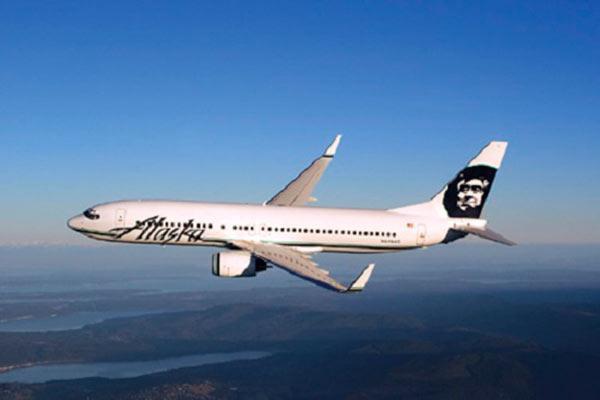
SEATTLE, July 8, 2014 /PRNewswire/ -- Customers can now book travel on Alaska Airlines new nonstop flights from Portland, Ore., to Los Cabos and Puerto Vallarta, Mexico. Pending approval by the Mexico Direccion General de Aeronautica Civil (DGAC), the airline plans to begin seasonal service between Portland and Los Cabos from Nov. 3 through April 27, 2015, and between Portland and Puerto Vallarta from Nov. 4 through April 26, 2015.

Alaska is offering introductory fares of $176 one way from Portland to Los Cabos, and $186 one way from Portland to Puerto Vallarta, on tickets purchased by July 14, for travel from the service start date through Feb 10, 2015*.

"We're happy to expand our longtime flying to Mexico with new flights to these two popular leisure resorts for our Portland travelers, who can take advantage of our award-winning service and low fares for their travel adventures," said Joe Sprague, Alaska Airlines' senior vice president of communications and external relations.

Summary of new seasonal service:  

Start date  City pair     Departs      Arrives   Frequency
Nov. 3 Portland-Los Cabos     11:25 a.m.     4:20 p.m.**    Mon, Wed, Thurs, Sat
Nov. 3 Los Cabos-Portland      5:15 p.m.**     8:35 p.m.   Mon, Wed,Thurs, Sat
Nov. 4  Portland-Puerto Vallarta     10:15 a.m     4:40 p.m.**   Tues, Fri, Sun
Nov. 4  Puerto Vallarta-Portland     5:40 p.m.**     8:35 p.m.   Tues, Fri, Sun

**Between March 8 and April 4, flights arrive and depart one hour earlier due to daylight saving time. All times are based on local time zones.

 Alaska Airlines began flying to Mexico a quarter century ago and operates 240 flights a week during the winter between the West Coast and Mexico—more than any other carrier. Alaska flies an average of 1.5 million passengers a year to six Mexico beach destinations—Ixtapa/Zihuatanejo, Loreto, Los Cabos, Manzanillo, Mazatlan and Puerto Vallarta—in addition to Guadalajara and Mexico City. Alaska also will begin flights between Seattle and Cancun on Nov. 6.

The new flights between Portland and Mexico will be operated with Boeing 737 aircraft.

To book, visit www.alaskaair.com or call 1-800-ALASKAAIR (800-252-7522 or Hearing & Speech Impaired (TTY): Dial 711 for Relay Services).

Alaska Airlines, a subsidiary of Alaska Air Group ALK -1.94% , together with its partner regional airlines, serves nearly 100 cities through an expansive network in Alaska, the Lower 48, Hawaii, Canada and Mexico. Alaska Airlines has ranked "Highest in Customer Satisfaction Among Traditional Network Carriers" in the J.D. Power North America Airline Satisfaction StudySM for seven consecutive years from 2008 to 2014. Alaska Airlines' Mileage Plan also ranked highest in the 2014 Airline Loyalty/Rewards Program Satisfaction Report. For reservations, visit www.alaskaair.com . For more news and information, visit the Alaska Airlines Newsroom at www.alaskaair.com/newsroom .

*General terms and conditions for the introductory fares: Fares include all taxes and fees. Seats are limited and may not be available on all flights or all days. A ticket purchased at an Alaska Airlines airport location or through a reservation call center will cost $15 more per person than the advertised fare. Tickets are nonrefundable. Applicable fare and tax differences apply to any changes made after ticketing. A $125 (USD) change fee per person applies to any changes made within 60-days of ticketed travel. All fares, taxes and fees shown are based on one-way travel. Additional U.S. taxes may apply to itineraries involving a U.S. stopover lasting more than 12 hours. Bag fees apply for checked baggage. See checked baggage policy at www.alaskaair.com for more details. Fares are subject to change without notice. Other restrictions — blackout dates, day of week restrictions, schedule availability, change fees and advance purchase requirements — may apply. Visit www.alaskaair.com or call Alaska Airlines' Reservations at 1-800-252-7522 for complete fare rules and fees.


[readon1 url="http://www.marketwatch.com/story/alaska-airlines-new-flights-from-portland-ore-to-los-cabos-and-puerto-vallarta-mexico-now-available-for-purchase-2014-07-08"]Source:www.marketwatch.com[/readon1]

bella-travel-network-logo

Known for its many landmarks and rich history, Puerto Vallarta has become a hub of tourist activity. The beach and water alone attract many visitors all year long, however Bella Travel Network wants travelers to know that there is so much more to Puerto Vallarta.

Los Arcos National Marine Park -- Arguably one of the most recognizable landmarks in Puerto Vallarta, the gorgeous arches are perfect for sunset photo ops and romantic picnic dinners. The arches also create an amphitheater. Along the Bahia Banderas (Banderas Bay), lie an array of sand sculptures, art pieces, street performers, and local vendors. Visitors can take a quiet walk along the oceanfront walkway and make stops along the way to enjoy the scenery.

Botanical Gardens of Vallarta -- Located just a half hour south of the city, Bella Travel Network knows that these gardens will provide a delightful way to spend a couple of hours away from all of the hubbub of the city. Boasting a wide assortment of wild flowers and walking paths, the gardens offer colorful views and aromatic pleasures. Visitors will find the location not only relaxing but also quite romantic.

Church of Our Lady of Guadalupe -- A trip to Puerto Vallarta would not be complete without a visit to the iconic landmark church. Beautifully constructed out of red brick, the Church of Our Lady of Guadalupe marks an impressive figure. Mass is still held in this historical building and the harmonic bells ring regularly before each mass.

Lighthouse On Matamoros -- Although no longer guiding boats in from the harbor, the lighthouse serves as the perfect place for a panoramic view of the city and the ocean below.

Photographers love the view and the abundance of photography subjects. Visitors can spend some time and take in the beauty of the city while exploring the lighthouse. Originally built in 1932, the lighthouse was closed in 1978. It was remodeled in 2006 so that visitors could enter.

With so many free and interesting things to do in Puerto Vallarta, Bella Travel Network is confident the visitors will certainly find something exciting to do this summer. For more information on great travel destinations and things to do on vacation visit http://www.bellatravelnetwork.com


[readon1 url="http://www.prweb.com/releases/BellaTravelNetwork/BellaTravelNetwork/prweb11998161.htm"]Source:www.prweb.com[/readon1]

photoEscudo San Miguel de Allende headersnmiguel

Interjet, the low cost Mexican airline, has launched a new seasonal route between the beach town of Puerto Vallarta and the colonial city of San Miguel de Allende.

This new direct flight will take travelers from the city of Leon, an hour and a half from San Miguel de Allende, to Puerto Vallarta in ninety minutes.

Flights will depart from el Bajio on Thursdays at 8 AM and arrive in Puerto Vallarta at 9 AM; flights from Puerto Vallarta will depart Thursdays at 9:25 and Sundays at 9:15, arriving an hour later in el Bajio.

Visit www.interjet.com.mx

[readon1 url="http://www.travelagentcentral.com/mexico/interjet-introduces-puerto-vallarta-san-miguel-de-allende-flight-46816"]Source:www.travelagentcentral.com[/readon1]

Health-Care-in-Mexico11

The healthcare market of Mexico has significant potential for growth. The increasing elderly population, prevalence of non-communicable diseases, improvements in regulatory guidelines, government support for the healthcare sector, and the North American Free Trade Agreement, which assures its members protection of intellectual property rights, provide the impetus for the growth of the Mexican pharmaceutical market.

The pharmaceutical market was valued at approximately $10 billion in 2008, and is projected to reach approximately $22.5 billion by 2020 at a Compound Annual Growth Rate (CAGR) of 7%. In 2010, the Mexican pharmaceutical market was the 14th largest pharmaceutical market in the world, and second in Latin America after Brazil (Daiichi Sankyo, News Release, August 2, 2011).


The prevalence of non-communicable disease is increasing due to the increasing elderly population, which accounted for approximately 7% of the population in 2013, as well as changes to food and lifestyle habits. The government has been successful in implementing steps needed to achieve universal healthcare coverage, such as reforms in the System of Social Protection in Health (Sistema de Protección Social en Salud). In 2012, approximately 56 million people in Mexico were covered by Public Health Insurance (Seguro Popular, PHI) (Bristol, 2014; OECD, 2011). The rest of the population uses either social security coverage for healthcare or private healthcare insurance.

Regulatory regulations have attracted significant investment in Mexico's pharmaceutical industry. The pharmaceutical sector had a cumulative Foreign Direct Investment (FDI) of $2.9 billion from 2005 to 2012. In 2012, Mexico received a total of $981M in FDI in pharmaceutical sector. The US, Luxemburg, Ireland, Canada, and Japan were main investors in the Mexican industry. The share of multi-national companies in Mexico is high, compared with the share of domestic companies in the total pharmaceutical market. The leading multi-national companies are Pfizer, Merck, Sanofi, and Novartis, the leading domestic players are Genomma Lab Internacional and Laboratorios Liomont.

[readon1 url="http://insurancenewsnet.com/oarticle/2014/07/05/mexico-pharmaceutical-medical-device-market-worth-$225b-$54b-by-2020-says--a-526420.html#.U7gprpRdUlI"]Source:insurancenewsnet.com[/readon1]

20140704-083931-31171318

This is a no-brainer…. CHEAP LABOR !!!! BMW announced that they are introducing a new division of BMW in Mexico which will offer easy access to the United States of America. The German automaker BMW inform the world of this monumental groundbreaking plan that will be in Mexico which will further the brand doesn’t closer to the United States. Surprisingly they’re going to another billion dollars into the South Carolina population so that they can almost tripled their production as well as continued quality.

Carlos Ghosn who is the chief executive officer for a company announced they will produce over 1 million cars in Mexico and shipped across United States of America. Since 2008 the production has almost doubled and they expect a 40 to 45% increase by 2017. Audi is coming out going to get a piece of the Central American pie by building a facility that is state-of-the-art don’t produce more than 150,000+ vehicles Amanda slow to be ready for production by 2016 they post that they will be the largest car maker in the world.

Chrysler is also spending $1.2 billion to retool and create a state-of-the-art facility in Mexico which will start with their main product commercial brands and four-cylinder engines that are used in the jeep Cherokee trucks Dodge Dart, with a total investment of about $3 billion dollars. The Mexican economy has caught fire by all of the automakers walking to these different areas of Mexico and other businesses are flourishing from this. The steel industry has increased either volume of production by over $3 billion in trying to meet these factory needs because galvanized steel is a hot commodity because coated inZink to prevent rust and very low in cost. The steel imports have risen close to 10 million tons last year which is close to 40% according to the tree national Iron and Steel industry chamber. The great thing about this is other businesses as far as restaurants, real estate market, and other off brand businesses will floors from this late revelation of car building in these regions. The labor cost is the main factor for these companies to grow and flourish and compete worldwide scale.

     
  20140704-083931-31171500   
     
  20140704-083931-31171559  
     

[readon1 url="http://huewire.com/business-2/is-mexico-the-next-michigan/2235/"]Source:huewire.com[/readon1]

6431091w

Remittances sent to Mexico by emigrants totaled $9.58 billion in the first five months of 2014, up 7.89 percent compared to the same period last year, the Bank of Mexico said.

Mexico received $8.87 billion in remittances during the January-May 2013 period, the central bank said in its monthly report.

The average remittance was $293.72 in the January-May period, up slightly from the $293.58 average registered in the same period last year, the central bank said.

The number of transactions increased 7.85 percent to 32.62 million, with the majority of remittances sent via electronic funds transfers, the central bank said.

Mexico received $21.58 billion in remittances in 2013, a figure that was down 3.8 percent compared to 2012, when emigrants sent $22.44 billion to their homeland.

Remittances sent by Mexicans living abroad, mainly in the United States, are the country's second-largest source of foreign exchange, after oil, and help cover the living expenses of millions of people.

[readon1 url="http://latino.foxnews.com/latino/news/2014/07/02/remittances-to-mexico-rise-78-pct/"]Source:latino.foxnews.com[/readon1]

s1.reutersmedia.net

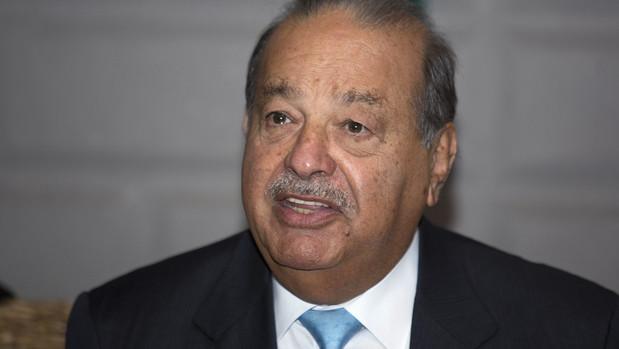
America Movil SAB’s top executives, attempting to maintain the company’s grasp on the telephone market it has ruled for more than a decade, are reassessing the structure of Carlos Slim’s $73 billion carrier.

The company put a special board committee to work after regulatory changes forcing it to share infrastructure and cut fees in Mexico, its biggest market. The members may consider spinning off faster-growing businesses in 17 other countries, according to analysts at Macquarie Group Ltd. Or, they could break up the Mexican unit, reducing its 80 percent share of the phone market to below 50 percent, Banco Itau BBA analysts said.

America Movil, which was also sanctioned this year by Mexican officials for operating more than half of the nation’s mobile-phone accounts, said last week the committee will consider a wide range of options that could be proposed to the full board or to shareholders. The company gave no indication of what specific scenarios it was reviewing and when it might make a decision, leaving all alternatives on the table.

“It could go in more than one direction,” Valeria Romo, an analyst with Banco Monex SA, said in a phone interview. “This is 100 percent focused on the regulator’s decision earlier this year.” She has a hold rating on the shares.

America Movil brought the committee together after the newly created Federal Telecommunications Institute, or IFT, declared it dominant, according to a filing last week. While it challenges the csruling, the company said the group will “assess the various structural, commercial, technological and other options available to it, as well as the opportunities offered by the new Mexican regulatory framework, in order to continue with the development of the telecommunications sector and providing services with high quality, state-of-the-art technologies and under best conditions.”
An America Movil press official declined to comment further on the committee’s work.

Proposing Breakups

Last year, lawmakers made constitutional changes to let regulators force companies to divest assets if they’re too dominant in the telecommunications industry. A joint Senate committee released a draft bill this week that would give dominant companies a way to propose their own breakups to the IFT, with the goal of reducing their market share below 50 percent.

Slim’s company must consider “bold, adaptive moves” to reduce the regulatory pressure it faces, Itau analyst Gregorio Tomassi wrote in a report last week.

The company “has an incentive, even a responsibility, to exhaustively explore breakup options as alternatives that could actually maximize value under the current conditions,” he said. He has the equivalent of a hold rating on the stock.

Shedding Clients

To cut its customer base, America Movil could try to shed its less profitable clients in rural and poor areas where competitors don’t even offer service because it’s unprofitable, said Vector Casa de Bolsa SA analyst Julio Zetina. America Movil would have to win regulatory approval to adjust its operating license, which requires it to cover those populations under the terms of its 1990 privatization.

“The strategy here could be, ‘What segment of clients can I release to lower my market share under 50 percent?’” Zetina said. “They have been obligated to serve markets that don’t represent their financial interests, so even if they drop their share by, say, 25 percent, the impact on revenues is infinitely lower.” He has a hold rating on the stock.

America Movil has looked into structural changes before. In 2011, its landline unit, Telmex, announced a reorganization that would have created a separate unit, Telmex Social, for its customers in rural and marginalized communities. With the division, which would have represented about 10 percent of its subscribers, Telmex sought for regulators to view it as two companies. Regulatory approval for the creation of Telmex Social was never granted.

Outside Directors

The eight-member committee formed by America Movil includes three outside board members: Alejandro Soberon, chief executive officer of entertainment company Corporacion Interamericana de Entretenimiento SAB; Pablo Gonzalez Guajardo, CEO of Kimberly-Clark de Mexico SAB; and Ernesto Vega Velasco, a retired executive of Grupo Kuo SAB, a consumer-goods and auto-parts conglomerate. Their presence gives the group independence and validity in front of regulators, Zetina said.

The committee includes five America Movil executives, including CEO Daniel Hajj, Slim’s son-in-law, and Telmex head Hector Slim, the billionaire’s nephew. The elder Slim isn’t on the committee himself.

Breakups Hard

Breaking up a dominant phone carrier to create more competition has proven difficult to sustain. To settle an antitrust suit in the U.S., AT&T Corp. agreed in 1982 to split with its regional phone networks, which would provide local telephone service while the national company focused on long distance, manufacturing and research. Many of those units are now part of the same company again, called AT&T Inc., while Verizon Communications Inc. owns most of the rest.

In Brazil, the government broke its telephone monopoly into 12 holding companies in 1998, including three regional landline carriers, eight mobile-phone companies and one long-distance carrier. They have since joined forces to create four major telecommunications providers in Brazil.

In both cases, the breakups separated the providers’ national infrastructure, such as the fiber-optic cables that stretch across the country, from their local networks, such as home-phone lines. Mexican regulators have already ordered America Movil to let its competitors use its network -- the biggest in the country -- to provide service to their customers, removing a key competitive advantage.

Calming Investors

The regulatory pressure has weighed on America Movil, sending shares down 11 percent this year, the sixth-worst performer on Mexico’s benchmark IPC index of 35 companies. Last week, Slim, 74, boosted his investment in the company, acquiring AT&T’s 8.3 percent stake for $5.57 billion. By increasing his holdings to 57 percent of the company, Slim calmed investor concerns that AT&T would dump its shares on the open market, diluting the stock, Itau said.

The acquisition was a sign that Slim “views value in the company,” Macquarie analyst Kevin Smithen wrote in a June 30 report. AT&T sold the stake because it’s acquiring satellite company DirecTV, which competes with America Movil for TV customers in Brazil and Colombia.

America Movil’s committee could consider other structural changes that would reduce its dependence on Mexico as regulations tighten there, Smithen said. Spinning off the businesses outside of Mexico would give investors access to a company with faster growth, he said.

TV Opportunity?

Selling the company’s 40,000 wireless towers in Latin America, as carriers from AT&T to Oi SA have done around the world, could produce as much as $10 billion that could be used for stock repurchases or for acquisitions, Smithen said. The company could also raise money by disposing of its stake in Dutch carrier Royal KPN NV, which rejected a full takeover last year, he said.

The funds would let America Movil seek acquisitions in Brazil or the U.S., or could help the company acquire satellite-TV operator Dish Mexico, Smithen said.

America Movil already has an option to take control of Dish Mexico if Slim’s company gets a license from the government to offer TV service. A Dish Mexico press official declined to comment.

The IFT has said Slim’s company must comply with its regulatory requirements for 18 months before it can apply for the TV license. America Movil has the technology to offer TV over its phone lines, too, as soon as it’s allowed, Zetina said.

“The infrastructure is there -- it’s like opening a valve,” Zetina said. He said America Movil is thinking, “I already give you telephone, Internet and data services -- now I can add another service to that list.”

To contact the reporter on this story: Patricia Laya in Mexico City at This email address is being protected from spambots. You need JavaScript enabled to view it.

To contact the editors responsible for this story: Sarah Rabil at This email address is being protected from spambots. You need JavaScript enabled to view it. Crayton Harrison

[readon1 url="http://www.bloomberg.com/news/2014-07-03/how-carlos-slim-can-fix-america-movil-s-antitrust-problem.html"]Source:www.bloomberg.com[/readon1]

xc

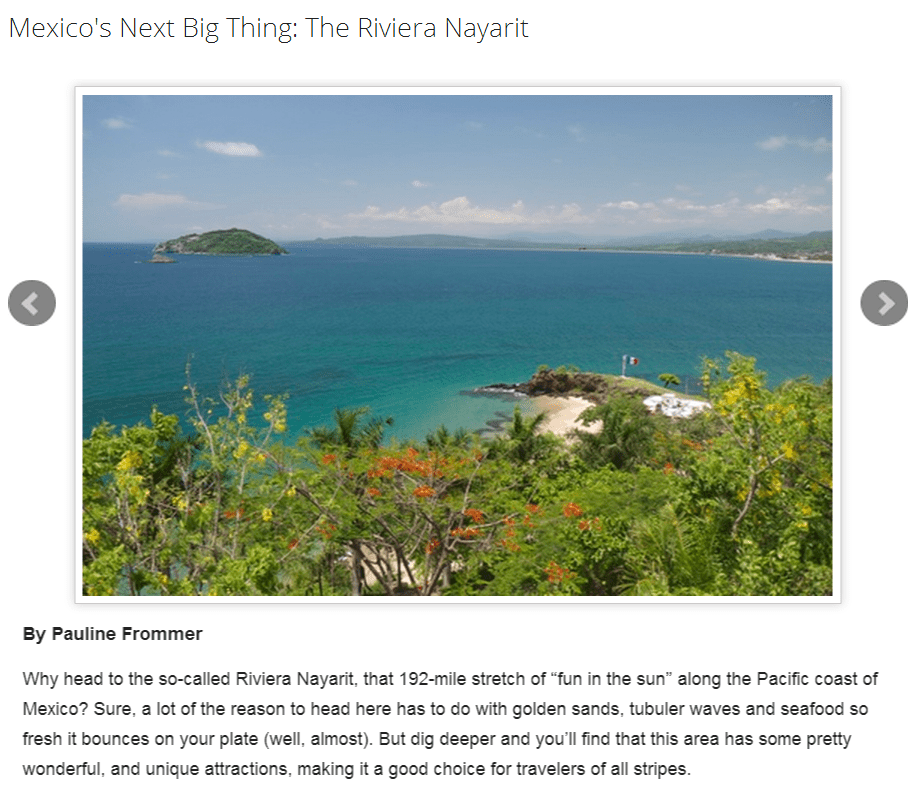
Arthur Frommer’s daughter, Pauline, published an article showcasing the Riviera Nayarit’s top ten special attractions, which she experienced during her FAM trip visit, coordinated by the destination’s CVB.

As a result of the FAM trip the Riviera Nayarit Convention and Visitors Bureau (CVB) coordinated with Pauline Frommer, daughter of Arthur Frommer, the travel maven published an article called “Mexico’s Next Big Thing: The Riviera Nayarit.”

Having already received the seal of approval from Mr. Frommer during his “Top 14 Destinations to Visit in 2014,” this time the focus was the top ten attractions Pauline highlighted as reasons to visit Mexico’s Pacific Treasure.

Among them were the destination’s vast beaches, birdwatching, idyllic colonial towns, exquisite folk art, the Marietas Islands, the relaxing all-inclusive resorts, water sports, its romantic ruins, its coastal surfing villages and its exclusivity and privacy for the rich and famous.

“…a lot of the reason to head here has to do with golden sands, tubuler [sic] waves and seafood so fresh it bounces on your plate (well, almost). But dig deeper and you’ll find that this area has some pretty wonderful, and unique attractions, making it a good choice for travelers of all stripes,” wrote Pauline Frommer.

The articles on the www.frommers.com portal serve as a tourist guide with a global reach, and they’re systematically sent to different media as well as to interested tourism markets.

The site itself has slightly less than 500 thousand unique visitors each month, which means it will give the destination very important exposure, particularly around the European and American continents.

A radio show is in the works produced by the same editorial group. It will go into further detail regarding all of the destination’s wonderful attractions as yet to be recommended. Pauline herself was awe-struck at what she experienced in the destination as far as tourism is concerned, and she has committed herself to give the Riviera Nayarit the promotion it deserves.

Click here to read the article in its entirety

s2.reutersmedia.net

Germany's BMW AG (BMWG.DE) will unveil this week plans to build a new factory in Mexico, a government official said, as the company seeks to meet growing demand for premium cars.

News of the factory comes just days after BMW's German rival, Daimler, announced similar plans, and adds to a growing list of companies plowing money into car making in Mexico.

Speaking on condition of anonymity, the Mexican official said the plant would likely amount to an investment of at least 1 billion euros ($1.36 billion) and would be located either in Hidalgo state north of Mexico City or San Luis Potosi in central Mexico.

A spokesman for Munich-based BMW said earlier on Monday that "a decision will be made public" on July 3.

BMW declined to comment further.

A new factory in Mexico would come on top of BMW's plans to invest $1 billion to expand capacity by 50 percent at its plant in Spartanburg, South Carolina.

BMW Chief Executive Norbert Reithofer said last week that the Bavarian carmaker was still deliberating about where to locate a new factory and would reach a decision before the summer break.

Premium auto makers BMW, Audi and Mercedes-Benz are expanding global production as their factories in Germany struggle to meet strong demand for off-road vehicles and limousines in the United States and Asia.

Supplier sources said BMW had already mapped out a production timetable for Mexico, with a tentative plan to begin assembly in late 2017, ramping up annual capacity to 200,000 by 2020.

On Friday, Daimler AG (DAIGn.DE) and Renault Nissan (RENA.PA) (7201.T) said they would invest 1 billion euros ($1.36 billion) to develop small cars and build a factory in Aguascalientes, Mexico.

Manufacturing in Mexico allows European car makers to sell vehicles in the United States while avoiding some of the currency and tariff costs that crimp profits on imports. Mexico also offers lower labor costs than Germany and the United States.

Daimler's Mercedes-Benz, Nissan Motor Co, Honda Motor Co (7267.T), Mazda Motor Corp (7261.T) and Volkswagen AG (VOWG_p.DE) already have large auto plants in Mexico.

At around $2.50 an hour, manufacturing wages in the country are nearly 20 percent cheaper than in China, according to a Bank of America study. That study put U.S. manufacturing wages at just under $20 an hour, on average.

German car makers' overall output is set to rise for the fifth year in 2014, driven by overseas production, German auto industry association VDA has said.


[readon1 url="http://www.reuters.com/article/2014/06/30/us-bmw-mexico-factory-idUSKBN0F52EA20140630"]Source:www.reuters.com[/readon1]