





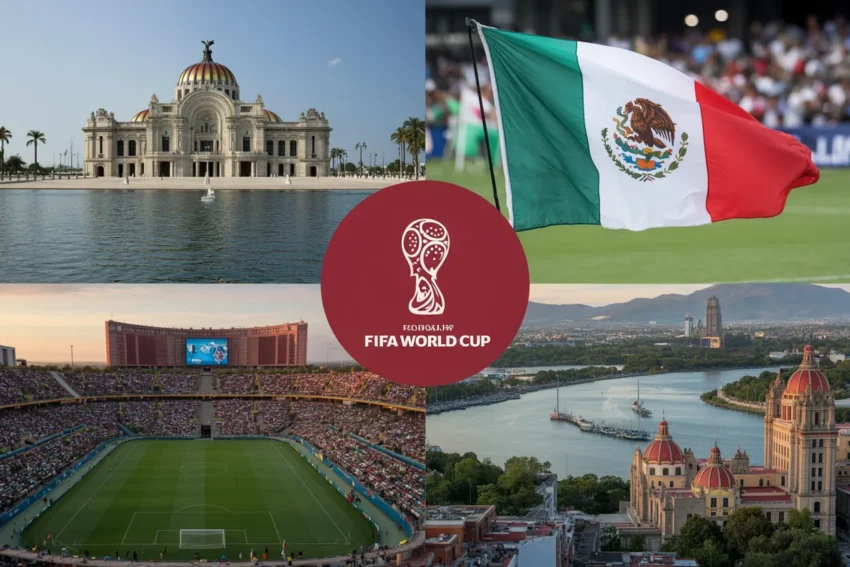
A Deloitte analysis estimates the 2026 FIFA World Cup will attract approximately 836,000 visitors to Mexico. The projection breaks down into roughly 556,000 domestic travelers and 280,000 international visitors, generating around $2.1 billion in tourism-related sales.
Antonio Cosío Pando, president of the National Business Tourism Council, has noted that the tournament's greatest long-term benefit may come after the championship. Global media exposure during the event continues to shape how audiences worldwide perceive Mexico as a destination.
What the Numbers Represent
The 836,000 visitor figure covers the Mexico portion of a tournament shared with the United States and Canada. Mexico is scheduled to host matches in Mexico City, Guadalajara, and Monterrey, including the opening match at Azteca Stadium on June 11.
The domestic component of 556,000 travelers reflects expected internal movement. Mexicans from cities without host venues will travel to the three host cities during the tournament period.
The $2.1 billion in projected sales covers spending across multiple categories, including hotel stays, food and beverage, local transport, retail and entertainment. Deloitte's methodology draws on comparable World Cup data from previous tournaments, adjusted for Mexico's existing infrastructure and host city market sizes.
It is worth contextualising the figure. Mexico received $34.99 billion in total tourism revenue in 2025. At $2.1 billion, the World Cup represents roughly 6 percent of annual revenue concentrated into the tournament period. That is a meaningful increment. The stronger argument for the tournament's importance rests on long-term brand exposure rather than on this direct revenue figure.
The Post-Tournament Effect
Cosío Pando's emphasis on post-championship exposure reflects a documented pattern in tourism economics. Destinations hosting major sporting events receive media coverage that functions as destination marketing. The scale and reach of that coverage exceeds what conventional advertising can achieve.
A viewer in Germany, Japan, or Brazil who watches a month of World Cup coverage in Mexican stadiums is repeatedly exposed to images of Mexico. That exposure may shift their consideration of the destination for future travel.
This effect is difficult to quantify. It does not manifest evenly across all host nations. It depends on the quality of coverage, how prominently host city visuals appear, and whether any operational incidents redirect the narrative. Mexico's security and infrastructure preparations are partly aimed at keeping that narrative focused on the event itself.
Domestic Versus International Visitor Mix
The domestic-to-international ratio in the Deloitte projection is approximately 2:1. This is consistent with Mexico's overall tourism profile. Domestic travelers accounted for 55.64 percent of hotel check-ins in Mexico in 2025.
International visitors generate higher average per-trip spending. Their expenditure includes long-haul transport costs, which inflate the headline revenue figure. The 280,000 international visitors are likely to account for a disproportionately large share of the $2.1 billion estimate.
For the three Mexican host cities, the relevant planning challenge is total aggregate demand. Both domestic and international visitors compete for the same hotel rooms, restaurant tables, and transport. Managing that demand is the practical concern for city authorities and operators.
Frequently Asked Questions (FAQs)
Q: How many visitors is the World Cup expected to bring to Mexico?
A: A Deloitte analysis estimates approximately 836,000 visitors, including around 556,000 domestic travelers and 280,000 international visitors. The tournament is projected to generate approximately $2.1 billion in tourism-related sales.
Q: How does the $2.1 billion World Cup revenue compare to Mexico's total tourism income?
A: Mexico received $34.99 billion in total tourism revenue in 2025. At $2.1 billion, the World Cup projection represents roughly 6 percent of that annual figure, concentrated into the tournament period. The longer-term argument for the tournament rests on brand exposure rather than direct revenue.
Q: Why does the National Business Tourism Council emphasise post-tournament benefits?
A: CNET president Antonio Cosío Pando has noted that global media exposure during the tournament continues to influence future travel consideration long after the event ends. World Cup coverage reaches audiences in source markets that conventional destination marketing cannot access at comparable scale or cost.
Q: Why do international visitors generate higher average spending than domestic ones?
A: International visitors spend more per trip because their expenditure includes international transportation costs, counted in tourism revenue figures. They also typically stay longer and spend more on accommodation. In the Deloitte projection, 280,000 international visitors are likely to account for a disproportionately large share of the $2.1 billion estimate.
Q: Which Mexican cities are hosting World Cup matches?
A: Mexico is hosting World Cup 2026 matches in Mexico City, Guadalajara, and Monterrey. Azteca Stadium in Mexico City hosts the opening match between Mexico and South Africa on June 11. Guadalajara and Monterrey host group stage, knockout round, and inter-confederation playoff matches.





 How to resolve AdBlock issue?