


Semana Santa, the week leading up to Easter Sunday, is the most significant religious observance in Mexico's Catholic calendar. In Puerto Vallarta, the period extends across two weeks, combining Holy Week itself with Pascua, the week following Easter Sunday running from April 6 to 11. The two-week span is one of the busiest periods in the city's annual calendar, drawing domestic visitors and concentrating public activity across the waterfront, beaches, and central neighbourhoods.
The Religious Calendar of Holy Week
Holy Week in Puerto Vallarta follows the structure observed across Catholic Mexico, with each day carrying a specific liturgical significance. Palm Sunday on March 29 opens the week with the blessing of palm fronds at churches across the city. Maundy Thursday on April 2 is marked by evening and overnight church vigils. Good Friday on April 3 is the most solemn day of the observance.
Processions and theatrical reenactments are central to Semana Santa in Mexico. These performances draw on a tradition stretching back to the colonial period, when the Catholic Church used dramatic reenactment as a tool for religious instruction. In many communities, including Puerto Vallarta, the performances incorporate pre-Hispanic theatrical elements that were adapted into the colonial religious framework.
Easter Sunday on April 5 marks the conclusion of the strictly religious observance. Parish masses and family gatherings characterise the day. It is generally quieter than the high-activity days preceding it.
The Passion Play
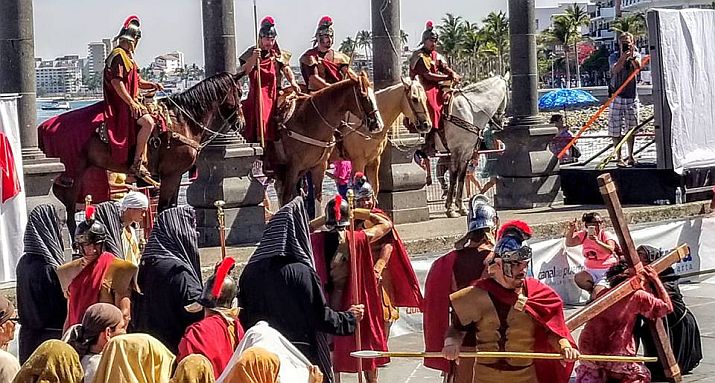
Good Friday's Passion Play is among the most widely attended public events of Semana Santa in Puerto Vallarta. Local performers prepare throughout the year for the reenactment, which traces the final days of Jesus Christ's life through staged scenes performed in public spaces.
The scale and form of the Puerto Vallarta Passion Play reflects a community tradition rather than a formal production. Performers are typically neighbourhood residents who take on their roles voluntarily. The reenactment moves through the streets and plazas of the city rather than being staged in a single fixed location, which keeps it embedded in the urban fabric rather than contained in a theatre or venue setting.
Pascua and the Week After Easter
The week following Easter, known as Pascua, brings a shift in character. The solemnity of Holy Week gives way to a period of leisure and social activity that draws domestic visitors in large numbers to beach destinations across Mexico.
Puerto Vallarta's beaches, waterfront, and Malecón fill with visitors during Pascua. Food vendors, live music, and outdoor activity concentrate along the seafront. This phase of the two-week period is driven primarily by domestic tourism rather than by religious observance. It represents the practical culmination of a week of restricted activity and is one of the periods of highest beach occupancy in the city's annual cycle.
Fireworks displays are common in the evenings during Pascua, particularly around the central waterfront area. These are neighbourhood and municipal events rather than organised commercial productions.
Frequently Asked Questions (FAQs)
Q: When does Semana Santa take place in Puerto Vallarta in 2026?
A: In 2026, Holy Week runs from Palm Sunday on March 29 through Easter Sunday on April 5. Pascua, the week following Easter, runs from April 6 to 11. Together the two-week period constitutes Puerto Vallarta's extended Easter season, one of the busiest periods in the city's annual calendar.
Q: What is the Passion Play and when does it take place?
A: The Passion Play is a theatrical reenactment of the final days of Jesus Christ's life, performed in public spaces on Good Friday, April 3. In Puerto Vallarta, local residents take on the performance roles voluntarily and prepare throughout the year. The reenactment moves through streets and plazas rather than being staged in a single fixed venue.
Q: How do Semana Santa and Pascua differ in character?
A: Semana Santa is the week of religious observance, with processions, church vigils, and the Passion Play marking the days from Palm Sunday through Easter. Pascua, the following week, shifts toward leisure and social activity. Beach destinations across Mexico see high domestic visitor volumes during Pascua as a period of relaxation following Holy Week's more observant character.
Q: What pre-Hispanic elements appear in Semana Santa observances in Mexico?
A: During the colonial period, the Catholic Church adapted pre-Hispanic theatrical traditions into religious instruction tools. Many Semana Santa reenactments in Mexico retain elements of that process, incorporating performance styles, symbolic elements, or community ritual structures that have pre-colonial origins. Puerto Vallarta's observances reflect this syncretic tradition alongside standard Catholic liturgical practice.
Q: What happens on Maundy Thursday during Semana Santa?
A: Maundy Thursday, April 2 in 2026, is marked by evening and overnight vigils at churches across Puerto Vallarta and Mexico more broadly. It commemorates the Last Supper in Catholic tradition. The overnight vigil format makes it one of the more participatory nights of Holy Week for practicing Catholic communities.






 How to resolve AdBlock issue?