Ancient Mexico provides lesson on human unity, experts sayTarahumara Indians in a community in Mexico. EFE/H. Montaño/INAH

Scientists have found substantial genomic differences among Mexico's indigenous populations that persist despite the widely popular concept of a homogeneous mestizo "la raza," experts say.

"There is a high degree of differentiation among indigenous populations, and more so between those who are more isolated," Victor Acuna Alonzo, an anthropologist at the National School of Anthropology and History, told Efe.

An international team of researchers analyzed genome samples taken from more than 1,000 individuals representing 20 indigenous and 11 mestizo, or mixed, population groups, the journal Science reported recently.

The greatest differences were found between the Seri ethnic group living in northwest Mexico and the Lacandones in the southeast, with genomic differences wider than those existing between European and Chinese people.

The Mexican Constitution states that the country's population is multicultural and rooted in its indigenous populations, but the diversity has tended to be hidden or shunned in mainstream discourse that favors the concept of a monolithic culture.

The National Council for the Prevention of Discrimination says one of the main reasons for this is the "mestizo myth" based on the emergence of a national identity that integrates all the distinct components of Mexico's population.

The 2012 report by the council said it was Mexican philosopher Jose Vasconcelos (1882-1959) "who best defined this narrative."

Vasconcelos's 1925 book, "The Cosmic Race," posited the idea that the "assimilation of the diverse origins coinciding in Mexico and in Latin America place the mestizo as the principal unit."

"Neither the 'cosmic race' nor the government's pro-mestizo propaganda managed to erase the multicultural and multiethnic nature of the country," the report said. "Vasconcelos was wrong: today in Mexico there are many races - not one - and all express themselves through a vast pleiad of spirits, just like that, in plural not in singular."

Paradoxically, both the argument for homogenization through miscegenation and its opposite, the vindication of diversity, have been used to refute racist positions.

The first argues that it is impossible to define clear boundaries among the races since they are so intertwined, while the second highlights each group's contributions to universal human culture.

[readon1 url="http://latino.foxnews.com/latino/news/2015/01/01/ancient-mexico-provides-lesson-on-human-unity-experts-say/"]Source:latino.foxnews.com[/readon1]

MART
Mexican film director Luis Estrada, who produced the film "The Perfect Dictatorship," speaks during an interview with AFP on September 29, 2014 in Mexico City. The movie, which criticizes the Mexican political system, will be in theaters next October 16th. (Omar Torres/AFP/Getty Images)


MEXICO CITY--A Luis Estrada film is not a riddle to decipher. The themes from the famous Mexican director come blaring at you with their high-beams on, usually from the opening credits.

Within the first minutes of his most famous film, the 2010 drug-war indictment “Infierno” (Hell), the main character gets deported, held up at gunpoint, robbed by police, and falls in with gangsters who have taken over his hometown; and it ends with blood dripping down the corrupt mayor’s podium and over Mexico’s eagle-and-serpent national symbols. In his 2006 film “Un Mundo Maravilloso” (A Wonderful World), about social inequality and globalization, his peasant protagonist finds himself stuck on a window ledge high up on the fictional World Financial Center, literally locked out from Mexico’s modernizing economy.

But the black-comedy satires that Estrada deals in have a fearless quality that takes aim at Mexico’s political class, including the ruling Institutional Revolutionary Party (or PRI) and the corruption, impunity, and violence he sees as embedded within it. Over the past 15 years, since his 1999 film "La Ley de Herodes" (Herod’s Law) about an extortionist PRI mayor, Estrada has established himself as one of Mexico’s most incisive social and political critics.

Mexican film directors have been on an exceptional run in recent years. Alejandro Gonzalez Iñarritu, whose first feature film, "Amores Perros," was nominated for an Academy Award in 2000, came out with the well-received "Birdman" this year. The more fantastically minded Guillermo Del Toro has directed movies such as "Hellboy" and "Pan’s Labyrinth." Last year, Alfonso Cuaron became the first Mexican to win the Oscar for best director for his film, "Gravity."

As those three have won fame in Hollywood, Estrada has kept his focus on his home country. He describes himself as passionate about information, “to levels a bit pathological,” reading up to five newspapers a day “to try to understand what is happening in this country and above all because I’m worried about where it’s going.”

This year, with "La Dictadura Perfecta" (The Perfect Dictatorship), he took on the presidency and the Mexican media. Estrada and his co-writer Jaime Sampietro came up with the film before Enrique Peña Nieto became president—bringing the PRI back to power after a 12-year hiatus—but that doesn’t mean it wasn’t about the man or the party. As the film declares: “In this story all the names are fictitious, the events suspiciously real. Any similarity with reality is not mere coincidence.”

The Mexican television giant, Televisa, had been a partner on the film, but then pulled out once executives saw it, and Estrada had to pay back the investment. Failing to find other backers, he partnered with a small art-film distributor. A company that was supposed to advertise the film on buses pulled out just before the launch.

But more than 4 million people have watched the trailer online and, despite the unconventional release, it went on to be the highest grossing Mexican film of the year and the third highest of all time. The film depicts a corrupt governor in cahoots with the mafia whose image is rehabilitated by a Mexican television network. The flattering coverage, including coupling him with one of their beautiful actresses, carries him to the presidency. (Peña Nieto, a telegenic former governor of Mexico State, also married a telenovela star.)

It has been a difficult stretch for Peña Nieto, who started his term trying to move the national narrative away from the drug war and towards his agenda of economic reforms, including opening up the country’s oil sector to foreign investment for the first time in decades. But the year ended with a slew of familiar problems. The disappearance of 43 teachers college students in Guerrero—allegedly at the hands of a local mayor and police aligned with a drug cartel—sparked months of nationwide protests and upheaval. At the same time it was revealed both the first lady and the finance minister bought homes from a favored contractor from Peña Nieto’s time as governor.

As another tumultuous year in Mexico comes to a close, we sat down with Luis Estrada to talk politics and filmmaking.

On the climate in Mexico for critical films

"Now it’s easier [to criticize the government], but not because of a desire or a political will of the government. It’s very interesting the way communication has changed in the past 15 years. If I use, as a reference, 'Herod’s Law,' compared with what has now occurred with 'The Perfect Dictatorship,' I think that the desire remains [by the government] to prevent showing a critical movie, a satire, with very clear references to institutions and people. It’s a curious thing: 'Herod’s Law' was the first film in the history of Mexican cinema that spoke about the PRI and the corruption and impunity that surrounded its reign for 70 years. 'The Perfect Dictatorship' is the first film in the history of Mexican cinema that satirizes the president. This sounds weird. Because in any real democracy—and we’ll talk about whether this country is a really a dictatorship or a democracy or what—this is something common, every day. If you are in the U.S., satires like 'Saturday Night Live,' or 'Family Guy,' or 'South Park,' are normal. In Mexico, as a product of its authoritarian tradition, for many decades, effectively, there was a clear censorship by the government."

...

"Before 'The Perfect Dictatorship' came out, I began to notice again a certain authoritarian intention to keep the film from being seen. I also discovered something else, that the world had changed a lot in those 15 years, in particular the power today of the Internet, the social networks....I’m not much in favor of globalization, but one of the few good and interesting things that globalization has given the world is that acts of authoritarianism are harder to keep silent. To exercise this control over what you can say, what you can’t say, what you can show. Therefore I feel that the great difference--rather than some great democratic awakening by the government--has more to do with society and the media, social media, that has changed the way people communicate about abuses of power."

On the genesis of "The Perfect Dictatorship"

[readon1 url="http://world.einnews.com/article/241987629/uEqWN_iP06ir6bPt"]Source:world.einnews.com[/readon1]

 79967006 9cc8e2b2 f236 4283 bcc8 b87f1009c3b5

A female Mexican bullfighter was gored twice on Sunday, suffering cuts to her leg, during an event at Mexico City's Plaza Mexico.

Karla de los Angeles suffered long gashes to her thigh and gluteal muscles from a bull called Gamusino, a 1,090lb animal that gored several others on Sunday.

Video from the event shows both of the gorings. The first sees the bull toss de los Angeles into the air and bounce her body a few times on its horns before she drops to the ground. The screams from the crowd are deafening. De los Angeles can be seen clutching her back and wincing, although she recovers from the ordeal and returns once more to the ring.

WARNING: SOME VIEWERS MAY FIND THIS FOOTAGE DISTRESSING

28698

In Mexico and all over the Catholic world, December 28 commemorates the Santos Inocentes or Holy Innocents, considered the first Christian martyrs. Upon hearing of the birth of Jesus, King Herod ordered the death of every child in Bethlehem under the age of two in an effort to wipe out all competition to his throne. But an angel warned the Holy Family and they sought refuge in a foreign land to save the life of their baby, the Christ child.

In Mexico — as well as Spain and other Latin American countries — December 28 is the equivalent of April Fool's Day. Although it may seem irreverent, jokes of all kinds are played on the innocents. Fortunately, the jokes are well taken.

Among the traditions, this poem is recited after someone has been fooled:

Inocente palomita,
Que te dejaste engañar,
Sabiendo que en este día
Nada se debe prestar.
                                Innocent little dove,
Innocent little dove,
Knowing that on this day
 

People make the most outlandish statements. They tell others shocking news like they're going to be parents, or they're getting married to someone else's sweetheart. In this electronic world, Facebook postings are a way of fooling friends at home and farther afield. For example, my brother posted that he'd won a scholarship and would be spending the next three years away at school. It wasn't true, but all day long he received e-mails of congratulations and encouragement, much to his perverse delight.

The news media also play a part in this traditional day. Newspapers often have two front pages — one with real information and another with headlines that are hard to believe. These reports are always something unexpected such as surprise marriages between politicians and famous musicians, huge salary donations by politicians, silly archeological discoveries and other improbable news.

Television journalists also prepare astonishing and hard to believe headlines and, if you're caught off guard, you can be fooled.

Fortunately for teachers, the holiday falls during Christmas vacations.

One of my favorite December 28 headlines said Kate Middleton was leaving Prince William for Mexican soccer star Chicharito!

It is on this day of Holy Innocents that people in Mexico get back in touch with the prank-playing child we all have inside.

mexico cholula catholic church keenpress
Mexico, Cholula, Catholic Church

It’s time for leaders in the Mexican Catholic Church to speak up where they are most needed.
 
Catholicism in Mexico has reached a flashpoint of contradiction when it comes to human rights. On the one hand, highly conservative religious leaders have aligned with powerful and economic elites, creating an authoritative force that is not amenable to certain types of human rights. On the other hand, progressive Catholics are the most active presence among Mexican NGOs working in the name of rights. In addition, the Catholic leadership has used the “right to life” to argue fiercely against sexual education and certain women’s rights, and yet stays silent on many other “right to life” issues like extrajudicial killings and disappearances. So why are we seeing these stark contrasts within the same religion?

First, as many other discussions of religion and human rights have pointed out, the rigidity and vertical hierarchy of religious conservatives are often reflections of individual power, values and interpretations, rather than of the doctrine itself. Human rights encourage political action based on the rights and freedoms of citizens, not from obligations imposed by institutions and normative frameworks. Human rights advocacy, then, resides in the basic interest of civilians' ability to stand up to authorities’ abuse of power, and this presents an obvious problem for those in power. The structure and teachings of Catholicism are actually strongly in favour of human rights (e.g., preserving the value of human life and dignity), yet enacting these rights may threaten the religion’s own power structure.

In fact, religions can provide doctrines, theology and pastoral models that may break free and even criticize their own organizations—and this is where we are seeing the conflict among many Mexican Catholics and their leadership. These “pastoral agents” of change are usually not part of the primary power centre of Catholicism, despite the fact that some bishops have taken up a strong defence of human rights.

In Mexico, the Dominicans and Jesuits in particular propelled the first advocacy centres. In the 1990s, both bishops and Catholic-inspired lay organizations had relevant and decisive roles in the country’s democratic transition, championing political rights and dethroning the dictatorship of the state party. Yet, these actions provoked conflict because of the intrusion of the church into the political workings of the country. Some segments of Catholicism backed off, while others have not, creating tension within various Catholic groups.

While the human rights discourse provides a framework of values that transcends and permeates different religions, in Mexico the discourse has almost become cliché in that any religious leader has to say he is a defender of human rights, regardless of actual practice. As Barbara Frey points out, it has become popular in Mexico to talk about human rights, but actually protecting and enforcing them is another story. And Catholicism (at least in its conservative, hierarchical form) is a large part of this doublespeak problem. What we end up with is a human rights discourse that has morphed into rhetorical territory where everyone seems to be converging. And this convergence should be a good thing for rights. Except that in practice human rights have become an area of conflict between various different ideological standpoints, creating tension rather than cooperation (e.g., liberals versus socialists, conservatives versus progressives, revolutionaries and reformers, democrats and anarchists, etc.).

Where this tension is particularly high is around the issue of the “right to life”. Since the conservative papacy of John Paul II, the Catholic leadership has had an absolutist motto of defence for life from birth to death. In the name of this stance, there have been “crusades” against freedom for lay people, such as rallying against public health campaigns that intend to reduce epidemics and deaths—like decriminalizing abortion, reducing the spread of HIV/AIDS, and making contraceptives such as the “morning after” pill more widely available—and also against sex education and homosexual marriage. These causes became a national campaign, and in 2010 “Mexicans for Life for All” was formed as an umbrella coalition of 204 right-wing groups, mega-entrepreneurs and elites. The right to life discourse became so radicalized that the Archdiocese of Guadalajara declared that feminism, along with the idea of gender and homosexuality were, “aberrations that destroy the basic fabric of society.”

[readon1 url="http://world.einnews.com/article/241635812/Phg1MBGmjtShnby_"]Source:world.einnews.com[/readon1]

BN FQ516 takata M 20141120063443

2014 12 18T023836Z 1006950002 LYNXMPEABH01G RTROPTP 2 CBUSINESS US AUTOS TAKATA RECALL MEXICONissan Motor Co Ltd said on Wednesday it has ordered the recall of more than 80,000 vehicles sold in Mexico to check for potential defects stemming from air bags made by Japanese company Takata Corp .

A total of 84,671 autos have been recalled this month, a company spokesman said. The vehicles were made between early 2011 and late 2014, according to figures published on the website of Mexico's consumer protection agency (Profeco).

Nissan is not the only automaker to act. Honda Motor Co Ltd, BMW and Toyota Motor Corp have also ordered recalls over the air bags this month, according to Profeco. The three companies have recalled a combined total of nearly 75,000 autos, the agency said.

More than 20 million vehicles have been recalled worldwide since 2008 because of defective Takata inflators, which have been linked to five deaths.

Separately, the Mexican Auto Industry Association (AMIA) said automakers and government officials have held meetings about potential problems with Takata air bags in recent weeks.

AMIA added that the companies "have begun to take necessary steps on their own to determine whether vehicles sold in Mexico could be affected," but did not provide further details.

f96da861d1585e9f89319221be294f4f

[readon1 url="http://news.yahoo.com/nissan-recalls-autos-mexico-check-takata-air-bags-021222529--business.html"]Source:news.yahoo.com[/readon1]

8776568w

Uber-type services and new collaborative economic trends such as carpooling are gaining strength in Mexico, changing the panorama of transportation and mobility and - in turn - bringing criticism from taxi associations.

Instead of walking to the nearest taxi stand or making a telephone call requesting a cab, users can call a taxi just by pressing a button in an app.

It's a service that is gaining popularity and which companies like Uber and Cabify are using to deal with transport problems.

In contrast to other apps involving taxis, the firms in question base their service on private individuals and their vehicles, people who have never obtained an official chauffer's license.

In response to the trend, the Organized Taxi Drivers of Mexico City group on Dec. 10 filed a legal complaint with the capital district attorney's office against the municipal transport secretary, Rufino H. Leon Tovar.

They accused him of failing to deal with the problem posed for them by Uber, Cabify and "those responsible for individual transport of passengers in the city without (being awarded) a concession" to do so, claiming that they are violating the Transport Law, which prohibits the use of private vehicles for business purposes, the spokesman for the taxi drivers' group, Daniel Medina, told Efe.

The complaint is also directed at local representatives of Uber and Cabify, to whom Mexico City cabbies claim they are losing approximately 10 percent of their income, Medina said.

However, the CEO of Cabify Mexico, Edgardo Rivera Torres, one of the defendants in the case, told Efe that "we've met with the local authorities and they've told us that we're not a substitute for the taxi service; our customers use (cabs) every day for certain needs and they use us for others."

What they offer is a "private drivers" service that "is not (covered by) current regulation, and they don't need a permit to provide their services."

A less controversial growing transportation alternative is the service proposed by Tripda, which has just been launched in Mexico after finishing its test phase.

With Tripda, users can publish announcements of their upcoming car trips and offer seats in their vehicles in exchange for the price they set.

Thus, "the cost of gasoline is shared," the head of Tripda in Mexico, Oscar Rosado, said, adding that the service is aimed particularly at "millennials" (the 18-30 age group), because of their consumption tendencies: "They're always connected to the Net, they have a more open feeling about ecology and less connection with material things."

Tripda provides travel between cities, but also on routes that are being developed within municipal areas, because "there are routes in the (capital) that, due to distance and time, are considered long distance in other countries," and also "70 percent of the cars on the road have just one passenger, wasted space that affects all traffic here."

In Rivera Torres' opinion, the opposition from the traditional transport sector is natural: "It's going as in any industry in which there is a revolution in service. Nobody accepts the change passively."

"What I really believe is that it's the future. A trend on the global level that can't be ignored. Customers are not being manipulated or hypnotized. They're looking for something that they're not getting (elsewhere)," Rivera Torres said

[readon1 url="http://latino.foxnews.com/latino/news/2014/12/25/uber-carpooling-shake-up-transport-in-mexico/"]Source:latino.foxnews.com[/readon1]

Mexico Ville

A Mexican is a national, native or an inhabitant of Mexico. Mexican is also a term used to define something which pertains or relates to Mexico or its inhabitants. Mexican is also used to refer to the United Mexican States, as the Mexican union is officially called. In the local language, Spanish, it is called Estados Unidos Mexicanos or Mexico. It also takes into consideration the use of the alternate spelling of the country's name, Mejico.

Mexicans live in Mexico, which is a country located in North America. The neighbouring countries of Mexico are the United States of America to the north and Belize and Guatemala to the southeast. It is the northernmost and westernmost country in the Latin American region. It is also the most highly-populated Spanish-speaking country in the world.

The term Mexican is Australian slang used by New South Welshmen to refer to Victorians (the state of Victoria is located to the south of the state of New South Wales) and Queenslanders to refer to New South Welshmen (the state of New South Wales is located to the south of the state of Queensland).

a fireworks 2

Do you love fireworks? We do too! Did you know that Puerto Vallarta will be hosting the Puerto Vallarta International Fireworks Festival, starting in less than two weeks?

This enormous event will bring together fireworks experts from Mexico, US, Canada, Spain and Italy in an 11-day extravaganza of nightly fireworks and live entertainment.

VYC will be there! We are planning a floatilla of members' boats to Puerto Vallarta to watch the fireworks from the water. The VYC Fireworks Floatilla will leave from Paradise Village Marina around 8pm in order to be onsite offshore Puerto Vallarta for the evening fireworks, starting around 9:30.

The dates for the event are December 25-31 (this is a change, see note below) A full calendar and description of all the entertainment can be found by clicking here.

Do you have a boat and would like to be part of the floatilla? Are you a VYC member and would like to be on one of the boats going out to watch? Contact Andy Barrow, VYC On-The-Water Director by email at This email address is being protected from spambots. You need JavaScript enabled to view it. While we are originally planning this for December 26 (note: this is a change), the start of the event, if you have a preference for a different day, please let us know - we are flexible!

Ready? Click here to sign up!

UPDATE: We have been informed that the original schedule for the event was in error. The actual dates are December 25-31.

[readon1 url="http://www.vallartayachtclub.org/on-the-water-home/870-puerto-vallarta-fireworks-festival-vyc-will-be-there"]Source:www.vallartayachtclub.org[/readon1]

NS02 16121 c1275292 141223 724

BALING: Residents in villages and housing estates who come across the harmful Mexican itchy weed or parthenium hysterophorus, (pix) are required to immediately report to their respective district agricultural office so that it can be destroyed.

Kedah Principal Assistant Director of the Biosecurity Plant Protection Division Department of Agriculture, Ramli Abdul Rahman said people need to be aware of the dangers of such plants which have been detected in several areas of the state.

He said there was no need for people to panic, instead they should immediately inform the district agricultural department so the noxious plant can be destroyed.

"I advise people in residential areas who see these poisonous plant to contact the district agriculture department to have the plant destroyed," he told Bernama after witnessing the destruction of the plant in Kampung Banggol Wan Mat and Kampung Seberang Pekan Baling, here, today.

Six personnel from the State Department of Agriculture and a Mobile Spray Unit as well as four from of Baling district agriculture office conducted surveys and destroyed the Mexican weed biotypes with the cooperation of residents.

There are more than two hectares of land in the area that is overgrown with these dangerous weeds. Landowners can also use appropriate poisonous substances to destroy the plant and children should be prohibited from playing in these areas, he added. – Bernama

[readon1 url="http://world.einnews.com/article/241167180/doSCax4Oqno8wT8R"]Source:world.einnews.com[/readon1]

site 1209 0001 500 363 20140121144632

The 34,658  site, between the foothills of the Tequila Volcano and the deep valley of the Rio Grande, is part of an expansive landscape of blue agave, shaped by the culture of the plant used since the 16th century to produce tequila spirit and for at least 2,000 years to make fermented drinks and cloth. Within the landscape are working distilleries reflecting the growth in the international consumption of tequila in the 19th and 20th centuries. Today, the agave culture is seen as part of national identity. The area encloses a living, working landscape of blue agave fields and the urban settlements of Tequila, Arenal, and Amatitan with large distilleries where the agave ‘pineapple' is fermented and distilled. The property is also a testimony to the Teuchitlan cultures which shaped the Tequila area from AD 200-900, notably through the creation of terraces for agriculture, housing, temples, ceremonial mounds and ball courts.

Outstanding Universal Value


Brief Synthesis

The Agave Region, in the Valles Region of the Jalisco State, is one of the most important cultural landscapes in Mexico, not only for the importance of the natural landscape that offers, but for the cultural tradition that has kept for several centuries and from which has arisen one of the main icons that identify this country: the tequila.
The 35,019 ha site, between the foothills of the Tequila Volcano and the deep valley of the Rio Grande River, is part of an expansive landscape of blue agave, shaped by the culture of the plant used since the 16th century to produce tequila spirit and for at least 2,000 years to make fermented drinks and cloth. Within the landscape are working distilleries reflecting the growth in the international consumption of tequila in the 19th and 20th centuries. Today, the agave culture is seen as part of national identity. The area encloses a living, working landscape of blue agave fields and the urban settlements of Tequila, Arenal, and Amatitan with large distilleries where the agave ‘pineapple' is fermented and distilled. The property is also a testimony to the Teuchitlan cultures which shaped the Tequila area from AD 200-900, notably through the creation of terraces for agriculture, housing, temples, ceremonial mounds and ball courts.

Criterion (ii): The cultivation of agave and its distillation have produced a distinctive landscape within which are a collection of fine haciendas and distilleries that reflect both the fusion of pre-Hispanic traditions of fermenting mescal juice with the European distillation processes and of local and imported technologies, both European and American.

Criterion (iv): The collection of haciendas and distilleries, in many cases complete with their equipment and reflecting the growth of tequila distillation over the past two hundred and fifty years, are together an outstanding example of distinct architectural complexes which illustrate the fusion of technologies and cultures.

Criterion (v): The agave landscape exemplified the continuous link between ancient Mesoamerican culture of the agave and today, as well as the contours process of cultivation since the 17th century when large scale plantations were created and distilleries first started production of tequila. The overall landscape of fields, distilleries, haciendas and towns is an outstanding example of a traditional human settlement and land-use which is representative of a specific culture that developed in Tequila.

Criterion (vi): The Tequila landscape has generated literary works, films, music, art and dance, all celebrating the links between Mexico and tequila and its heartland in Jalisco. The Tequila landscape is thus strongly associated with perceptions of cultural significances far beyond its boundaries.

Integrity

The World Heritage property is large and encompasses the whole of the core of tequila growing landscape and most of the related elements and interdependent that characterizes the agave region. The area also includes all aspects of the tequila growing and distillation process, and the haciendas and factories and associated towns, thus encompassing an economic and cultural area.

In the municipalities of Magdalena, Tequila, Amatitán and El Arenal concentrate the tangible and intangible testimonies of different historical periods that favour the comprehension and appreciation as a whole coherent and vital. The inscribed property is the region of origin of the cultural process and therefore the one that better exemplifies its historical development.

The extension deployed on the municipalities of El Arenal, Amatitán, Tequila and Magdalena embraces a valley with geographical and agricultural continuity where most of the tangible elements of the occupation of the territory are located, represented by the archaeological vestiges, plantations and industrial facilities as well as the intangible ones, represented by practices and customs of the community that inhabits the region. They have been the support of the cultural process of the production of Tequila. These same elements can propitiate their long term conservation and their sustainable development. To the date, significant problems produced by the human activity that could commit the integrity of the site have not occurred.

Authenticity

In terms of the cultivated landscape, haciendas, distilleries and the centres of the urban settlements, there is no doubt of their authenticity as reflecting the way the landscape has been used and still is to grow and process the agave plant and distil tequila. The methods of cultivation and processing both retain their authenticity and there is still a defined link between where the agave plants grow and the distilleries to which they are sent: only tequila processed from agave pineapples grown in the inscribed property is eligible for a Declaration of Origin. The work in the agricultural field attests the survival of essential elements that have shaped the agave landscape from its creation and the continuity of an ancient cultural process.

The extensive cultivations and the old distilleries of the region of Tequila have a strong character of syncretism since in them fuse ancestral knowledge of the American and European traditions. The hefty character of the landscape is the result of the cultivation and domestication of the Agave Azul Tequilana Weber native plant of the region, through a long journey along the time. From it comes the genus loci that impregnates the site in a single way. It is characterized by countless undulant lines of agave that adapt to the irregular topography of the region. The outskirts of the urban areas have been subject to recent development and change and there is less well defined local building traditions and authenticity. In these areas positive programmes will be needed to manage change in a beneficial way. The Management Plan addresses this need.

Protection and management requirements

About 22% of the nominated area is owned privately; 44% is common land; the remainder, 34% is what is called mixed productive associations which are private investment on common land. Most of the factories still in production are in urban areas. Those in rural areas belong to private owners. Altogether there are 60 factories in the inscribed property.

Legal protection applies at Federal, State and Municipal levels. At the Federal level, there are different legal tools that pertain to the Tequila product itself, while heritage protection is granted through the 1972 Federal Law Regarding Artistic, Historical and Archaeological Monuments and Sites, the General Law in Human Settlements and the General Law of National Properties, the General Law of Ecological Balance and Environmental Protection. With these tools, federal protection applies to historical monuments before the 20th century, designated towns and villages, archaeological and industrial sites and the relationship between natural sites and cultural ones. This covers the core of the towns and nominated factories and haciendas. At the State Level, the Law of the Cultural Patrimony of the State of Jalisco and Municipalities, the Regulations for the Cultural Patrimony of the State of Jalisco and Municipalities, the Law of Urban Development of the State of Jalisco, the Decrees of Natural Protection Areas, are tools to ensure the preservation of both cultural and natural patrimony and people’s culture. The State has responsibility for the preservation and restoration of historical, architectural and archaeological sites, urban and territorial development and the delineation of settlements. In particular it is responsible for the protected Tequila landscape through the Tequila Master Plan. Finally, at the Municipal level, the Regulations for the Protection and Improvement of the Urban Image of Tequila, Jalisco, the Partial Plan of Urban Development on the Historical Centre of Tequila, Jalisco, the Partial Plan of Urban Development for the Conservation of the Urban and Architectural Patrimony of the Historical Centre of Amatitán, Jalisco, the Plan of Urban Development of the El Arenal, Jalisco, the Model of Territorial Ecological Classification of the State of Jalisco, Region Valles, provide control over 20th and 21st century heritage building at the property.

The Management Plan for the Agave Landscape and the Ancient Facilities of Tequila is the main management and planning tool. Its implantation is centred on improving the quality of life of the inhabitant communities and to act as factor of integration of the diverse effective legal instruments and competent instances in the region. It also seeks to ensure that the conditions of authenticity and integrity of each one of the components of the Agave Landscape are maintained through its conservation, restoration and appropriate use. Likewise, it strives to stimulate a sustainable regional growth supported by the local cultural values. The implementation of the management plan sets out the provisions for the conservation and sustainable use of the ensemble of attributes of the property: the natural landscape, the agave landscape, the archaeological vestiges, the ancient industrial facilities and the traditional towns. It is also a tool to promote that the social sectors of less economic income are contemplated as high-priority groups for the benefits derived from the rescue and conservation of the Cultural Agave Landscape. As part of the strategy followed by the Instituto Nacional de Antropología e Historia and State Government of Jalisco to ensure the conservation and protection of the property through the sustainable regional development of the entity, the “Agave Landscape of Tequila” has been incorporated as a “Strategic Project for the development of Jalisco”.

Historical Description

The domestication of wild agave seems to have begun around 3,500 years ago. The wild plant may have originated in the Rio Grande canyon. The agave plant is ideally suited to the poor soil and rough terrain of the Tequila area.

Agave was extensively cultivated by the Teuchitlans and served to provide many basis necessities: its fibres were used for fabric, rope and paper, the flower stem provided wood for construction, the fleshy leaves were used as roof tiles and fuel, the spines for needles and arrow heads, the sap produced a type of honey and its juices were used for medicinal balm and fermented to produce an alcoholic drink. The leaders of the complex, stratified, Teuchitlan society created wealth from their apparent monopoly of the agave resources.

To transform the starches in the plant to sugar, for eating and fermenting into alcohol, the pineapples need cooking. There is archaeological evidence from nearby Lake Sayula (outside the nominated area) that the practice of cooking agave pineapples in open, conical ovens, made of volcanic stone, existed around 400 BC. These ovens were preheated with wood and the pineapples covered with branches and clay.

The Spanish priest, Friar Francisco Ximenez, wrote in 1615 how juice from the cooked plant was fermented to make wine flavoured with orange and melon rinds.
In the 16th century the area was conquered by the Spanish who established the town of Santiago de Tequila. The Caxcanes who were living in the areas gradually assimilated with the Spanish. In order to mitigate shortages of spirits from Europe, the Spanish experimented with local beverages and begun to distil the agave fermented juice to make vino de mezcal. At the same time rum was being developed in the Antilles and so the necessary equipment for the new agave spirit was introduced from the rum making areas.

The taxes levied on the new spirit produced a significant income for the Spanish government of Guadalajara. It funded a water supply and the government palace of Jalisco in Guadalajara.

At the end of the 17th century the first formal distilleries were established and the first intensive agave plantations created. During the course of the 18th century industrial facilities begun to be established within haciendas, and gradually agave cultivation spread out across the plain.

As the liquor became better known in the 18th century, so demand increased. Its growth was greatly helped by the creation in 1758 of the commercial route known as the Camino Real connecting Tequila to the port of San Blas on the Pacific Ocean, to Guadalajara and to Mexico City. The wine was transported by mule teams and donkeys along the new road and became the first export product from the region. The significant increase in production and consumption of this drink contributed to the development of a clear regional identity.

Overuse of the spirit became at times a cause for concern amongst the civil and religious authorities, and there were periodic, but ultimately unsuccessful, attempts to ban the drink, in spite of the loss of revenue, but these merely resulted in clandestine activity developing in remote areas. In 1795, after almost three centuries of Spanish colonial rule, a regional producer, José Maria Guadalupe Cuervo received the first licence permitting the legal establishment of a mescal distillery.

In the mid 19th century, with the growth of the export trade, large distilleries were established in the towns, separating the production of liquor from the growth of the raw materials. This led to the decline of some rural distilleries and their haciendas begun to concentrate instead on producing raw materials for the urban distilleries, resulting in a rapid increase in land under agave cultivation.
The second half of the 19th century saw consolidation amongst the urban distilleries and the introduction of more efficient machinery, such as enclosed steam heated ovens and mechanical mills.

The Mexican Revolution in the third decade of the 20th century led to a temporary decline of the tequila production process as land attached to haciendas was reallocated to workers on a communal basis or became private property.

Today measures have been put in place, such as the renting of land, and the advance purchasing of the agave plants, to try and ensure continuity in production to meet the continuing high demands.

Agave Landscape Gallery

[readon1 url="http://whc.unesco.org/en/list/1209/"]Source:whc.unesco.org[/readon1]

Church alter protruding from the lava Paricutin

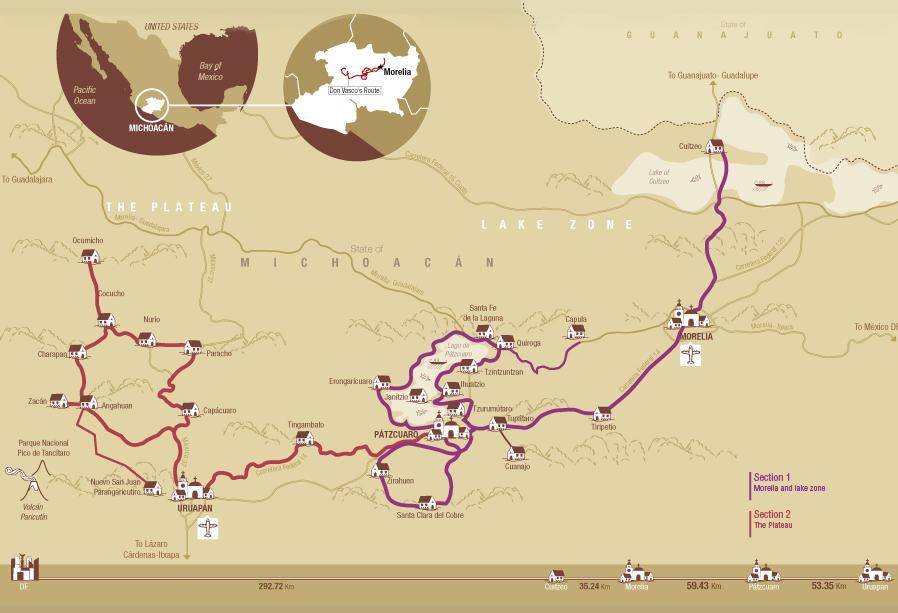
The sensuality of a guitar. The ecstasy found in a sweet. Redemption beneath the wing of an angel. The mystery of a mask. the dance of the old men. Butterflies dancing on the waters of the lake. 500 years of tradition at your fingertips What are you waiting for? Discover the Don Vasco route.

Meet Don Vasco of Quiroga, the humanist who believed that Utopia was possible and constructed a universe by combining the new world with the old. The man who created a common future for the mixed race. This upholder of justice, the visionary, the tireless worker. The bishop who deserved the greatest honour: to be remembered as Tata Vasco.

Maps FOR TRAVELLING

A collection of maps so that you can begin your trip along the Don Vasco route, by viewing the screen.


mapa grande

 The Don Vasco Route Gallery

 Mexico pope immigration

MEXICO CITY – The Roman Catholic Church in Mexico is calling on the government of President Enrique Pena Nieto to change its strategies for dealing with a crisis of violence and impunity shaking the country.

Cardinal Norberto Rivera told reporters on Sunday that such changes “are absolutely necessary” and he emphasized that Pope Francis is monitoring events in Mexico with concern — not just the September disappearance of 43 students from a rural teachers’ college in southern Guerrero state.

Mexican church leaders will meet with relatives of the missing students in Ayotzinapa, Guerrero on Monday and will celebrate Mass, church officials said.

The case of the missing students has ignited indignation across Mexico and concern worldwide over the fact that the students apparently disappeared at the hands of a corrupt local government and that federal authorities took 10 days to intervene.

Tens of thousands of people have taken to the streets, some calling for Pena Nieto to resign.

Rivera said that Pena Nieto “will have to know how to confront this, with the same or different people,” adding that changes in strategies and attitudes are needed.

He said impunity has allowed violence to grow in Mexico and that it is “very understandable” that civil society is demanding justice.

He noted that besides the missing students, more than 20,000 people across Mexico are reported as missing.

Meanwhile, Mexico’s Catholic Multimedia Center released a report Sunday saying that Mexico is the most dangerous country in Latin America for priests to work in.

The report said that since Pena Nieto took office, in December 2012, eight priests have been killed and that two more have been missing since 2013.

It said there have been 520 reported threats, many of them blunt death threats, and 1,520 cases of extortion against religious workers.

[readon1 url="http://www.japantimes.co.jp/news/2014/12/22/world/politics-diplomacy-world/catholic-church-calls-on-mexican-leaders-to-confront-culture-of-violence-impunity/#.VJg-d14As"]Source:www.japantimes.co.jp[/readon1]