stado

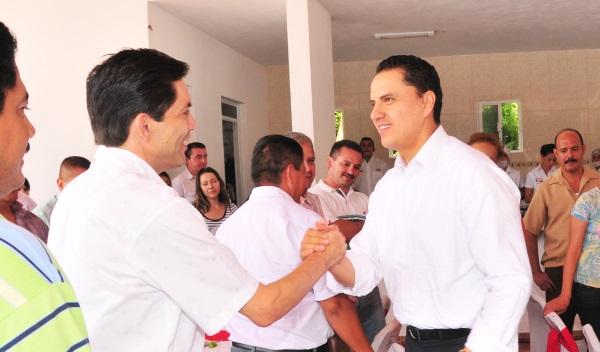
Roberto Sandoval Castañeda, Governor of the People, meets with the nayaritas university. Instructed to pay 18.5 million dollars to the highest seat of learning, while the proposed law in Congress gave the state for municipalities to comply promptly with the tax corresponding to the Autonomous University of Nayarit.

The governor said that education is a priority in Nayarit, so it will remain committed to the authorities to have sufficient resources to strengthen the infrastructure of the university.

Since Roberto Sandoval was a member, then as mayor of Tepic and now as Governor of the People, has complied with the UAN and searched for resources that nayaritas have more worthy spaces to prepare for the future.

Thus, last Friday, on instructions from Roberto Sandoval, Secretary General of the Government, José Trinidad Espinoza Vargas, was delivered to the members of the Thirty state Legislature Initiative amending Act the Board to Manage the Special Tax, intended for UAN.

For the Government of the People, education is a priority, education is the foundation of economic and social development of the state and we need to invest in a comprehensive educational growth and that the bodies responsible for the management of resources, have better mechanisms for obtaining the same.

This initiative aims to improve efficiency Law Board which administers the excise duty at the Autonomous University of Nayarit, to comply with all mandates imposed by the regulations, in order to become more flexible and more transparent the collection process and enteramiento of excise duty.

Thus, a more efficient tax collecting authorities that directly deliver what corresponds to the UAN and resources are not triangulate mechanism is established.


COMUNICADO PRINCIPAL 2

Derived from intense prevention campaigns on health, operating against dengue and health inspection that implements the Government of the People Roberto Sandoval Castañeda header length and breadth of the state, have recently been certified three Healthy communities, this thanks to the constant effort of health workers as to the Government the State of Nayarit health is priority.

Currently operating nebulization were implemented to combat dengue and Chikungunya mosquito with a team of over 500 health workers, 30 gondolas, 40 vehicles,plus caravans information, are held trash removal and cleanup actions courtyards, also larval control and entomological.

The Governor of the People has managed resources that are intended to improve the quality of services in this sector, providing infrastructure and equipping each of the medical facilities, clinics and hospitals in the state; he has also managed the construction of more hospitals and medical centers to run out any Nayarit receive quality care, as for administration nayaritas health comes first.

It is worth mentioning that the town of Mecatán in the municipality of San Blas, was certified as a Healthy Community, what will become the third city in the state with such certification so far in 2014, actions to ensure that the community receives this appointment are strictly supervised by staff from the Ministry of Health of the entity, that is why the State Government continues to make efforts to ensure that there is adequate disease prevention and wellness that requires the Nayarit population statewide.

logo nayarit muestra

ninos

In order to offer leisure, recreational and cultural activities for children, young people and adults across the state of Nayarit, the State Council for Culture and the Arts invites all Nayarit general public to be part of this holiday summer, taking advantage of the free time in the best way, especially children and Nayaritas girls, holidays being a good excuse to encourage their art in different disciplines.

Thus there will be activities in all the museums and schools such as:

  • The State Nayarit School of Fine Arts Gallery of Plastic
  • The State Center for Popular and Indigenous Cultures
  • Museum Amado Nervo
  • The School of Music, the Arts Centre Emilia Ortiz Contemporary
  • Traditional Mariachi School Children and Youth,
  • The Coordination of Children's Culture
  • the State Public Library Everardo Peña Navarro
  • Children's Theatre
  • The Museum Juan Escutia
  • The Coordination Reading Promoting .

Furthermore, as each year the government of the people offering activities in the metropolitan park with your summer course "Children joined the rescue" with activities like swimming, arts, nutrition, body language, zip, music, theater, first aid, environmental education , among other sports, for children 6 to 13 years.

Most activities will begin this July 21, can go to the facilities of museums to learn of the activities or offices directly CECAN, also communicate tel. 311 216 42 46.

comunicado cecan 3

comunicado cecan 1

SGG 1

As he had already advanced the Governor Roberto Sandoval Castañeda during the fourth report of activities of the Autonomous University of Nayarit, this day the Secretary General of the Government, José Trinidad Espinoza Vargas delivered to the members of the Thirty state Legislature, of the Initiative Reform Act of Trustees for Managing the Special Tax, for the Autonomous University of Nayarit.

For the Government of the People, education is a priority, education is the foundation of economic and social development of the state and we need to invest in a comprehensive educational growth and that the bodies responsible for the management of resources, have better mechanisms for obtaining the same.

In that vein, it is proposed this important initiative to bring more efficiency to the Law of the Board that administers the excise duty at the Autonomous University of Nayarit, so that this organization complies with all mandates imposed by the regulations, to effect of the process of collection of excise duty and enteramiento become more agile and more transparent; and thus give the society in general, greater certainty and confidence that our high House of Studies, has the resources necessary to fulfill its purposes.

In his opportunity Jose Espinoza Vargas said, "the need for a more effective and efficient mechanism that allows the collecting authorities do not triangulate the proceeds, but you find out immediately and directly to the Board without establishment is evident need to concentrate on a third entity, which as we mentioned, makes ineffective the remission of the amount collected by the collection of excise duties immediately.'s a comprehensive reform that is needed to give greater certainty to the resources and move forward ", he said.

logo nayarit muestra

"We already work to return freedom to the Nayaritas, and we left the terror that provoked the shootings; Today also fought misdemeanors, as we are burglary-room; not lower our guard and the results are noticeable, "said the Governor of the People, Roberto Sandoval Castañeda, declining to 70 percent of common crimes.

The security strategy has yielded good results, placing Nayarit as the second safest state in the country, and recently unveiled collected in the first half of 2014 data, yielding the 70 percent reduction in offenses common law.

After the fight against organized crime, Nayarit lives an atmosphere of peace and tranquility; also, the state governor witnessed the success of the work of the Nayarit police, and strategy today has been harnessed to fight common crimes.

According to data released by the General Prosecutor's Office, was reduced by 70 percent this modus operandi; during 2012 299 crimes were reported, and in the first months of 2014 recorded only 87; addition, a reduction of 92 percent was reported in a vehicle theft crimes, during 2012 had 771 cases and in 2014 only 56.

"We have placed Nayarit in the top; 2014 in this study we stand as the first nation in fewer cases of extortion, and the third decline in high-impact crimes; We have been compared with the states of Guerrero, Morelos and Baja California, who unfortunately live in violence; status are less in death and kidnapping rates, "said the chief executive.


It is noteworthy that the figures for the most recent 18 months have been a total of 44 deaths five kidnappings; the latter have been successfully solved, so that the Governor of the People congratulated the work of men and women of the elite security force and police summoned Nayarit continue placing the entity as one of the safest in the country.


SGG 1

An evaluation of the highly positive results was performed, informed the Secretary General of Government

Roberto Sandoval Castañeda, Secretary General of the Government, José Trinidad Espinoza Vargas, chaired a working meeting with members of the state cabinet.

The purpose of it was to check the progress, measurement and monitoring achieved so far with the implementation of the State Development Plan, a document that summarizes the proposals of all citizens and where projects and strategic programs to trigger the growth of Nayarit are integrated.

In evaluating the three main objectives of the Master Plan, which are: Governance , Quality of Life and Integral Development, the Secretary General of Government received all the information for each area, during this activity each of the members of the Government of the People , presented results and goals achieved.

Finally it was found that the results have been very favorable for the benefit of all nayaritas, fulfilled on time and the charge made by the state governor.

José Trinidad Espinoza Vargas, at the time, told the audience: "The positive percentages shows the State Development Plan, our strategic objectives and projects are the result of teamwork, of working together with the same goal: the benefit of all nayaritas; that's the charge and are fulfilling as it should, "he said.

In the end, the public servant entire cabinet congratulated for their perseverance and work, which obviously in the interest of Nayarit inhabiting the 20 municipalities of the state.

SGG 3

PRINCIPAL 4

Tepic council workers expressed their gratitude to the Governor of the People, Roberto Sandoval Castañeda, who by a pop municipality of Tepic loan in the order of 15 million, enabled the payment of wages last fortnight.

They stated that they can not understand why the city does not face as elemental as the wages of workers pay, but acknowledge the great effort of the state executive, who despite his many commitments pending the needs of workers municipal.

The clerk of the Civil Registry, Liliana Hernandez, regretted that there is no money in the capital's City Hall, because that discourages workers, but acknowledged that the Governor Roberto Sandoval has been on the lookout for that have what corresponds to them by law.

"Because the State Government again gave a loan to the council; rescued again. And because of that he paid us, "She said.

Meanwhile, Servando Hernandez Castaneda said that "this time the problem of the lack of liquidity of the fortnight of workers presented. The Government financially supported the council could clear the debt for half of the worker. Has been very attentive to the Governor with what is still the salary of workers, do not miss. "

Claudia Rodriguez, municipal department press website: "We thank the Governor who has made the payment on time, just because the people looked very desperate, not knowing what to do or who to turn to good, thank God that could intervene and pay. "

Raul Castro, an employee of the City Secretary, also acknowledged the work of the state governor to deal with the responsibilities that correspond directly to the City.

"I want to thank the Governor directly, for supporting us in resolving the issue that the mayor left," he said.

BT Mexico

MEXICO CITY ― Less than two years into Enrique Pena Nieto’s presidency, Mexico is implementing an ambitious structural-reform package designed to lift its economy out of a multi-decade low-growth trap and create new opportunities for its citizens. The reforms involve restructuring economic sectors once deemed politically untouchable, and are backed by constitutional amendments and a bold legislative agenda.

Indeed, thanks to the “Pact for Mexico,” much of this agenda has the support not only of Pena Nieto’s government, but also of the two main opposition parties. This unique arrangement soon will be tested as the reforms begin to bite, and the outcome could have important and lasting consequences for efforts to implement structural reforms elsewhere around the world.

Such reforms are never easy to initiate and are usually difficult to complete. Politicians advocate them when they are in opposition, but rarely embrace and sustain them when in government. The reason is simple: front-loaded costs and back-loaded benefits make structural reforms politically perilous.

Governments that do embark on structural reform often find it frustrating to wait for that often-elusive “critical mass” of revitalized sectors to materialize; and economists find it very difficult to predict the timing and magnitude of the growth liftoff that should follow. Complicating matters further, the inevitability of unanticipated developments, whether homegrown or external in origin, means that course corrections often are needed.

As a result, there are only a few good historical examples ― including China, Poland, and South Korea ― of successful structural reforms. And many dismiss countries that succeed as “special” or “unique” ― and thus of little value as a model for other countries to emulate.

Against this background, it is fascinating to observe what is happening in Mexico. The “why,” “how,” and “what” of the country’s ambitious structural-reform efforts could ― and should ― have important signaling effects around the world.

Mexican officials are the first to point out their country’s relatively poor economic performance over the last 33 years. Average annual growth, at only 2.4 percent, is well below what is needed and possible for a country with such enormous human and natural endowments, a prime location on the United States’ doorstep, and considerable catch-up potential. Moreover, Mexico’s growth record is far inferior to that of some other countries that started with a lot less and yet leap-frogged it (and other Latin American economies).

Policymakers could easily dodge responsibility for Mexico’s middling performance by hiding behind the various emerging-market crises, Latin America’s “lost decade,” and the impact of the 2008 global financial crisis and the subsequent Great Recession. But Mexico’s officials are not looking for excuses. Instead, they point to domestic indicators showing poor productivity and competitiveness, both over time and relative to other countries. They also note that Mexico’s impressive accomplishments in terms of macroeconomic stabilization, while necessary, have not proved sufficient to unleash the country’s growth potential.

Yes, Mexico has built strong domestic and foreign financial buffers, put its fiscal house in order, opened up its economy to the outside world, and concluded many free-trade arrangements, led by the North American Free Trade Agreement. But now the time has come to build on this progress by simultaneously reforming five large and influential sectors: education, energy, finance, telecommunications, and the labor market. And Pea Nieto’s government has worked hard ― and successfully ― in recent months to adopt the necessary constitutional amendments and enact initial legislation.

At least three of these areas ― education, energy, and the labor market ― were long deemed untouchable or nearly so. Indeed, I remember my own experience in Mexico in the late 1980s and early 1990s, when I was part of the International Monetary Fund’s team working with officials there to assist with the country’s recovery from the Latin American debt crisis. Any mention of energy reforms was met with immediate resistance, including references to national sovereignty and constitutional protections.

Today, Mexico is seeking long-term foreign investors to support ambitious and comprehensive reform efforts, with foreign participation particularly important for infrastructure investments in telecom networks, toll roads, gas pipelines, and, down the road, the oil sector.

All of this is anchored by a clear political mandate, as well as by Pea Nieto’s stated personal commitment to overcome three decades of inadequate growth and productivity deficits. Given the possibility of a domestic political backlash, the inherent complexities of implementing a multi-dimensional reform package, and the cyclical headwinds implied by still-sluggish growth in the U.S. (which accounts for roughly 80 percent of exports), Mexico may need both anchors if it is to sustain reform momentum. Fortunately, the government has room for countercyclical policy, and has already responded with more accommodating fiscal and monetary policies.

Mexico has a good chance to realize its impressive structural-reform agenda. Doing so would give the rest of the world an important example of how such programs can be designed and implemented for the long term, thereby enabling a critical mass of strong sectors ― and thus faster growth and greater prosperity ― to be achieved and citizens’ legitimate aspirations to be met.

Mohamed A. El-Erian is chief economic adviser at Allianz and a member of its International Executive Committee. He is chairman of President Barack Obama’s Global Development Council and the author, most recently, of “When Markets Collide.” ― Ed.

[readon1 url="http://nwww.koreaherald.com/view.php?ud=20140622000380"]Source:nwww.koreaherald.com[/readon1]

Mexico-business-006

Observers reserve judgment on political and economic reforms approved by new president Enrique Peña Nieto

Mexico begins the new year bathed in predictions that its "moment" has finally arrived thanks, primarily, to a frenzy of reforms since President Enrique Peña Nieto took office in December 2012.

But beneath the glow, question marks hang over the country because of its longstanding security crisis, rampant poverty, inequality – and even the reforms themselves.

"If things go well, Peña Nieto could go down in history as one of the great reformers of the past 100 years," says political analyst Raymundo Riva Palacio. "If it does not, the failure will be monumental."

The reforms include education, telecommunications and tax overhauls, crowned by last December's audacious constitutional changes that open the way for more private sector participation in the crisis-ridden state-owned energy sector.

For Pierpaolo Barbieri and Niall Ferguson, writing in the Wall Street Journal, the reforms put Mexico on the threshold of transforming itself "from Latin America's laggard into North America's new engine of growth".

Mexican economists tend to be less upbeat. "The reforms should give the 'Mexican moment' some momentum," says Carlos Elizondo, a staunch supporter of the free market vision that inspired the changes. "Now the government has to deliver."

It already seems clear investors are holding back until they see what kind of secondary legislation is put in place to make the reforms operable, while left-leaning observers are particularly concerned about the capacity of national regulators to have any control over multinational companies, particularly in energy.

Economist Rogelio Ramírez de la O takes his criticism deeper. "The reforms are not enough," he says, pointing to the absence of a complementary drive to dynamise the domestic economyand allow Mexico to become less dependent on exporting to US consumers. "They do not validate talk of a moment."

Almost everybody, meanwhile, stresses the potential impact on investor confidence of drug war-related violence and regional governability crises that have continued unabated since Peña Nieto took office, though they receive less media attention.

The national official death toll has fallen slightly, but even the government admits that kidnapping rates have risen dramatically. Some regions also hover on the verge of civil war as new armed vigilante groups challenge the influence of the cartels and the security forces seem at a loss about what to do.

Even the best-case scenarios predict that the majority of Mexicans will see no direct benefits, such as lower energy bills, from the reforms for at least 18 months. It will take years more for even substantially higher GDP growth than the paltry 1.3% managed in 2013 to make any dent in the poverty that affects about half the population.

The current disarray of Mexico's political left also leaves fewer institutional channels for neutralising growing signs of radical discontent in a country with world-record inequality rates where conspicuous corruption remains common.

In his new year message Peña Nieto urged Mexicans to think of 2013 as "the year Mexico dared to take off". A look at the projected flight path suggests he should prepare for turbulence.

[readon1 url="http://www.theguardian.com/world/2014/jan/09/mexico-moment-reforms-enrique-pena-nieto"]Source:www.theguardian.com[/readon1]

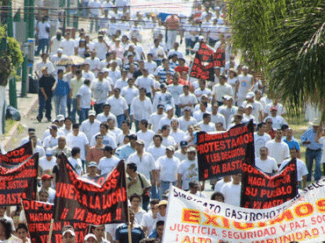
desMay 1st Parade in Puerto Vallarta is suspended for purely economic issues, as Reported by Rafael Yerena Zambrano, General secretary of the Federation of Jalisco (FTJ), who Noted that this determination is Analyzed for Municipalities THROUGHOUT the state.
He explained that in the metropolitan area of ​​Guadalajara the only event will be held with the Governor of Jalisco, Aristotle Sandoval and Puerto Vallarta traditional official act "will then breakfast with the union leaders, headed by the secretary of organization CTM, Salvador Alcaraz Rolón.

Regarding the reasons why the traditional parade Labor Day is suspended, said the reason is that "there were extraordinary expenses, many of them to mobilize troops to the Board of the National CTM to Guadalajara on 28 and 29 March. This is why we decided to cancel it. "

As to what this might mean for workers who take advantage of this moment to express disagreements, the CTM leader added that the manifestation that represents this parade, it should seek to solving challenges for workers.

"And that's the job we have to do union leaders, look what condition will resolve the issue to the people."

In this context, it recognized that the tradition has been that the disagreements in these marches of manifest workers, however insisted that this is not the reason but is suspended for economic reasons.

With regard to the statement by a public transport operator Union Permittees in the sense that despite the circular received from the suspension of the parade, they did attend to march, Zambrano Yerena stressed that this situation known and CTM not endorse any march, procession or demonstration.

"The Federation does not endorse any statement at this time anyone is nervous, but is free to anyone who wants to make a parade, but I do not know to wish parade to go and those who participate."

At the same time, he said, as always in his speech, the Secretary General of the FTJ, the current conditions of the working class are not enough to celebrate, "we do not celebrate anything, commemorating the struggle that has occurred and is gave the working class at the time. "

So that questioned who would participate in the parade on May 1 whenever reiterated that to manifest a disagreement does not have to be on this particular date and on the contrary, you may do at any time.

Who has said that this parade will take place "has no idea what is commemorated on May 1st and if they take it as the day that can be expressed, are wrong, because thanks to the laws in Mexico there is freedom of expression at any time.

ninosStudents stated that they did not belong to any political party

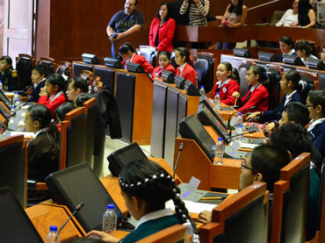
Pupils in 40 primary filled the Legislature with their proposals requests and concerns

Children of 40 prominent primary led to the Legislature its proposal their requests and concerns.

This for Wednesday in the framework of the month of April when we commemorate the day of the child 39 children sat in the seats and made the times of local legislators one more sat down on the space intended for the Secretary General.

Benjamin Antonio García Carmona was appointed as General Secretary of the Congress. The children are students of primary and led to the Legislature its concerns in the rostrum.

The issues  that the children discussed were,insecurity, bullying and harassment minors called on the authorities to ensure the tranquillity of the children so that they may develop.

The students stated that they did not belong to any political party and said that they would be interested in the events that occur in the Legislature.

[readon1 url="http://www.informador.com.mx/jalisco/2014/522387/6/son-ninos-legisladores-de-jalisco-por-un-dia.htm"]Source:www.informador.com.mx [/readon1]