9422548w

Alfredo Castillo, the federal commissioner for security and development in Michoacan, will have to appear before Congress to explain his strategy to lawmakers in the wake of a wave of violence in the western Mexican state, legislative officials told Efe Thursday.

A working group from the Permanent Commission of Congress, which acts when the legislative branch is in recess, will meet soon with Castillo to discuss the public safety situation in Michoacan, but no date has been set for the federal official's appearance.

Congresswoman Lilia Aguilar Gil, of the Workers' Party, or PT, requested that the commissioner, who was appointed to his post by President Enrique Peña Nieto to develop a security strategy for Michoacan, appear before legislators.

Castillo will appear before lawmakers as the violence grows in the western state, where 11 people died in an incident last month involving rival members of a security force created to absorb the vigilante groups formed to fight drug traffickers in the region.

On Dec. 16, more than 80 vigilantes led by Luis Antonio Torres, known as "El Americano," attacked the barricades manned by followers of Hipolito Mora, founder of the vigilante movement that arose in Michoacan nearly two years ago to protect communities from the Caballeros Templarios drug cartel.

Mora founded the community self-defense groups on Feb. 24, 2013, to fight the cartel and the Peña Nieto administration sent Castillo to the state in January 2014 to deal with the wave of violence in Michoacan.

Castillo said on May 10, 2014, that the vigilante groups were being legalized and incorporated into the Rural Force.

The commissioner will also have to discuss the shootouts on Tuesday that left nine people dead during a federal operation to retake Apatzingan city hall from an armed group that had occupied the building.

Castillo said the deaths occurred during a shootout, but the Reforma newspaper reported on Wednesday, citing eyewitnesses, that at least three people were executed by Federal Police officers after they surrendered.

The Permanent Commission of Congress also plans to meet with National Security Commissioner Monte Alejandro Rubido and Deputy Attorney General Mariana Benitez Tiburcio to discuss security issues.

erro
This email address is being protected from spambots. You need JavaScript enabled to view it.

[readon1 url="http://latino.foxnews.com/latino/news/2015/01/08/official-to-appear-before-mexican-congress-to-explain-security-policy/"]Source: latino.foxnews.com[/readon1]

0059

Citizens are reporting that starting Saturday. January 3, 2015, they are being charged 2 more pesos over the transportation fare. Nayarit transit authorities informed that they had not authorized such increase and are encouraging people to report to transit authorities if they are asked to pay more.

0010Maria de los Angeles Pineda Villa was, for the second time, placed under a twenty day restriction order
and brought before a federal judge for organized crime.

MEXICO CITY, 01/05/2015. Maria de los Angeles Pineda Villa, wife of ex mayor Jose Luis Abarca, was transfered from the Centro Nacional de Arraigos, to Nayarit federal prison.

According to the information obtained, the female was detained together with her husband , as the suspected couple directly responsible for the disappearance of the 43 students from Ayotzinapa, on September 26 in Iguala. She was taken to the Federal Center of Social Rehabilitation (Cefereso), located en El Rincon, Nayarit.

The office of Government Security confirmed that Pineda Villa was presented before a federal judge as the suspect of organized crime.

Pineda Villela was apprehended November 4 at her home at Iztapalapa, in Mexico City, where she and her husband remained hidding since right after the students’ disappearance. She had been put under a restriction order for 40 days, and at the end of its term, the authorities prolonged the restriction order 20 more days. The restriction order expired Sunday, Jan. 4.

On the other hand, Jose Luis Abarca is kept imprison in the Altiplano prison, situated in Almoyola de Juares, Mexico, accused of murder, kidnapping and organized crime.

This afternoon, the Attorney General will be holding a press conference to offer more information and give more details about the legal implications in the case of Pineda Villa.

[readon1 url="http://www.excelsior.com.mx/nacional/2015/01/05/1000871"]Source: www.excelsior.com.mx - Translated by MAR Translation Services[/readon1]

009

Mexican Ministry of Foreign Affairs

In 2014, Mexico and Canada marked their 70th anniversary of diplomatic relations, the 40th anniversary of the Seasonal Agricultural Workers Program (SAWP), and the first ten years of a partnership with shared goals. Both countries agreed to further deepen their relationship and to join together to strengthen cooperation mechanisms with a strategic reach.

In February, Prime Minister Stephen Harper made his first official visit to Mexico, during which the following were signed: the third Mexico-Canada Joint Action Plan 2014-2016; a Memorandum of Understanding for the Exchange of Resources for the Management of Forest Fires; an Air Transport Agreement; and the Export Development Canada-BANCOMEXT Memorandum of Understanding and Master Cooperation Agreement on commercial financing activities.

In education, various student mobility agreements were signed to train young people in areas of interest to both countries, including: a Memorandum of Understanding between the Education Ministry and the University of British Columbia to develop a cooperation program to promote the mobility of researchers and students; a Memorandum of Understanding between the Association of Universities and Colleges of Canada (AUCC) and the National Association of Universities and Higher Education Institutions (ANUIES); and a Memorandum of Understanding on Educational Cooperation between the Mexican Foreign Ministry and the Governors of the University of Calgary, Canada.

During the sixth meeting for consultations with Canada on new and traditional security issues, good progress was made on facilitating the exchange of information, experience and best practices among government officials of the two countries to effectively address common challenges.

The Canada-Mexico Partnership was also restructured and an Executive Committee was created to make the partnership more dynamic. A High Level Dialogue on Best Practices and Consular Protection was also begun.

The Mexican government has also maintained an ongoing and proactive dialogue with Canadian authorities to discuss eliminating visas for Mexican citizens.

[readon1 url="http://world.einnews.com/article/242694770/KL0cOKCkYYF500SC"]Source: world.einnews.com[/readon1]

007

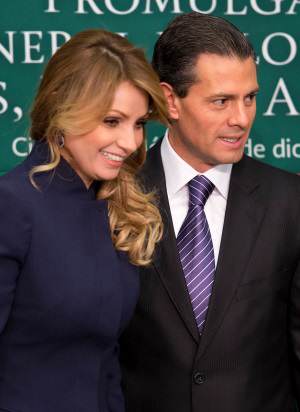
Mexican President Enrique Pena Nieto has been under pressure after revelations linking his wife and his treasury secretary to a company that received a high-speed train contract. Mexico canceled the contract and will bid it out again. (Juan Karita/AP)

MEXICO CITY — Mexico will publish preliminary terms on Jan. 14 for a $3.75 billion high-speed train contract that was abruptly canceled in November, Mexico’s Transportation Ministry said Sunday.

The government revoked the single-bid deal shortly before disclosures that the Mexican president’s wife was acquiring a luxury home from a Mexican company that was part of the winning consortium led by China Railway Construction Corp.

The terms of the tender, which will be open for 180 days, will be similar to the original one, the government said.

A supervisor will oversee the process, the statement added, to ensure “the full transparency and legality of the process from the start of the bidding process.”

Mexican President Enrique Peña Nieto is under growing pressure to end corruption since a group of trainee teachers was apparently killed after being abducted by police and handed over to a local drug gang on Sept. 26, prompting nationwide protests.

008Revelations that his wife was acquiring a home worth nearly $4 million from Grupo Higa, whose subsidiary was part of the consortium that initially won the train contract, have added fuel to the fire.

The first lady said she would sell the house, but Mexican Finance Minister Luis Videgaray’s admission last month that he also had bought a house from the company has kept the conflict-of-interest scandal alive.

The Mexican government has said that CRCC can take part in the new bidding process and that the state-owned company will bid again, after expressing shock about Mexico’s reversal.

The government has said it does not expect Grupo Higa to participate in the second tender.


French engineering group Alstom SA and Canada’s Bombardier Inc. have said they would consider taking part in the new tender.

The 130-mile line to connect Mexico City and the central city of Queretaro is expected to move 27,000 passengers daily at speeds of up to 186 mph.


[readon1 url="http://world.einnews.com/article/242676748/93gqCANKmDqZ8rw-"]Source: world.einnews.com[/readon1]

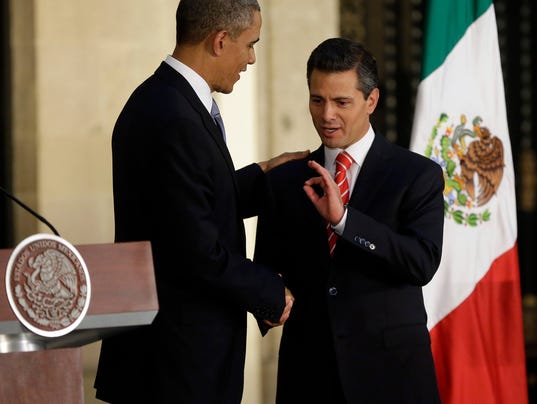
AP OBAMA US MEXICO I MEX(Photo: Pablo Martinez Monsivais, AP)

President Obama opens the new year in foreign diplomacy Tuesday by welcoming the leader of Mexico to the White House.

Obama and President Enrique Pena Nieto will discuss "strengthening the strategic partnership between the United States and Mexico and advancing our common goals," says the White House schedule.

The agenda is likely to include Obama immigration actions that would grant legal status to millions of migrants currently in the U.S. illegally.

The drug wars are another possible topic of discussion.

The White House says "the two leaders will highlight the importance of expanding dialogue and cooperation between the United States and Mexico on economic, security and social issues, as well as underscoring the deep cultural ties and friendship that exist between our two countries."

[readon1 url="http://www.usatoday.com/story/theoval/2015/01/04/obama-mexico-enrique-pena-nieto-immigration/21255615/"]Source:www.usatoday.com[/readon1]

Screen Shot 2014 12 25 at 7.04.48 PM

MCALLEN, Texas — The latest scandal surrounding Mexican corruption and politics deals with Mexican authorities exonerating the brother of a former president who had been accused of ransacking millions out of the president’s secret account as well as making money through other corrupt means.

After more than 19 years of court battles and a short trip to jail, Raul Salinas De Gortari, the brother of former President Carlos Salinas De Gortari, was declared innocent of the charges against him, Mexico’s Reforma newspaper reported.

Salinas’ exoneration is the most recent court case that has left the Mexican public scratching their head at the apparent impunity with which people with ties to power are able to beat criminal accusations. Salinas had initially been jailed in 1995 accused of the financial crimes as well as of the murder of Jose Francisco Ruiz Massieu, a former polititician who was one of the main power brokers of the time in Mexico until his execution in 1994.

As time went on, Raul Salinas started beating the many charges filed against him including the murder one and just last year on July 19, 2013, Mexican judge Carlos Lopez Cruz issued an absolution on the financial crimes. Mexico’s Attorney General’s Office (PGR) filed an appeal which was just ruled against thus exonerating Salinas of all crimes.

In August 2013 another Mexican court released Rafael Caro Quintero, a legendary capo who ruled the Guadalajara which the original crime syndicate that later became the Sinaloa Cartel. Caro Quintero remains a fugitive in the U.S. wanted for the capital murder of DEA agent Enrique “Kiki” Camarena.

Just this summer, another Mexican court released Rogelio “El Kelin or Z2” Gonzalez Pizana one of the original Zetas who had been arrested in Matamoros in 2005 after a fierce firefight outside of a strip club.

mexico salinas.jpeg 1280x960


[readon1 url="http://www.breitbart.com/texas/2014/12/25/former-mexican-presidents-brother-acquitted-of-raiding-mexicos-coffers/"]Source:www.breitbart.com[/readon1]

mexicanmother 1940x1293

As the search for the 42 missing students continues, Mexico’s deep-seated history of corruption and impunity is unearthed.

This past October, while savoring a fancy quinoa salad in one of Mexico City’s trendiest neighborhoods, I heard the news that Toño, the longtime doorman of a nearby building I’d once lived in, had been fatally beaten. A rebar, shoved through his eye and skull, is what eventually caused his death.

A group of franeleros — individuals who secure street parking spaces and then demand pay for their use, often in collaboration with local police, are the presumed murderers. According to a recent news story, they ambushed Toño for not allowing them to park at the entrance of the building the doorman watched over in the Roma neighborhood, a popular nightlife destination. There, as in much of Mexico, a false sense of security reigns.

Toño’s gruesome death didn’t make world news, but just like the presumed massacre of 43 students last September, it is a symbol of a rapidly spreading cancer gradually bringing Mexico to its knees. Cases of corruption, injustice and the appalling loss of respect for human life and dignity are so pervasive that they’ve become the norm. With an impunity rate of 93 percent, Mexico isn’t likely to bring Toño’s murderers to justice.

Last February, President Enrique Peña Nieto was featured in a Time Magazine cover story titled “Saving Mexico” as his “sweeping reforms” were praised abroad and clouded flagrant human rights violations at home. Fast-forward seven months and Mexico is living one of its worst crises in recent memory.

On September 26, a violent clash between police and students in the southern city of Iguala, in the state of Guerrero, resulted in six deaths and the disappearance of 43 students. According to the government, the young men were carried away by police and subsequently turned over to a criminal gang called Guerreros Unidos. They say some were asphyxiated in the back of a truck, others executed, and all eventually burned at an isolated dump site nearby. Scores have since been arrested.

In addition to municipal police involvement, prosecutors have said that the town’s then mayor, José Luis Abarca, and his wife, both accused of deep ties to organized crime and since arrested, masterminded the kidnapping of the students for being too unruly. The 43 men were students at a rural teachers college in Ayotzinapa, also in the state of Guerrero, with a long history of activism.

forbes ayotzinapa 1940x1293
Thousands march in Mexico City on October 8, 2014 to protest the disappearance of 43 students
in the state of Guerrero. Photo: Sandra Larriva Henaine

But even this official version of events is now being questioned after a news investigation stated that it was federal officials who orchestrated and executed the attack, with possible collaboration from the military. Mexico’s Attorney General Jesús Murillo Karam, who has said it is “absurd” to search for the students in military bases, has denied these claims. of Guerrero, with a long history of activism.

To date, only one student has been identified, yet several graves have been uncovered as a result of the ongoing investigation. Corpse after corpse, experts announce that the remains do not match any of the students’ DNA, begging the question: If not the students, who lies at the bottom of these pits? And who is responsible?

This “elimination of human beings” in Mexico, said Mexican writer Elena Poniatowska last month, “reminds us of concentration camps, of Auschwitz, of Birkenau, of Treblinka, it reminds us of World War II.”

Last year, Mexico’s National Human Rights Commission (CNDH) reported 2,443 disappearances in which the state was presumably involved. The official figure for missing people during former president Felipe Calderón’s bloody drug war exceeds 26,000. This June, 22 presumed criminals were killed by the army in Tlatlaya, State of Mexico. Apparently, some died during crossfire while others were executed after having surrendered, according to a CNDH report.In the last decade, “at least 370 journalists have been murdered in direct connection to their work,” says the Committee to Protect Journalists. In 90 percent of the cases, no convictions have been made.

To top it off, Mexico was ranked the most corrupt among OECD countries in a Transparency International report released earlier this month. It comes as no surprise, then, that Peña Nieto’s administration is also at the heart of favoritism and conflict of interest allegations involving a prominent government contractor.


“How can Peña Nieto take on government corruption and impunity when he has become the most obvious symbol of those ills?” asked writer Francisco Goldman in a recent New Yorker article.

Ayotzinapa is not an isolated incident, but it’s the one that caught the world’s attention. Forensic experts from Argentina and a lab in Innsbruck, Austria, are assisting in the investigation of the case while countries around the globe press Mexico for answers. In a nation where the public’s mistrust of its government is at an all-time high and the president’s approval ratings have plummeted, foreign scrutiny may very well be this catastrophe’s silver lining.

Since the students’ disappearance, #AyotzinapaSomosTodos (“Ayotzinapa is all of us”) has emerged as a popular hashtag in the Twittersphere. Ayotzinapa isn’t just the 42 students who, to date, are still missing, or the 19-year-old aspiring teacher whose remains have been identified, or the dozens of family members who’ve kindled Mexico’s largest protest movement in recent years.

Ayotzinapa is also the tens of thousands kidnapped and often killed every year, or the 72 migrants who were massacred in the border town of San Fernando in 2010. Ayotzinapa is also Toño, the kind and humble doorman who was brutally murdered last October for doing his job.

As the three-month anniversary of the disappearances nears and the government attempts to close the case, Mexico’s dirty laundry is being hung out to dry. It’s not a pretty sight, but one whose shocking barbarism is opening the world’s eyes to the deep-seated lawlessness that rules over this North American nation and affects us all. We can sit at a hip Mexico City café and look the other way as franeleros take over the streets and organized crime eats away at a broken nation, or we can seize this historic opportunity to start putting the pieces back together, one case at a time.

Ayotzinapa is all of us.

 forbes headshot Sandra Larriva

Ms. Larriva is a freelance multimedia journalist


[readon1 url="http://world.einnews.com/article/241179230/gBjC-k5yPXUlyfmi"]Source:world.einnews.com[/readon1]

 Journalism In MexicoThe Mexican Senate has called on authorities at all levels of government to protect human rights activists and journalists.

Rights activists and members of the media must deal with harassment, threats, forced disappearances and murder, the Senate said in a statement.

Officials should take measures to prevent attacks on journalists and human rights activists, senators said.

The Senate called on the federal Attorney General’s Office and on the state attorneys general to investigate human rights violations.

The Government Secretariat and state and municipal authorities should issue reports on the mechanisms established to protect human rights, the Senate said.

During the 2010-2012 period, 89 aggressions targeting these groups were registered in Mexico, of which 38 percent were threats; 13 percent were arbitrary actions; 12 percent constituted harassment; 11 percent involved the taking of lives; 11 percent were arbitrary arrests; 6 percent were attacks; 7 percent involved arbitrary use of the criminal justice system; and 2 percent involved forced disappearances, the U. N. High Commissioner for Human Rights said.

The Senate called on officials to continue taking actions aimed at promoting, protecting and guaranteeing the human rights of journalists and rights activists.

[readon1 url="http://world.einnews.com/article/240957826/3ITy9oCB9ZEz_D0B"]Source:world.einnews.com[/readon1]

bs

Puerto Vallarta, Jal.- One of President Barack Obama's first meetings of the New Year will be with Mexican President Enrique Peña Nieto (PAYN'-yuh nee-EH'-toh).

The White House says the leaders will meet in the Oval Office on Jan. 6.

The White House says Obama looks forward to working with Peña Nietoto continue strengthening economic, security and other ties between the U.S. and Mexico.

Obama said earlier this week that the U.S. has offered to help Mexico figure out what happened to a group of 43 college students who have been missing since September.

Next month's meeting follows Obama's trip to Mexico earlier this year.

[readon1 url="http://notivallarta.com/2014/12/12/obama-recibira-a-pena-nieto-el-6-de-enero/"]Source:notivallarta.com/[/readon1] 

 8040181w

Spain's King Felipe VI on Monday called on the Ibero-American community to make history by taking advantage of its "cultural power" to improve a world that demands "collective responses."

Making needed changes through the "culture of cultures" was the idea at the heart of a meeting entitled "Rethinking Ibero-America: Building the Future," held as part of the 24th Ibero-American Summit that began Monday in this Mexican port city.

The cultural event was an opportunity for the king to stress the importance of cooperation among Ibero-American nations with a view to the future while always respecting their diversity, a fine sample of which was on display at the event in Veracruz's Teatro de la Reforma.

Latin American artists, musicians and writers performed and contributed their different points of view in brief appearances that climaxed with the awarding of Mexico Prizes for Science and Technology to scientists Juan Carlos Garcia from Chile, Victor Alberto Ramos from Argentina and Carlos Martinez Alonso from Spain.

"We're in a world where we have to form alliances, join forces and work together - we have to give collective responses to collective challenges," the king said onstage, accompanied by the presidents on hand: Mexico's Enrique Peña Nieto, Chile's Michelle Bachelet; Ollanta Humala from Peru, and Uruguay's Jose Mujica, along with the head of the Ibero-American Secretariat, Rebeca Grynspan.

The king noted the "institutional system" of Ibero-American nations, created by means of summits like the one beginning Monday in Veracruz, since they provide "a meeting place for sharing experiences, exchanging visions and projecting ourselves to the world."

For the Spanish monarch, the "best starter we have for doing that is the culture we share, founded on such human values as tolerance and solidarity with one another. We ought to make it pay."

Felipe VI is convinced that "if we work to strengthen and enrich our cultural power," using it to "multiply social and economic benefits" and to provide greater opportunities for students, creative people, scientists and entrepreneurs, the contribution of Ibero-America will be "historic" and can change the world. EFE

[readon1 url="http://latino.foxnews.com/latino/politics/2014/12/08/spain-king-urges-ibero-america-to-unite-to-meet-collective-challenges/"]Source:latino.foxnews.com[/readon1]